

Choosing a 1031 exchange replacement property investors can consider means balancing the exchange timeline with the realities of condition, income potential, and ongoing ownership. The property that is easiest to buy under a deadline may not be the one that best supports your investment goals.
It’s understandable to feel pressure to move quickly while still wanting to make a considered decision. A replacement property must fit the exchange, but tax objectives alone don’t determine whether it’s the right acquisition for you. A clear set of investment criteria can help bring focus to the search.
This guide explains the key decision points to consider, from reviewing eligibility with qualified tax and exchange professionals to comparing a property’s financial assumptions and management needs with your objectives. You’ll also learn how to coordinate real estate due diligence and acquisition analysis without letting a deadline become the only reason to commit. With preparation and guidance from Abode Real Estate, the next property can be a thoughtful step in your investment strategy.

Key Takeaways
- Understand how a replacement property differs from the property being relinquished before evaluating candidates.
- Use a planned sequence for professional coordination, setting investment criteria, identifying properties, and completing due diligence.
- Compare each candidate for investment fit, including operating assumptions, condition, liquidity, and management demands.
- Organize due diligence around financial, physical, title, operational, and transaction-coordination considerations.
- Use acquisition analysis and transaction representation to connect property selection with ownership goals, while keeping tax and legal guidance distinct.
Table of Contents
- What Is a 1031 Exchange Replacement Property?
- How 1031 Exchange Timelines Shape Replacement-Property Decisions
- How to Compare 1031 Replacement Properties Beyond Tax Eligibility
- A Practical Due-Diligence Checklist for a 1031 Replacement Property
- Plan Your Replacement-Property Search with Abode Real Estate
What Is a 1031 Exchange Replacement Property?
An exchange can create pressure to choose quickly, even when the next acquisition deserves careful thought. Start by separating two questions: does the property meet the exchange’s requirements, and does it make sense for your investment plans? These questions are related, but they are not interchangeable.
A 1031 exchange replacement property is real property acquired to take the place of relinquished real property in an exchange. The relinquished property is the investment or business property being given up; the replacement property is the prospective acquisition. Whether a specific property qualifies depends on the applicable rules and transaction details.
How a replacement property fits into a like-kind exchange
At a broad level, Section 1031 allows an investor to exchange qualifying real property held for investment or business use for other qualifying real property, potentially deferring tax on gain. “Like-kind” generally refers to the nature or character of the real estate, not whether the properties are identical in grade or quality. The Internal Revenue Code Section 1031 overview introduces this terminology and the exchange’s general purpose.
Intended use matters. Investment or business real estate and property used personally can raise different eligibility questions, so don’t assume a property qualifies simply because it is real estate. Confirm current IRS requirements, exceptions, and how they apply to your circumstances with a qualified tax professional before relying on an exchange treatment.
What a 1031 exchange does not guarantee
Exchange eligibility is not an investment endorsement. A property may meet tax-related criteria yet still have condition concerns, uncertain operating assumptions, or management demands that don’t suit your plans. Likewise, an appealing asset does not automatically qualify for an exchange.
An exchange may defer tax on gain; that is different from eliminating tax obligations. The eventual treatment depends on the transaction and the taxpayer’s circumstances, so don’t treat deferral as a promise of permanent tax savings. A qualified tax professional can assess that side of the decision, while real estate analysis can help you evaluate the property itself.
Keep both perspectives in view before committing. Confirm exchange fit with qualified tax and exchange guidance, then assess condition, ownership responsibilities, and investment suitability on their own merits. A thoughtful replacement decision should support more than the transaction. It should also serve your investment strategy.
How 1031 Exchange Timelines Shape Replacement-Property Decisions
A clear process can ease the pressure of making a consequential purchase on a limited schedule. Coordinate exchange mechanics early, define acquisition criteria, identify potential properties, and reserve time to examine each candidate. A real estate professional can support property analysis and transaction representation, but does not determine tax eligibility.
What to organize before identifying a property
Before reviewing listings, put your investment priorities and practical boundaries in writing. Consider:
- Your investment objectives and the role you want the next property to play.
- Available capital and the purchase assumptions you’re prepared to evaluate.
- Ownership preferences, including how involved you want to be in ongoing management.
- Practical constraints that may affect property selection or the transaction.
Coordinate the exchange structure and handling of proceeds with your qualified intermediary. Discuss tax treatment and eligibility with a qualified tax professional. The Fidelity Investments guide to 1031 exchange mechanics provides an overview of the intermediary’s role and the general timeline. This is planning guidance, not individualized tax or legal advice.
How to manage deadlines without rushing due diligence
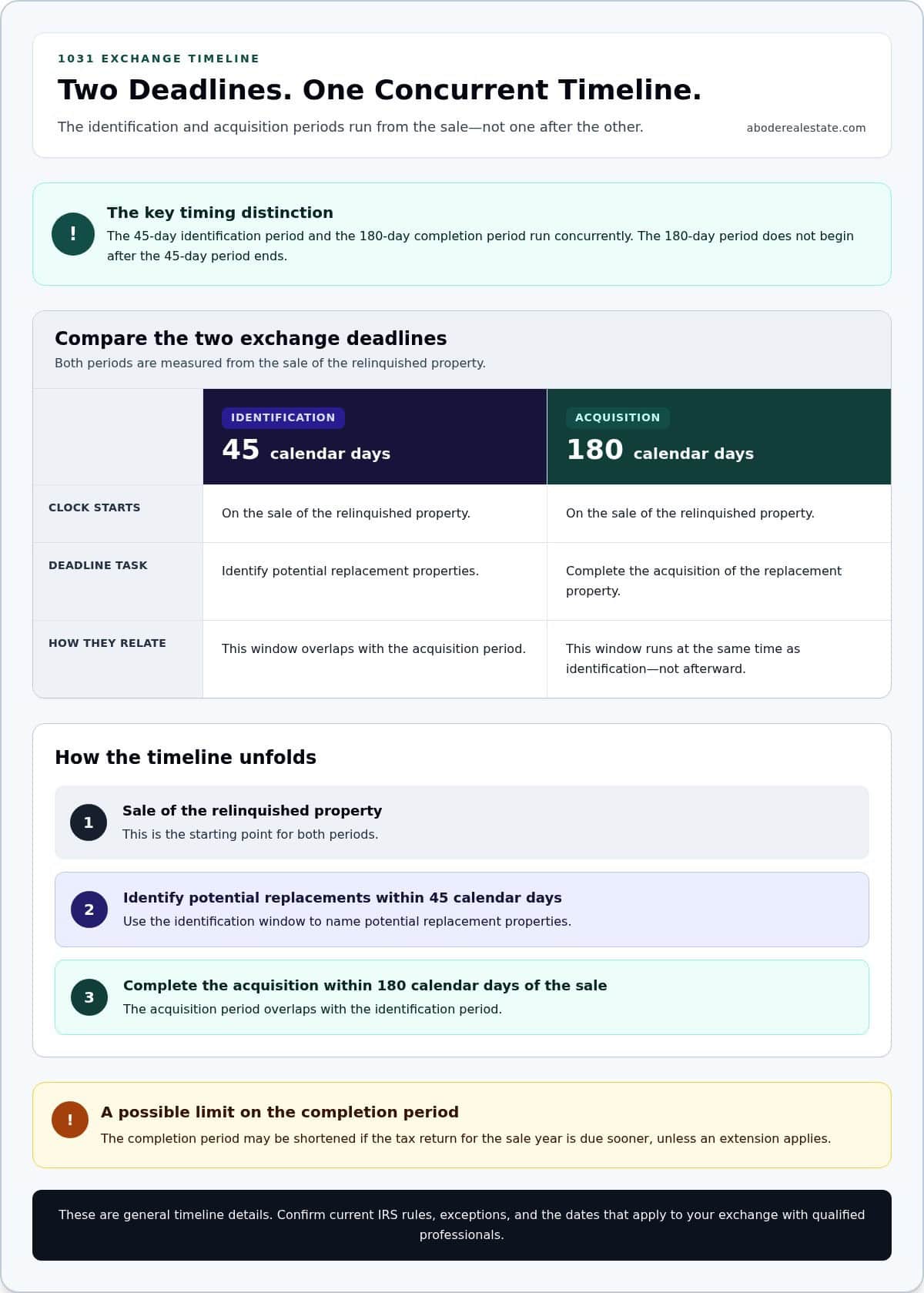
Under the general timeline described in current exchange guidance, an investor has 45 calendar days from the sale of the relinquished property to identify potential replacement properties and 180 calendar days to complete the acquisition. These periods run concurrently, not one after the other. The completion period may also be shortened if the tax return for the sale year is due sooner, unless an extension applies. Confirm current IRS rules, exceptions, and the dates that apply to your exchange with qualified professionals before acting.
Simple timeline: Sale of relinquished property → identify potential replacements within 45 calendar days → complete the acquisition within 180 calendar days of the sale, subject to applicable rules and exceptions.
Screening properties early creates room to investigate rather than react. When a candidate looks promising, allow time to review title matters, property condition, financial assumptions, and operational needs. A property that appears suitable at first glance may raise questions that affect its fit or need closer examination. Build those review steps into the search from the beginning, and keep your exchange professional informed as the transaction progresses.
For a more deliberate search, explore investment property acquisition analysis as you shape your criteria for a replacement property.
How to Compare 1031 Replacement Properties Beyond Tax Eligibility
Once a candidate appears to fit the exchange, assess whether it also fits your investment plan. Apply the same criteria to every property so an appealing feature, such as a strong income assumption or good condition, doesn’t overshadow costs or ownership demands. Keep exchange questions distinct from investment questions, and review tax eligibility with qualified exchange and tax professionals.
Exchange fit
What eligibility questions need review by your qualified tax and exchange professionals?
Purchase assumptions
What price, income, and expense assumptions support the acquisition analysis, and which are documented versus estimated?
Operating costs
Have you considered recurring expenses, insurance, maintenance, vacancies, reserves, and management needs where relevant?
Condition and use
What is the property’s present condition, intended use, and likely level of operational attention?
Liquidity and management
How might resale flexibility and the time required to oversee ownership compare with other candidates?
Assessing financial assumptions and ownership costs
Look beyond a headline yield. Review the records that support income and expense assumptions, and label estimates clearly so they aren’t mistaken for established results. Consider how vacancies, insurance, maintenance, reserves, and management responsibilities could affect ownership costs. No projection guarantees future performance. Comparing assumptions side by side helps reveal where a candidate depends on optimistic estimates or leaves important costs unclear.
Matching property type to investment objectives
Residential and other real-property categories can involve different operating demands and ownership considerations. Compare them in light of your objectives, and confirm exchange eligibility with qualified guidance. A property with more involved operations may be a poor match for an investor seeking limited oversight, even if its purchase assumptions look appealing. Condition, intended use, and potential resale flexibility also matter. Let your time horizon and risk tolerance shape how heavily you weigh each factor.
For a shorter time horizon, you may place more weight on practical resale flexibility and near-term condition. With a longer horizon, ongoing maintenance and management demands may deserve more attention. These are decision lenses, not guarantees. Explore investment property acquisition strategies as you refine the criteria for comparing candidates. The strongest choice is not automatically the one with the most compelling single metric. It is the one whose documented assumptions, ownership profile, and investment purpose align most closely with your priorities.
A Practical Due-Diligence Checklist for a 1031 Replacement Property
A disciplined review helps turn a promising candidate into a better-understood acquisition. Organize the work across five areas: financial records, physical condition, title information, day-to-day operations, and exchange coordination. This checklist is a starting point, not a statement that any particular document or inspection is legally required. Confirm transaction-specific requirements with the professionals advising you.
Review condition and transaction records
Gather available property disclosures, inspection findings, title information, and operating records. Compare the documents with what you observe and with the assumptions in your investment analysis. If an inspection identifies an area for further review, clarify its potential effect on condition, expenses, or future ownership planning. Keep a written record of open questions and who is addressing each one.
- Financial: Review available income and expense records, leases or occupancy information where relevant, and assumptions for ongoing costs. Separate documented figures from estimates.
- Physical: Examine available inspection findings and property condition information. Note items that may warrant additional evaluation by an appropriate professional.
- Title: Review available title information with your transaction and legal professionals. Record questions about ownership or matters that could affect the acquisition.
- Operational: Consider maintenance responsibilities, reporting needs, tenant or guest coordination where relevant, and the level of oversight the property may require.
- Transaction coordination: Keep your real estate, tax, legal, and exchange professionals aligned on outstanding questions and transaction progress. Exchange mechanics and tax treatment require qualified guidance.
Test the property against your ownership plan
Due diligence should cover more than the asset. Consider how much time you can devote to oversight, what reporting would help you monitor ownership, and how you would handle maintenance and operating decisions. A property that looks suitable on paper may not align with your preferred level of involvement. Management needs can influence practical fit as much as condition or financial assumptions.
Use the checklist as a working document. Mark each item reviewed, note information still needed, and record follow-up questions rather than treating silence in a file as a settled answer. Your real estate professional can help assess the property and coordinate transaction representation; tax, legal, and exchange questions belong with the qualified professionals handling those areas.
For a clearer picture of ongoing oversight, explore full-service property management as part of your ownership planning.
Plan Your Replacement-Property Search with Abode Real Estate
A replacement-property search becomes more manageable when the acquisition reflects your investment priorities, not only the exchange schedule. Abode Real Estate supports investors with property analysis and transaction representation, helping translate objectives into practical criteria for screening and comparing candidates. This is real estate support, not tax or legal advice, and it does not determine whether a property qualifies for an exchange.
What tailored acquisition support can clarify
Begin with the ownership plan you want the next property to support. Your desired level of involvement, investment horizon, property condition preferences, and management expectations can all shape the search. With those priorities in view, candidate comparisons can focus on relevant details, including documented income and expense assumptions, physical condition, operational demands, and potential resale flexibility.
This approach also brings future ownership into the decision. A property that appears suitable at acquisition may require more oversight or maintenance than you intend to take on. Considering those responsibilities early helps you weigh practical fit alongside investment characteristics. For additional perspective as you refine your criteria, read Abode’s investment property acquisition strategies.
Take the next step with a clear plan
Before beginning or narrowing your search, gather a concise picture of your objectives, key property preferences, ownership expectations, available capital, and exchange timing. Share the criteria that matter most and where you’re open to trade-offs. Abode can use that direction to support candidate screening, structured comparisons, and transaction representation as you evaluate a potential acquisition.
Keep the professional roles clear. Tax eligibility, exchange structuring, and related tax or legal questions belong with your qualified tax, legal, and exchange professionals. Abode’s role is to support the real estate decision and acquisition process. Thoughtful coordination can help you pursue a property that fits both the transaction and your longer-term investment intentions.
To start shaping your acquisition criteria, discuss your investment property objectives with Abode Real Estate. A clear conversation about your goals can be a measured first step toward identifying suitable candidates.
Choose Your Next Property with Confidence
A thoughtful replacement decision balances exchange eligibility with the realities of investment and ownership. Define your priorities before comparing candidates, then review each property’s financial assumptions, condition, and management demands with the same care. Exchange timelines matter, but they shouldn’t be the only measure of a sound acquisition.
For greater clarity, align real estate analysis with qualified tax and exchange guidance. Abode Real Estate brings investment property acquisition analysis and transaction representation together, while property management expertise can help inform practical ownership considerations. Tax eligibility and exchange structuring remain questions for qualified professionals.
When you’re ready to explore your real estate objectives, explore investment property opportunities with Abode Real Estate. A clear plan can make the next step more considered and bring you closer to an acquisition that reflects your investment goals.
Frequently Asked Questions
What qualifies as a replacement property in a 1031 exchange?
A replacement property is real property acquired to take the place of relinquished real property in an exchange. Generally, both properties must be held for investment or business use, and the replacement must meet applicable like-kind requirements. Eligibility depends on the transaction and the taxpayer’s circumstances, so have a qualified tax professional review current rules before committing. A property’s potential as an investment is a separate question from its exchange eligibility.
How long do I have to identify a 1031 replacement property?
Under the general timeline, you have 45 calendar days from the sale of the relinquished property to identify potential replacements. The acquisition period generally runs for 180 calendar days from that sale, with both periods running concurrently. The completion period may be shortened if your tax return due date comes first, unless an extension applies. Confirm the dates and any applicable exceptions with qualified exchange and tax professionals.
Can I buy more than one replacement property in a 1031 exchange?
It may be possible to identify or acquire multiple replacement properties, but the exchange rules governing identification and the transaction’s details matter. Don’t assume that naming several candidates automatically means each will qualify or that any combination will meet your exchange objectives. Discuss the intended number of properties and structure with your qualified intermediary and tax professional before identification, and make sure your real estate search reflects the plan they review.
Does a replacement property have to be the same type as the property I sold?
No. Like-kind generally describes the nature or character of the real property, not that both assets must be identical in type or quality. For example, an apartment building and raw land may be considered like-kind real property when held for qualifying investment or business purposes. That broad principle doesn’t determine eligibility in every case. Have a qualified tax professional assess the specific properties, their use, and current requirements.
What happens if I cannot find a suitable replacement property in time?
If you don’t identify or acquire a suitable property within the applicable exchange periods, the transaction may not qualify for the intended tax deferral. The result depends on your facts and tax circumstances, so don’t rely on a general answer to determine what you may owe. Speak with your qualified intermediary and tax professional promptly about your timeline and options. Avoid committing to a poor-fit acquisition solely to meet a date.
Should I choose a replacement property based only on tax benefits?
No. Tax considerations are only one part of the decision. Compare each candidate’s documented income and expense assumptions, condition, expected operating costs, management demands, and fit with your investment objectives. A property may raise tax eligibility questions while still being unsuitable for your ownership plan, or appear attractive as an investment without qualifying for the exchange. Coordinate tax guidance with careful real estate due diligence before choosing.
Can a replacement property be used as a rental investment?
Yes, a rental property may be considered when it is held for investment or business use and meets applicable exchange requirements. Its rental potential doesn’t guarantee eligibility, income, appreciation, or a successful investment. Review available operating records, expenses, physical condition, and management needs to understand the ownership commitment. Have a qualified tax professional assess intended use and exchange treatment before purchase, especially if personal use is also planned.
Posted by Brook Walsh onEnjoy this blog post? Click here to subscribe for updates
Leave A Comment