

What if the most significant risk in your portfolio isn't a shifting market, but a single overlooked detail in your due diligence process? For many sophisticated investors, the process of analyzing a commercial real estate deal often feels like a battle between overwhelming financial spreadsheets and the intuitive vision of a seasoned asset manager. It's natural to feel a sense of hesitation when high-stakes capital is on the line, especially as you weigh the 2.0% GDP growth forecast against the complexities of the 2026 tax landscape. You deserve a process that feels less like a hurdle and more like a curated transition into your next chapter of wealth.
This guide will help you master the essential quantitative metrics and qualitative strategies required to evaluate premium investments with absolute precision. You'll gain a clear framework for vetting opportunities, ensuring you can calculate ROI and risk with the quiet authority of a true market expert. We'll walk through everything from the impact of restored bonus depreciation to the art of identifying hidden property liabilities. By the end, you'll have the tools to transform a mere transaction into a strategic partnership that secures your financial legacy.
Key Takeaways
- Shift your perspective from simple data entry to strategic asset optimization by understanding the macro-market forces that shape property value.
- Gain absolute clarity when analyzing a commercial real estate deal by mastering the quantitative interplay between Net Operating Income and market-specific Cap Rates.
- Uncover hidden liabilities through a sophisticated qualitative audit that balances structural due diligence with a deep evaluation of tenant quality.
- Develop actionable value-add strategies to refine underperforming assets and integrate them seamlessly into a diversified, high-performing portfolio.
- Experience a more intentional path to growth by leveraging a boutique approach that prioritizes tactical planning and long-term relationships over quick wins.
Table of Contents
- The Foundations of Commercial Real Estate Analysis
- The Quantitative Core: Mastering Essential Financial Metrics
- The Qualitative Audit: Assessing Physical Assets and Risk
- Strategic Implementation: From Analysis to Portfolio Optimization
- The Abode Advantage: Navigating Complex Transactions with Precision
The Foundations of Commercial Real Estate Analysis
Analyzing a commercial real estate deal is more than a simple calculation of square footage and rental income. It is a refined craft that transforms raw data into a strategic roadmap for asset optimization. By grounding your search in the fundamentals of real estate investing, you move beyond the basics of property acquisition and into the discipline of tactical wealth preservation. This initial phase requires a steady hand and a keen eye for how a single asset fits into the broader tapestry of your portfolio. It's about finding the quiet authority in the numbers before the first contract is ever signed.
To better understand this concept, watch this helpful video:
Understanding the rhythm of the market is essential for any sophisticated investor. While national market cycles often span a decade, the nuances of timing can be the difference between a standard return and a generational gain. You must distinguish between property classes with precision. Class A assets offer the security of modern construction and high-profile tenants. Class B and C properties provide opportunities for value-add strategies that can significantly elevate your internal rate of return through careful management and renovation. Each class carries a different emotional and financial weight, requiring a tailored approach to risk.
Macro-Level Factors and Market Cycles
National economic indicators serve as the compass for your investment journey. With a U.S. GDP growth forecast of 2.0% for 2026, the environment remains stable for those who know where to look. We are seeing a distinct flight to quality in the industrial sector, where reshoring and logistics demand continue to drive value. Meanwhile, the retail sector is evolving; grocery-anchored centers show remarkable resilience with vacancy rates hitting historic lows. Interest rates, currently anchored by a 10-year Treasury yield of 4.48%, play a pivotal role in your long-term planning. These figures aren't just numbers. They are the signals that dictate when to hold firm and when to move with confidence.
Defining Your Investment Objectives
Every acquisition should be a reflection of your personal financial legacy. Are you seeking the immediate emotional security of steady cash flow, or is your vision set on long-term capital appreciation? There is a profound difference between a passive investment, where you trust the steady hands of a property manager, and active asset management, which requires a more hands-on approach to drive value. Aligning these objectives early ensures that every deal you analyze serves your broader purpose. This alignment creates a sense of belonging within your own financial future, making the transition into a new asset feel like a curated step forward rather than a financial hurdle.
The Quantitative Core: Mastering Essential Financial Metrics
Precision in the numbers provides the calm confidence needed to move forward with a high-stakes investment. When you're analyzing a commercial real estate deal, the quantitative core serves as a vital reality check against the aspirational vision of the asset. It's the point where tactical planning meets the concrete facts of cash flow. While the macro environment provides the wind, these metrics are the rudder that steers your investment toward a secure financial legacy. Every figure tells a story about the property's past performance and its future potential for optimization.
Net Operating Income (NOI) isn't just a line item; it's the heartbeat of your investment. This metric reveals the property's ability to generate revenue after all necessary operating expenses are met, but before you account for taxes or financing costs. Without a healthy NOI, even the most aesthetically pleasing building becomes a liability rather than an asset. For those seeking liquidity planning, the Cash-on-Cash return is equally essential. It measures the annual pre-tax cash flow relative to the amount of initial cash invested, providing a clear picture of how hard your capital is working for you from day one.
In a lending environment where the bank prime loan rate sits at 6.75%, the Debt Service Coverage Ratio (DSCR) becomes a critical metric for financing security. Lenders typically look for a ratio that ensures the property generates enough income to cover its debt obligations with a comfortable margin. Partnering with an expert for investment property acquisition ensures these metrics are vetted with boutique-level attention to detail, protecting you from the hidden risks of over-leverage.
Deep Dive into Income and Expenses
Auditing the income requires a discerning eye. You must distinguish between gross potential income, which assumes 100% occupancy, and effective gross income, which accounts for the reality of vacancy and collection losses. Understanding these commercial real estate basics is vital for anyone looking to optimize their portfolio. Operating expenses must be categorized with precision, including everything from routine maintenance to professional management fees. Even a slight fluctuation in the vacancy rate can have a dramatic impact on your bottom line, making a thorough audit of the current rent roll a non-negotiable step in your due diligence.
Advanced Valuation Methods
For a more sophisticated view, the Internal Rate of Return (IRR) allows you to project the total profitability of an investment over a multi-year holding period. This accounts for the time value of money and the eventual sale of the asset. If you need a quick comparison between similar properties, the Gross Rent Multiplier (GRM) offers a helpful, though less detailed, snapshot of value based on gross rental income. The Cap Rate is defined as the ratio of Net Operating Income to the property's current market value. This single percentage helps you gauge the market's perception of risk and return, allowing you to compare assets across different geographic regions with quiet authority.
The Qualitative Audit: Assessing Physical Assets and Risk
Numbers may tell the story of a property's past, but the physical structure dictates its future. Analyzing a commercial real estate deal requires a transition from the clinical precision of a spreadsheet to the tangible reality of the asset itself. It's a process of unmasking hidden liabilities and identifying the subtle markers of quality that data alone often misses. A sophisticated investor understands that a building is more than a collection of square footage. It is a living environment that must support the lifestyle and professional ambitions of its occupants.
Zoning laws and environmental considerations serve as the quiet boundaries of your investment's potential. You must verify that the current operations are in full compliance with local ordinances while also vetting the property for future development opportunities. Environmental due diligence is a critical shield against the high-stakes liabilities of the past. Beyond the legalities, don't underestimate the power of curb appeal. An asset that projects a sense of arrival and belonging naturally attracts a higher caliber of tenant, ensuring long-term stability and consistent appreciation.
Physical Due Diligence Checklist
A thorough audit begins with the mechanical heartbeat of the building. You must assess the remaining useful life of HVAC systems, roofing, and structural foundations with unhurried precision. Engaging professional inspectors who specialize in high-end assets is essential for maintaining your peace of mind. Identifying deferred maintenance early allows you to adjust the acquisition price or plan for capital expenditures without the anxiety of unexpected hurdles. It turns a potential liability into a tactical opportunity for optimization.
Tenant and Lease Analysis
The strength of your investment is inextricably linked to the quality of those who inhabit it. With national office vacancy rates reaching 19.6% in early 2026, evaluating the creditworthiness of existing commercial tenants has never been more vital. You must analyze lease structures, distinguishing between the hands-off nature of Triple Net (NNN) leases and the management-intensive Gross leases. Understanding renewal options and expiration schedules allows you to anticipate transitions before they occur. A stable, long-term tenant base is the foundation of a resilient financial legacy.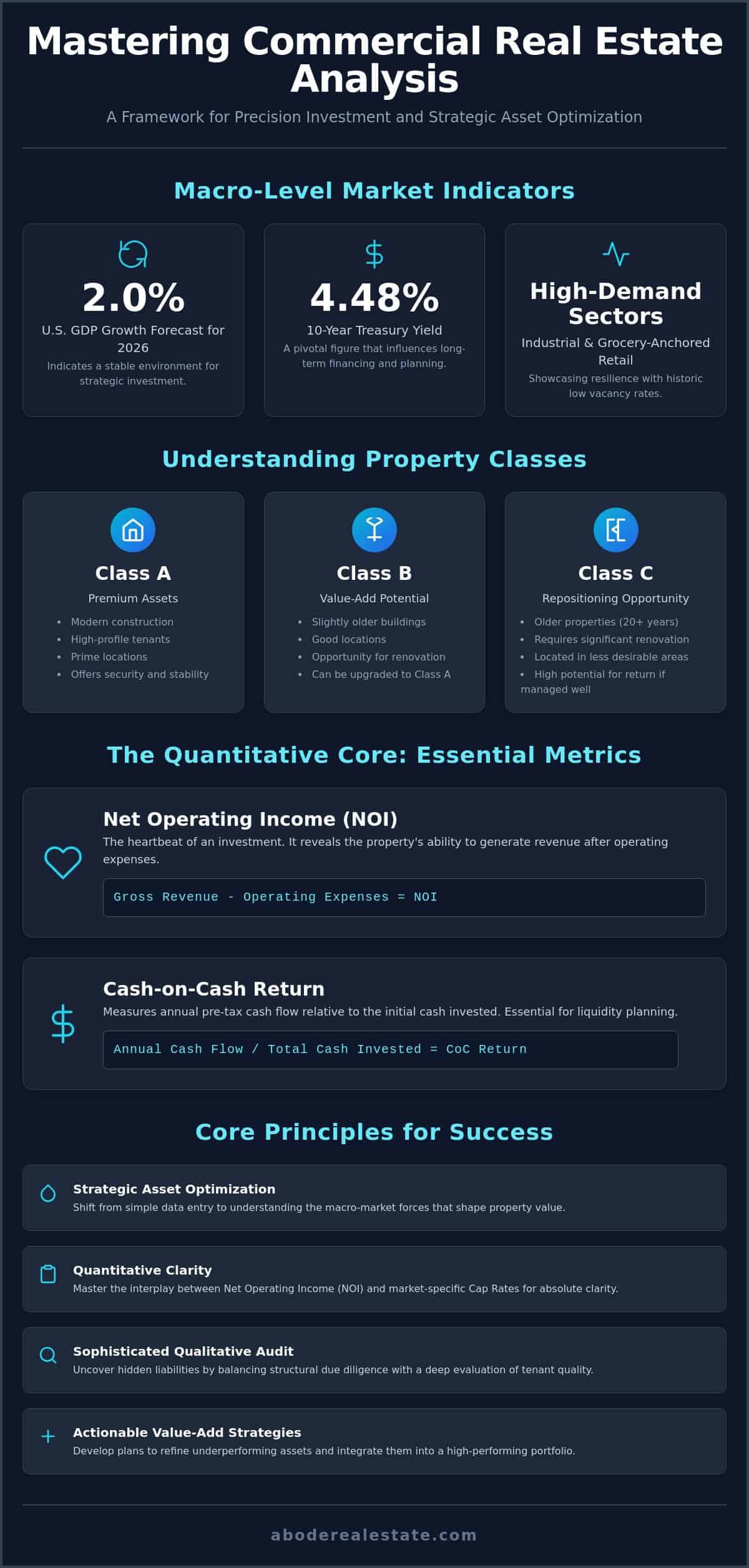
Strategic Implementation: From Analysis to Portfolio Optimization
The transition from evaluation to execution is where a sophisticated investor truly defines their financial legacy. Analyzing a commercial real estate deal provides the necessary foundation, but strategic implementation is what elevates a property from a line item to a thriving asset. This phase requires a shift in focus toward long-term optimization and the seamless integration of the property into your broader portfolio. It's about more than just owning space. It's about curating an environment that yields consistent results and reflects a refined philosophy of living and working.
Integrating a new acquisition into a diversified portfolio requires a steady hand and a clear vision of your overall risk profile. While you might focus on industrial assets for growth, a retail or multi-family property can provide the emotional security of stable monthly income. Sustaining this ROI over the long term is a craft in itself. Relying on full-service property management ensures that the daily mechanical aspects of the industry are handled with a refined touch, allowing you to focus on high-level facilitation and tactical planning.
Value-Add and Remodeling Strategies
Identifying opportunities for tactical remodeling allows you to increase rent while enhancing the property's sense of arrival. By modernizing common areas or upgrading mechanical systems, you can attract premier tenants who value quality and exclusivity. Optimizing operational efficiencies, such as renegotiating service contracts or implementing tech-savvy energy solutions, directly boosts your Net Operating Income. Asset optimization reduces investment risk by increasing the property's competitive advantage and ensuring its resilience against market shifts.
Exit Planning and Tax Considerations
A well-crafted investment strategy always includes a clear vision for the eventual exit. With the One Big Beautiful Bill Act making 100% bonus depreciation permanent for qualifying property, the tax landscape for 2026 offers unique advantages for those planning their next move. Utilizing 1031 exchanges remains a cornerstone of wealth preservation, allowing you to defer capital gains taxes and roll your equity into larger, more sophisticated assets. While analyzing a commercial real estate deal provides the initial data, your exit strategy ultimately determines the success of the investment. Preparing the property for a premium sale involves years of meticulous record-keeping and aesthetic maintenance, ensuring that when you decide to divest, you do so with quiet authority and maximum gain.
The Abode Advantage: Navigating Complex Transactions with Precision
In a market where large national franchises often treat clients as mere data points, the boutique approach offers a refreshing sense of calm confidence. Analyzing a commercial real estate deal is a journey that requires more than just technical proficiency; it demands a guide who understands that every transaction represents a curated move into a new chapter of your financial legacy. At Abode, we replace the cold, clinical feel of traditional sales with a personalized service model that prioritizes your unique asset vision. We act as high-level facilitators, ensuring that the optimization of your assets is handled with quiet authority and deep market expertise. This intentional pacing creates a feeling of transparency and control, mirroring the frictionless experience we promise to deliver during the final stages of a professional engagement.
Our Curated Acquisition Process
We move beyond the surface-level metrics to find properties that resonate with your specific lifestyle and long-term goals. While the quantitative core is essential, our specialized knowledge in contract negotiation allows us to navigate the nuances of high-stakes transitions with ease. We believe that investment property acquisition should feel like an unhurried progression toward growth rather than a stressful financial hurdle. By leveraging deep market insights, we provide the tactical planning necessary to secure premium assets while reducing the anxiety often associated with complex commercial real estate sales. Our team is tech-savvy and attuned to current design and market trends, ensuring that your property is not just a financial asset, but a reflection of a sophisticated philosophy of living.
Partnering for Long-Term Success
Our commitment to your success doesn't end when the papers are signed. We view ourselves as your trusted advisor, guiding you from the initial stages of analyzing a commercial real estate deal through to full-service property management. This continuity ensures that the integrity of your investment is preserved and that your portfolio remains aligned with current market trends. We value long-term relationships over quick wins, focusing on transparency and a frictionless experience that mirrors the premium quality of the assets we manage. We are deeply rooted in our specific geographic market, projecting the image of a well-connected guide who is sophisticated enough to handle luxury assets but humble enough to provide personalized, hands-on attention. If you're ready to explore a more intentional approach to growth, Contact Abode Real Estate for a curated consultation on your next deal.
Securing Your Financial Legacy with Precision
Mastering the art of analyzing a commercial real estate deal is about finding the perfect intersection between mathematical rigor and visionary asset management. Success in this field requires a steady hand to audit mechanical systems and a refined eye to evaluate tenant creditworthiness with absolute clarity. By integrating these quantitative and qualitative insights into a long-term strategy, you transform a simple transaction into a curated chapter of your wealth story. You deserve a partner who views technical expertise as a refined craft rather than a mechanical process.
Since 2018, Abode has provided boutique luxury expertise to investors who value personalized, high-touch service over impersonal data. We offer specialized investment property analysis and full-service property management for high-end assets, ensuring your portfolio remains resilient and optimized for the future. Your next acquisition should be a frictionless transition into a new era of prosperity and peace of mind. Explore our Investment Property Acquisition services today and discover the difference that quiet authority and deep market knowledge can make for your financial future. We look forward to helping you build a legacy that stands the test of time.
Frequently Asked Questions
What is the most important metric when analyzing a commercial real estate deal?
Net Operating Income (NOI) is the most vital metric because it represents the property's ability to generate revenue after all operating expenses are met. It serves as the essential foundation for calculating the property's market value and determining its potential for long-term optimization. By focusing on a clean NOI, you can strip away the complexities of financing to see the true performance of the asset itself.
How do I calculate the capitalization rate for a commercial property?
You calculate the capitalization rate by dividing the property's annual Net Operating Income by its current market value or purchase price. This resulting percentage helps you gauge market risk and compare different assets with unhurried precision across various geographic regions. It's a snapshot of the expected unleveraged return, allowing you to move forward with the quiet authority of a seasoned expert.
Is it better to invest in multi-family or retail commercial properties in 2026?
Both sectors offer unique advantages in 2026; retail is experiencing historic lows in vacancy at 4.2%, while multi-family remains a cornerstone for stable, long-term cash flow. Your choice should align with your specific risk tolerance and the lifestyle goals you have for your portfolio. Retail often requires more specialized tenant management, whereas multi-family offers a sense of emotional security through diversified residential income.
Can a beginner successfully analyze a commercial real estate deal alone?
While a beginner can learn the basics, analyzing a commercial real estate deal involves complex variables that often require the specialized knowledge of a seasoned facilitator. Partnering with a boutique firm ensures you don't miss hidden liabilities or subtle market shifts that could jeopardize your capital. Professional guidance transforms a high-stakes financial hurdle into a curated move toward a more secure financial legacy.
How much should I budget for due diligence during a commercial acquisition?
Budgeting for due diligence requires accounting for specialized inspections, environmental assessments, and detailed legal reviews, which typically scale with the complexity of the asset. These costs are a necessary investment in your peace of mind and long-term financial security. It's better to invest in a thorough audit upfront than to face the anxiety of unexpected structural repairs or legal hurdles after the closing.
What happens if the property's Net Operating Income is lower than projected?
If the Net Operating Income falls below projections, you should immediately audit operating expenses and explore tactical remodeling strategies to boost rental rates. This proactive approach to asset optimization can often restore the property's expected performance and protect your ROI. Identifying these discrepancies early allows you to adjust your tactical planning and maintain control over the asset's financial health.
How does professional property management affect the ROI of a commercial deal?
Professional property management significantly enhances ROI by reducing vacancy rates and maintaining the physical integrity of high-end assets through refined, hands-on attention. It transforms a management-intensive property into a more passive, optimized investment for the sophisticated owner. This high-touch service model ensures that the mechanical aspects of the industry are handled as a craft, preserving the property's value for years to come.
What is a 1031 exchange and how does it benefit commercial investors?
A 1031 exchange allows you to defer capital gains taxes by reinvesting the proceeds from a sale into a similar investment property within a specific timeframe. This strategy is a powerful tool for portfolio growth, enabling you to roll equity into larger, more exclusive assets without immediate tax liabilities. It supports a philosophy of continuous arrival and belonging as you curate a more sophisticated and diverse real estate portfolio.
Posted by Brook Walsh onEnjoy this blog post? Click here to subscribe for updates
Leave A Comment