

What if the very assets you've spent years meticulously acquiring for your family's future are the same ones that could lead to your financial undoing? It's a heavy thought that keeps many successful owners awake at night. You've worked hard to curate a collection of properties, yet the fear that a single tenant dispute or a predatory lawsuit could reach past your business and into your personal savings is a constant, quiet anxiety. Finding the right asset protection strategies for real estate investors often feels like trying to solve a puzzle where the pieces are constantly shifting, especially with the evolving legal landscape of 2026.
We understand that your portfolio is more than just a balance sheet; it's a legacy you're building for the next generation. This guide provides a clear roadmap to shielding your wealth through multi-layered legal frameworks and proactive operational stewardship. You'll discover how to utilize the current $15 million estate tax exemption and sophisticated entity structures to create a fortress around your holdings. We'll preview a system that transforms your properties from vulnerable targets into a secure, unattractive prospect for potential litigants. This approach offers the peace of mind you need to focus on your next move with quiet confidence.

Key Takeaways
- Learn why decoupling personal assets from business liabilities is the essential first step in modern portfolio management and legacy preservation.
- Explore how to properly implement asset protection strategies for real estate investors using the LLC as a sophisticated shield against both inside and outside liability.
- Discover the two-tiered approach of combining Land Trusts with corporate entities to ensure anonymity and deter potential litigants from identifying your high-value holdings.
- Understand how professional property management serves as a proactive defense by standardizing risk mitigation and tenant screening across your luxury portfolio.
- Identify the essential roles within your professional advisory team to ensure your protective structures remain resilient and fully optimized for the long term.
Table of Contents
- The Strategic Architecture of Real Estate Asset Protection
- Entity Structuring: Building Barriers Between Personal and Professional Assets
- Beyond the LLC: Trusts and Privacy-First Investment Models
- Operational Risk Mitigation: The Role of Professional Property Management
- Implementing a Multi-Layered Defense for Your Luxury Portfolio
The Strategic Architecture of Real Estate Asset Protection
True wealth preservation begins with a fundamental shift in perspective. You must view your portfolio not just as a collection of properties, but as a series of distinct legal compartments. Asset protection is the intentional decoupling of your personal life from your investment liabilities; it ensures that a mishap at a rental property doesn't jeopardize your family home or your children's savings. By implementing sophisticated legal techniques for asset protection, you create a barrier that keeps creditors at bay. Real estate investors are unique targets for litigation because their assets are visible, physical, and involve constant human interaction. Unlike a silent stock portfolio, a luxury rental involves tenants, guests, and contractors, each representing a potential point of conflict.
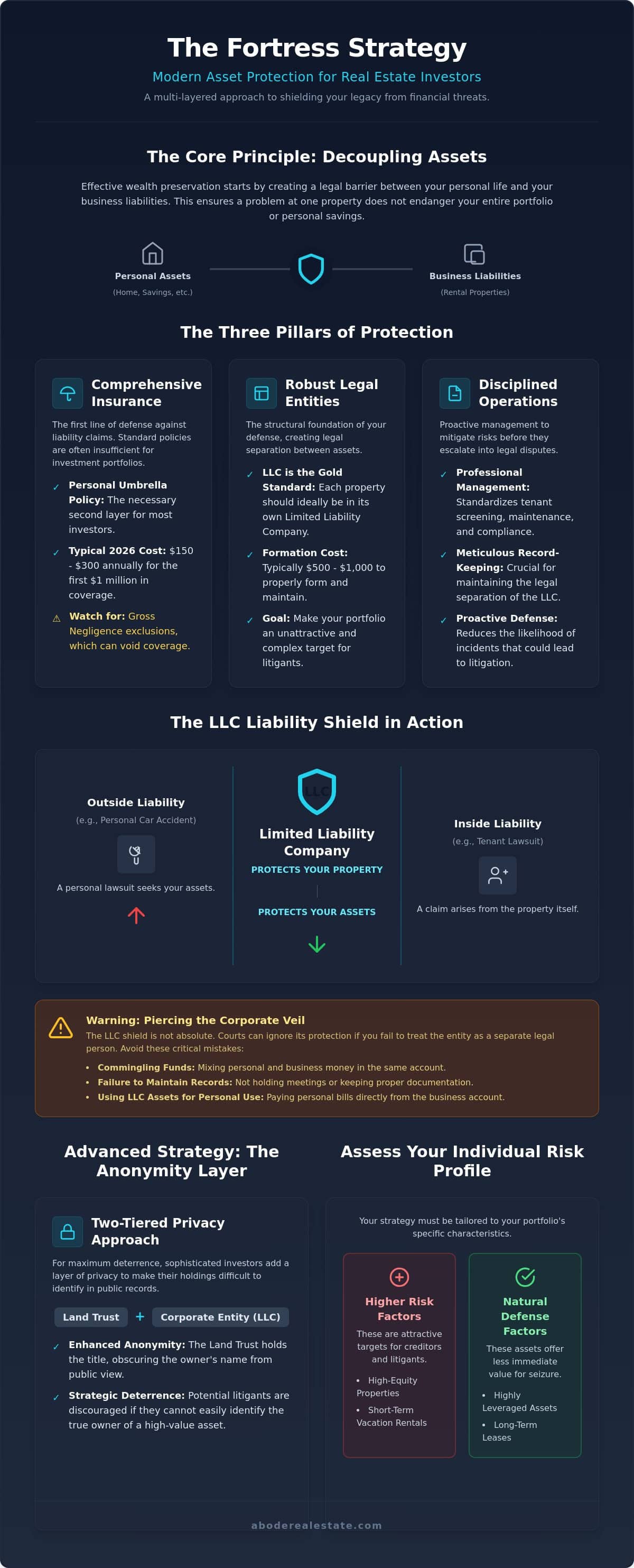
The most effective asset protection strategies for real estate investors rely on a Three Pillars framework. This includes comprehensive insurance, robust legal entities, and disciplined operational stewardship. The ultimate goal isn't just to win a lawsuit in court. It's to become so legally complex and judgment-proof that a plaintiff's attorney decides your portfolio is an unattractive target before they even file a claim. By making the cost of litigation higher than the potential reward, you protect your legacy through strategic deterrence.
Insurance as the Primary Defensive Layer
Standard homeowners policies rarely provide the depth of coverage required for sophisticated investment portfolios. While they might cover basic fire or theft, they often fall short when faced with complex liability claims. For most luxury investors, a personal umbrella policy is the necessary second skin. For $1 million in coverage, the typical annual cost in 2026 is between $150 and $300, with each additional million adding a fraction of that amount. However, you must remain vigilant regarding Gross Negligence exclusions. If a court determines you willfully ignored a known safety hazard, your insurance carrier might step aside, leaving your personal assets exposed to the full weight of a judgment.
Assessing Your Individual Risk Profile
Your specific strategy depends heavily on the equity you hold. High-equity properties are low-hanging fruit for creditors, whereas highly leveraged assets often offer a natural defense because there is less immediate value to seize. Short-term vacation rentals introduce another layer of complexity; the high turnover of guests increases the statistical likelihood of an incident compared to long-term leases. Asset protection for real estate is a multi-layered shield of legal, financial, and operational barriers.
Entity Structuring: Building Barriers Between Personal and Professional Assets
Holding a luxury estate in your personal name is akin to leaving the front door of your financial life wide open. If a tenant or guest experiences an injury on your property, your personal savings, your primary residence, and your future are all on the line. The Limited Liability Company (LLC) remains the gold standard for establishing a legal boundary between your private life and your business ventures. By placing each property into its own entity, you ensure that a legal storm at one location doesn't wash away the rest of your portfolio. This is the cornerstone of effective asset protection strategies for real estate investors who prioritize long-term security over short-term convenience.
It's vital to understand the dual nature of this shield. Inside liability occurs when a claim arises from the property itself; the LLC prevents that claim from reaching your personal assets. Outside liability is the reverse. If you are involved in a personal lawsuit, such as a car accident, the LLC structure helps protect the property from being seized by your personal creditors. However, simply filing paperwork isn't enough to secure these benefits. You must treat the entity with meticulous care. Commingling funds or failing to maintain separate bank accounts can lead to piercing the corporate veil, a legal scenario where a court ignores the LLC protection because you failed to treat it as a separate person. In 2026, the total cost to properly form and maintain an LLC typically ranges between $500 and $1,000, including state fees and registered agent services. This is a small price to pay for such profound security.
The Series LLC: Compartmentalization for Large Portfolios
For those with growing portfolios, the Series LLC offers a rhythmic way to compartmentalize risk. This structure allows you to create individual cells for separate properties under one master entity. It's often more cost-effective than filing dozens of standalone LLCs, especially in states with high annual fees like Massachusetts, where initial filings can reach $500. Not all states recognize the Series LLC, so it's essential to consult with a guide who understands investment property acquisition and the nuances of the local legal landscape before you commit to a specific structure.
Charging Order Protection: The Silent Shield
The most powerful, yet least understood, feature of the LLC is the charging order protection. In many jurisdictions, a creditor cannot simply take your real estate to satisfy a debt. Instead, they are only entitled to a charging order, which gives them a right to distributions from the LLC but no control over the asset itself. Since you can choose not to make distributions, the creditor is left with a potential tax bill for income they haven't received, making your assets a very unattractive target. This protection is often more robust in multi-member LLCs than in single-member structures, providing an extra layer of peace of mind for your financial legacy.
Beyond the LLC: Trusts and Privacy-First Investment Models
While the corporate structures discussed previously provide a robust legal fortress, privacy acts as the invisible perimeter that prevents a conflict from even reaching your gates. In a world where public data is easily accessible, high-net-worth owners are often viewed as deep-pocket targets for litigious individuals. Sophisticated asset protection strategies for real estate investors prioritize anonymity just as much as they do liability shields. By removing your name from the public record, you reduce the psychological incentive for a plaintiff to pursue a claim. If an attorney cannot easily identify a vast portfolio tied to your Social Security number, they are far less likely to take a case on a contingency basis. This is where the integration of land trusts and specialized investment models becomes essential for a curated portfolio.
A Land Trust functions as a title-holding vehicle while the LLC remains the operational shield. This two-tiered approach allows you to keep the actual ownership of the property out of the county recorder's public database. Instead of your personal name appearing on the deed, the trust's name is listed, providing a layer of obscurity that deters casual searches. For even greater security, some investors employ equity stripping as a tactical maneuver. By placing a mortgage or a lien against a property to reduce its visible net equity, you make the asset appear less valuable to creditors. A property with $2 million in equity is a prize; a property that appears to have only $50,000 in equity after debt is a litigation nightmare that most attorneys will simply avoid.
Privacy as a Preemptive Defense
Public records make luxury investors easy targets for those looking for a quick settlement. Using a land trust ensures that your personal retreat or high-end rental doesn't become a beacon for liability. This anonymity creates a psychological barrier for potential plaintiffs. When an initial search yields only a generic trust name with no clear connection to a wealthy individual, the perceived reward for a lawsuit diminishes rapidly. It's about maintaining a low profile so you can focus on asset optimization rather than defensive legal battles.
Irrevocable Trusts and Legacy Planning
For those looking toward the next chapter, irrevocable trusts offer the highest level of security against divorce, creditors, and future tax liabilities. With the federal estate tax exemption reaching $15 million per person in 2026, these structures are vital for preserving a financial legacy. The trade-off involves a loss of direct control, but giving up ownership is often your strongest defense. Assets held in a properly structured Asset Protection Trust are generally unreachable by personal creditors because you no longer technically own them. This creates a sanctuary for your wealth that remains resilient across generations.
Operational Risk Mitigation: The Role of Professional Property Management
While legal structures provide a passive fortress, professional property management represents the active defense of your financial legacy. Many lawsuits don't arise from simple bad luck; they stem from operational oversights that could have been avoided through disciplined stewardship. By delegating the daily complexities of your portfolio to an expert team, you integrate a layer of professional oversight that serves as a primary deterrent to liability. This approach is one of the most practical asset protection strategies for real estate investors, as it addresses risks before they ever reach a courtroom.
A third-party manager creates an essential buffer between the owner and the tenant. This distance is vital in high-stakes environments where personal emotions can lead to legal errors. When an owner manages their own luxury assets, they often lack the standardized systems required to defend against Fair Housing claims or liability disputes. Professional management relies on rigorous, documented tenant screening processes that ensure every applicant is treated with the same high register of precision. This consistency doesn't just protect your reputation. It provides a verifiable trail of evidence that you have acted with integrity and transparency.
Documented maintenance logs are another critical component of this operational shield. In the event of a negligence suit, the ability to produce a clear history of inspections and repairs can be the difference between a dismissed case and a multi-million dollar judgment. It proves that you have prioritized safety and asset optimization over short-term gains. If you want to ensure your portfolio receives this level of refined care, consider the benefits of full-service property management to secure your peace of mind.
Mitigating Short-Term Rental Risks
The liability landscape for luxury vacation rentals is particularly complex due to the high volume of transient guests. Professional management handles the intricate guest vetting and safety compliance requirements that many individual owners overlook. By utilizing multi-platform listing optimization and high-touch communication, a boutique manager ensures that your property attracts high-quality occupants who value the space as much as you do. This proactive vetting reduces the likelihood of property damage or guest-related incidents that could trigger insurance claims.
The Fiduciary Benefit of Professional Oversight
Financial mismanagement is a common entry point for creditors looking to pierce the corporate veil. Professional financial reporting ensures that your entity's books remain clean, separate, and accurate, reinforcing the legal separation between your personal and business lives. Consistent lease enforcement is handled legally and dispassionately, which avoids the appearance of discrimination or favoritism. This unhurried, intentional approach to management ensures that every decision aligns with the long-term health of your investment portfolio.
Implementing a Multi-Layered Defense for Your Luxury Portfolio
Implementing the architecture we've discussed requires a deliberate and unhurried transition. Moving existing properties from your personal name into new protective structures is a delicate process that requires precision to avoid triggering due-on-sale clauses or unnecessary tax events. This integration phase is where your strategic planning meets practical execution. You should treat asset protection as a core component of your ROI calculation, as the value of a high-yielding property is zero if it's lost to a single legal claim. By weaving these asset protection strategies for real estate investors into your initial acquisition plan, you ensure that every move you make is backed by a sense of calm confidence.
Maintaining this fortress requires a team of experts who act as your personal board of directors. A real estate-focused attorney, a specialized CPA, and a boutique advisor work in harmony to ensure your legal, tax, and operational barriers remain impenetrable. With federal estate tax exemptions rising to $15 million per person in 2026, the stakes for your financial legacy have never been higher. An annual audit of your asset protection architecture ensures that your shield evolves alongside changing market trends and legislative updates. Asset protection is a journey of stewardship, not a one-time transaction. It's about protecting the spirit and character of the wealth you've built.
The Boutique Advantage in Portfolio Optimization
Abode Real Estate provides a unique perspective that goes beyond mere transaction data. Our team assists in detailed investment property acquisition services to identify clean assets with lower inherent risk profiles. By using local market insights, we help you evaluate the specific liability landscape of a luxury neighborhood or a vacation rental district. This high-touch approach ensures that your portfolio isn't just profitable, but also resilient against unforeseen challenges. We focus on asset optimization, helping you curate a move into a new chapter of secure, sovereign ownership.
Your Next Steps Toward Sovereign Ownership
Your path forward begins with a clear assessment of your current exposure. This isn't a financial hurdle; it's a curated move toward long term security. Taking these steps today ensures that your arrival at financial independence is both permanent and protected.
- Conduct an immediate audit of your existing insurance policies to ensure they align with the 2026 coverage standards for luxury assets.
- Verify the status of your current legal entities and ensure you aren't commingling personal and business funds.
- Schedule a consultation with a real estate-focused asset protection attorney to discuss the integration of Land Trusts.
- Review your estate plan to take full advantage of the permanently indexed inflation protections for federal exemptions.
The Path to Sovereign Ownership
Building a resilient portfolio is a journey of refined craft and steady stewardship. By now, you understand that the most effective asset protection strategies for real estate investors aren't found in a single document; they're found in the harmonious integration of legal entities, privacy-first models, and active operational defense. From the anonymity provided by Land Trusts to the proactive buffer of professional property management, every layer serves as a testament to your commitment to legacy. Each step you take reinforces the legal and financial barriers that keep your personal life separate from your professional ventures.
At Abode Real Estate, we specialize in this level of tactical planning. Our boutique luxury market expertise and deep investment property analysis allow us to identify low-risk opportunities that align with your long-term goals. We provide the comprehensive property management buffer that transforms high-stakes ownership into a curated move toward financial peace. This is your arrival at a chapter where your wealth is both optimized and secure. Secure your legacy with a curated investment strategy from Abode Real Estate. Your future is a collection of the intentional choices you make today; we're here to ensure those choices stand the test of time.
Frequently Asked Questions
Is an LLC enough to protect my personal assets as a real estate investor?
An LLC is a foundational shield, but it's rarely sufficient on its own. True security requires a multi-layered approach including adequate insurance and disciplined operational habits. If you neglect separate bank accounts or fail to maintain the property, a court could bypass the LLC's protection. Effective asset protection strategies for real estate investors integrate these legal structures with professional oversight to ensure the shield remains resilient against diverse legal challenges.
What is the difference between a Land Trust and an LLC for asset protection?
A Land Trust is primarily a privacy tool used to keep your name off public records, while an LLC provides the actual legal liability shield. The trust holds the title to the property, making it difficult for "deep pocket" seekers to find you. Conversely, the LLC owns the beneficial interest in the trust and handles the daily operations. Using them together creates a sophisticated two-tiered defense that offers both anonymity and structural protection.
How much umbrella insurance should a real estate investor have in 2026?
Most luxury investors should carry a minimum of $2 million to $5 million in umbrella coverage, depending on their total net worth and portfolio risk. For a homeowner with rental properties, a $1 million policy typically costs between $150 and $300 annually, with additional millions generally adding $50 to $75 to the premium. Your coverage should ideally exceed your total exposed equity to ensure that a single judgment doesn't reach into your personal savings.
Can a Series LLC protect multiple properties from each other's liabilities?
Yes, a Series LLC is designed to compartmentalize risk by placing each property into its own "cell" or series. If a lawsuit occurs at one property, the assets held in other series are theoretically shielded from that specific claim. It's a cost-effective alternative to forming dozens of standalone LLCs. However, you must maintain strict separation between the records and bank accounts of each series to ensure these legal barriers remain valid in court.
Does property management help reduce my personal liability as a landlord?
Professional property management acts as an active defense by standardizing operations and creating a professional buffer between you and your tenants. By using a third party to handle guest vetting, safety compliance, and lease enforcement, you reduce the risk of claims rooted in discrimination or negligence. Documented maintenance logs and professional financial reporting further reinforce your legal standing. This operational stewardship is a vital part of comprehensive asset protection strategies for real estate investors.
What is 'piercing the corporate veil' and how do real estate investors avoid it?
Piercing the corporate veil occurs when a court decides your LLC isn't truly separate from your personal life, allowing creditors to seize your personal assets. To avoid this, you must treat the entity with absolute precision. This includes maintaining separate bank accounts, signing all contracts in the LLC's name, and never using business funds for personal expenses. Consistent record-keeping and annual filings are the best ways to prove that your entity is a legitimate, independent legal person.
Are asset protection strategies for real estate investors tax-deductible?
Many costs associated with establishing and maintaining these structures are deductible as ordinary and necessary business expenses. This includes LLC filing fees, which average $132 across the US, as well as registered agent costs and professional management fees. However, personal estate planning costs may be treated differently. You should consult with a CPA to maximize your deductions under the 2026 tax laws, which include enhanced provisions for qualified business income and expanded Section 179 expensing.
How do I protect my personal home if I am also a real estate investor?
Protecting your primary residence often involves a combination of homestead exemptions and keeping the home legally isolated from your business ventures. Since your investment properties carry higher liability risks, you should never hold them in the same entity as your personal home. Placing your residence in a separate trust or utilizing tenancy by the entirety can provide additional layers of security. Ensuring your personal umbrella policy specifically covers your residence adds a final, crucial layer of protection to your family's sanctuary.
Posted by Brook Walsh onEnjoy this blog post? Click here to subscribe for updates
Leave A Comment