
Your first commercial acquisition is more than a simple transaction; it's a curated move into a new chapter of asset optimization and financial legacy. While the $16.0 billion in commercial sales recorded across Southeast Florida in 2025 highlights the immense opportunity, it also underscores the absolute precision required to succeed. You've likely felt the weight of this high-stakes market, perhaps worrying that complex metrics like Cap Rates or Net Operating Income might hide a costly mistake. This beginner's guide to buying commercial property in South Florida serves as your steady, intentional roadmap to navigate these waters with calm confidence. Success here isn't about luck; it's about strategy.
We'll provide the essential frameworks and financial clarity you need to evaluate property value like a seasoned expert. You'll learn how the elimination of the commercial lease sales tax in October 2025 has shifted the landscape for retail assets and how to interpret the current vacancy rates across Miami and Palm Beach. By the end of this guide, you'll understand how to leverage professional expertise to transform a daunting process into a frictionless experience. We're here to help you build the right team and master the strategic steps required to secure your first premium commercial asset.
Key Takeaways
- Discover how to transition from residential thinking to a commercial mindset that treats every square foot as a tactical asset for wealth appreciation.
- Learn to identify the right property type for your portfolio, whether you are drawn to the stability of multi-family units or the high-growth potential of boutique retail and office spaces.
- Gain the confidence to evaluate any deal by mastering Net Operating Income and using Cap Rates to interpret current market sentiment and risk.
- Navigate the acquisition process with ease by following the roadmap in this beginner's guide to buying commercial property in South Florida.
- Understand the importance of building a specialized team of advisors to ensure your first commercial transition is handled with precision and personalized care.
The Fundamentals of Commercial Real Estate Investment
Entering the world of commercial acquisition requires a shift in perspective, moving from the emotional resonance of a home to the tactical precision of an income-producing asset. Commercial property represents a sophisticated vehicle for both operational utility and long-term wealth appreciation, allowing you to anchor your capital in the very fabric of the local economy. Commercial real estate is an asset class dedicated to business purposes, ranging from retail to multi-family units. This beginner's guide to buying commercial property in South Florida is designed to help you curate a portfolio that balances risk and return with the same care you'd apply to any other high-end investment.
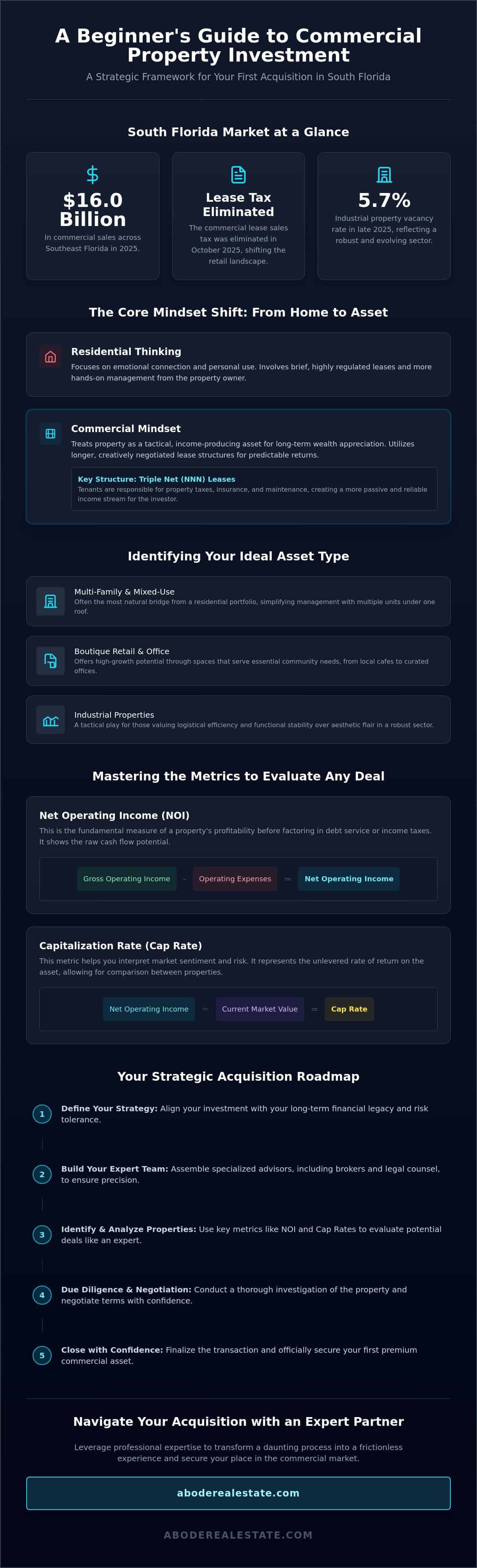
The core distinction between residential and commercial investments lies in the structure of the lease. Residential agreements are often brief and highly regulated, while commercial contracts offer room for creative negotiation and strategic planning. You'll encounter structures like Triple Net (NNN) leases, where tenants take responsibility for property taxes, insurance, and maintenance. This shift in responsibility creates a more passive income stream, turning your property into a reliable financial engine rather than a source of daily management tasks.
To better understand which types of assets might suit your initial entry into this market, watch this helpful video:
Why Investors are Transitioning to Commercial Assets
Many investors find that commercial assets offer a sense of security that residential rentals simply cannot match. The potential for higher yields is often accompanied by significantly longer lease terms, which provide a predictable rhythm to your financial planning. You'll also find that the tenant-landlord relationship is inherently more professional. Business owners tend to treat their space with a level of care that reflects their own brand standards, leading to fewer management headaches. Integrating these assets into your financial strategy offers a layer of diversification that protects your legacy against market volatility.
Understanding the Scale of Commercial Ventures
The landscape of South Florida commercial real estate spans from intimate, boutique storefronts to massive, institutional-grade complexes. For those using this beginner's guide to buying commercial property in South Florida, starting with lifestyle commercial properties often feels most natural. These are the neighborhood hubs, local cafes, and curated office spaces that serve essential community needs. These smaller-scale assets offer a manageable entry point while benefiting from the stability of commercial contracts. Whether you're looking at a sleek multi-family building or a refined retail space, the emphasis remains on the tactical planning of the asset's future value.
Categorizing Assets: Identifying the Right Property Type
Selecting the right asset is about more than just numbers; it's about finding a property that aligns with your lifestyle and legacy. In South Florida, the market offers a rich tapestry of choices, from the rhythmic predictability of residential-adjacent units to the high-stakes precision of logistical hubs. This beginner's guide to buying commercial property in South Florida helps you decipher which asset class speaks to your specific risk tolerance. Industrial properties, for instance, have become a tactical play for those seeking logistical efficiency. While regional vacancy rates rose to 5.7% in late 2025 due to new construction completions, the sector remains a robust pillar for investors who value functional stability over aesthetic flair.
Multi-Family and Mixed-Use Developments
These assets often serve as the most natural bridge for those transitioning from residential portfolios. Having multiple units under one roof simplifies management and creates a sense of community that single-family rentals often lack. With stabilized occupancy rates holding steady at 94.2% in late 2025, these properties offer a reassuring level of security for the cautious investor. Mixed-use spaces go a step further, blending living quarters with ground-floor retail to create vibrant, self-sustaining ecosystems. This approach mirrors the Beginner's Guide to Commercial Real Estate philosophy of diversifying income streams within a single physical structure.
Retail and Boutique Office Spaces
The modern economy has sparked a renaissance in curated environments. Today's professional firms seek boutique offices that offer more than just four walls; they want amenity-rich spaces that reflect their brand's identity. In Miami-Dade, Class A office asking rents averaged $66.87 per square foot in early 2026, proving that premium quality still commands a significant premium. Retail is equally dynamic. The elimination of the commercial lease sales tax in October 2025 has invigorated the sector, making necessity-based retail the tightest asset class in the region with vacancy rates as low as 3.2%. Visibility and location are paramount here.
Every choice you make should reflect your ultimate financial objectives. Whether you prioritize the steady pulse of a multi-family building or the high-growth potential of a Brickell storefront, your strategy must be intentional and unhurried. If you're ready to explore how these categories fit into your broader vision, consider partnering with a team that understands investment property acquisition as a refined craft. Mastery begins with choosing the right vehicle for your capital.
Analyzing the Quantitative Value of a Commercial Asset
Quantitative analysis is the refined craft of translating a physical space into a financial narrative. While a property's aesthetic appeal or location provides the initial spark, its true value lies in the data. This beginner's guide to buying commercial property in South Florida focuses on the metrics that allow you to strip away the noise and evaluate an asset on its own merits. Mastering these calculations provides the calm confidence needed to make a curated move into commercial ownership.
The Role of Net Operating Income
Net Operating Income, or NOI, is the heartbeat of property valuation. It represents the total income generated by the asset after all necessary operating expenses have been paid but before you account for debt service or taxes. To calculate your NOI, you'll subtract expenses like property management fees, insurance, utilities, and maintenance from the gross rental income. It's a pure measure of the asset's efficiency. Because NOI excludes mortgage payments, it allows you to compare the performance of different properties regardless of how they are financed. Optimizing these expenses is a tactical way to increase value; every dollar saved in operations is a direct boost to your bottom line and the property's eventual resale price.
Evaluating Risk with Cap Rates
The Capitalization Rate, or Cap Rate, serves as a measure of market sentiment and risk. Cap Rate is the ratio between Net Operating Income and the original capital cost or current market value. It tells you the expected rate of return on an all-cash investment. In high-demand markets like Miami or West Palm Beach, you'll often see lower cap rates. This suggests the market views these assets as lower risk and higher quality. While a high cap rate might seem attractive at first glance, it often signals underlying risks such as high vacancy potential or deferred maintenance. You should use cap rates to compare similar assets within the same geographic pocket to ensure you aren't overpaying for the perceived security of the location.
Understanding Lender Metrics
When you move toward acquisition, you'll need to view your asset through the eyes of a lender. The Debt Service Coverage Ratio (DSCR) is a key metric they use to determine if the property's income can comfortably cover its debt obligations. Most institutional programs in early 2026 require a minimum DSCR of 1.25x. This means the property must generate 25% more income than is required to pay the mortgage. Understanding this ratio helps you determine how much leverage you can safely apply to your purchase. This beginner's guide to buying commercial property in South Florida encourages you to treat these numbers as a protective framework, ensuring your first asset is a source of security rather than stress.
- NOI: Focuses on operational efficiency.
- Cap Rate: Measures market risk and return.
- DSCR: Evaluates the safety of the debt.
The Strategic Roadmap for Acquisition and Due Diligence
The path from initial curiosity to the final transfer of title is a sequence of deliberate, unhurried steps. In a market as dynamic as Southeast Florida, where commercial sales reached $16.0 billion in 2025, rushing into a contract can lead to overlooked details. This beginner's guide to buying commercial property in South Florida frames the acquisition process as a curated journey rather than a race. It begins with a deep market analysis to identify assets that resonate with your long-term goals and ends with a seamless transition of ownership that secures your financial legacy.
Building Your Professional Inner Circle
Success in commercial real estate is rarely a solo endeavor. You'll need to assemble a specialized team of advisors who prioritize your interests over high-volume transactions. This inner circle typically includes a commercial broker, a real estate attorney, and an accountant with deep investment expertise. A boutique brokerage offers a distinct advantage here, providing personalized tactical planning that national franchises often lack. You aren't just looking for a salesperson; you're seeking a refined local expert who acts as a high-level facilitator. Vet your team based on their transparency and their ability to explain complex market trends with calm confidence.
The Due Diligence Checklist
Due diligence is your period of tactical discovery. It's the time to peel back the layers of an asset to ensure its physical and financial health matches the marketing narrative. Your checklist should be exhaustive and intentional. You'll need to review rent rolls for accuracy, examine existing service contracts, and conduct thorough physical inspections. In South Florida, environmental assessments and zoning verifications are non-negotiable steps to protect your capital. This phase is also where you'll finalize your financing strategy.
For stabilized, income-producing assets, certain programs in early 2026 offer loan-to-value (LTV) ratios up to 70% with amortization periods extending to 40 years. Understanding these financial levers allows you to use your due diligence findings as a tool for negotiation. If an inspection reveals deferred maintenance, you can adjust your offer to reflect the true cost of optimization. This level of precision ensures that when you reach the closing table, you do so with absolute clarity. If you're ready to begin this journey with a team that values your long-term success, explore our approach to Commercial Real Estate Sales. Mastery of the roadmap is the first step toward a frictionless acquisition.
- Review all lease agreements and historical operating statements.
- Conduct Phase I and, if necessary, Phase II environmental site assessments.
- Verify that current property use aligns with local zoning ordinances.
- Evaluate the structural integrity of the asset through professional inspections.
The Abode Philosophy: Boutique Commercial Representation
At Abode, we believe commercial real estate is more than a portfolio addition; it is an extension of your lifestyle and a testament to your legacy. While large national firms often focus on the velocity of transactions, we prioritize the depth of the relationship. This beginner's guide to buying commercial property in South Florida has outlined the technical frameworks required for success, but the final component is the partnership that brings these frameworks to life. We view our role as refined facilitators who transform a complex financial hurdle into a curated move into a new chapter. Our team speaks with an inviting and lifestyle-oriented voice, ensuring that every transition feels personal rather than clinical.
We treat technical expertise as a refined craft. This perspective allows us to move beyond basic market data and discuss the essential character and spirit of the areas we serve, from the vibrant energy of Brickell to the sophisticated calm of West Palm Beach. By choosing a boutique approach, you're opting for a level of precision and careful management that is tailored to your unique financial narrative. We don't just facilitate sales; we help you arrive at a place of belonging within the South Florida business community.
Personalized Asset Optimization
Our approach to investment property acquisition is rooted in the optimization of assets and tactical planning. We don't just find spaces; we identify opportunities that align with your specific social bonds and financial goals. Whether you are looking for a boutique office or a stabilized multi-family asset, we provide the hands-on attention that ensures every detail is managed with exclusivity. Our team operates with a sense of calm confidence and quiet authority, providing the transparency you need to make high-stakes decisions with ease. This customized, high-touch service model is the cornerstone of how we help you build a resilient portfolio.
Beyond the Transaction
The Abode philosophy extends far beyond the moment you receive the keys. We understand that acquiring an asset is only the beginning of its story, and maintaining its value requires a sophisticated discipline. To ensure your property continues to perform at its peak, we offer full-service property management that treats your asset with the same level of care you would provide yourself. We act as your trusted advisor throughout the entire lifecycle of the investment, providing steady and intentional guidance as market trends evolve. This holistic view ensures that your move into commercial ownership is frictionless, rewarding, and deeply rooted in the local landscape.
Your transition into this market should feel like an arrival, not a struggle. We invite you to experience a more sophisticated discipline of representation that values long-term security over quick wins. If you are ready to apply the insights from this beginner's guide to buying commercial property in South Florida to your own unique vision, contact us for a personalized consultation. Let's work together to secure your place in the future of South Florida.
Securing Your Legacy in the South Florida Market
Acquiring your first commercial asset is a significant move toward financial optimization and long-term security. You've gained the clarity to navigate complex metrics like Net Operating Income and the strategic foresight to choose properties that align with your lifestyle goals. This beginner's guide to buying commercial property in South Florida has laid the foundation, but the true craft lies in the execution of your unique vision. Success in this high-stakes environment isn't just about the data; it's about the partnership that guides you through every high-touch detail.
As you prepare for this curated transition, you deserve a team that values your trust as much as the transaction itself. Discover a curated approach to Commercial Real Estate Sales with Abode Real Estate. Our boutique firm is led by local market experts who provide specialized investment property analysis through a sophisticated, client-centric service model. We're here to ensure your arrival in the commercial sector is marked by calm confidence and tactical precision. Your journey into the South Florida market is an exciting step toward a new chapter of growth, and we look forward to facilitating your success.
Frequently Asked Questions
How does commercial real estate differ from residential investing?
Commercial real estate focuses on the asset's ability to generate income and serve business functions rather than providing personal shelter. While residential deals center on livability and emotional appeal, commercial acquisitions rely on tactical metrics like cash flow and lease stability. This shift in perspective is a core part of any beginner's guide to buying commercial property in South Florida. It transforms the property from a dwelling into a sophisticated financial engine.
What is a typical down payment for a commercial property purchase?
Investors should typically prepare for a down payment ranging from 20% to 35% of the purchase price. While residential loans often allow for lower entry points, commercial lenders prioritize the property's income potential and debt coverage. For example, some life company programs for stabilized assets in early 2026 allow for a 70% loan-to-value ratio, requiring a 30% equity contribution. This ensures the investor has enough skin in the game.
What exactly is a Triple Net (NNN) lease?
A Triple Net lease is a structure where the tenant assumes responsibility for the property's three primary operating expenses: real estate taxes, building insurance, and maintenance. This arrangement allows the owner to enjoy a more passive income stream with fewer management burdens. It's a popular choice for those seeking the long-term security of a professional, hands-off investment. This beginner's guide to buying commercial property in South Florida recommends NNN leases for their predictability.
How do I calculate the Capitalization Rate for a potential investment?
You calculate the Capitalization Rate by dividing the property's Net Operating Income by its current market value or purchase price. This percentage helps you evaluate the potential return on an all-cash investment and compare different assets within the same geographic market. It serves as a vital measure of market sentiment and the perceived risk of the asset. A lower rate often suggests a higher-quality property in a premium location.
What are the most common risks for first-time commercial buyers?
First-time buyers often face risks related to unexpected vacancy periods and the complexities of commercial zoning. Unlike residential properties, a vacant commercial space can take months to re-lease, significantly impacting your cash flow. It's also easy to underestimate the cost of tenant improvements or hidden structural issues without a thorough, professional inspection during the due diligence phase. Managing these risks requires a calm, intentional approach to market analysis.
How long does the commercial real estate closing process usually take?
The closing process for a commercial transaction typically spans between 60 and 120 days. This extended timeline allows for the rigorous due diligence required to verify financial records, environmental reports, and physical inspections. While residential deals move quickly, commercial acquisitions require a more intentional and unhurried pace to ensure every detail is curated for long-term success. This deliberate pacing helps reduce the anxiety often associated with high-stakes transactions.
Can I use a residential real estate agent for a commercial purchase?
While it's legally possible, using a residential agent for a commercial purchase is generally not recommended due to the specialized nature of the industry. Commercial deals require a deep understanding of complex financial metrics, specialized lease structures, and specific market trends. Partnering with a dedicated commercial facilitator ensures your transaction is handled with the precision and authority it deserves. A specialized expert act as a high-level guide through the entire process.
What is the importance of an Estoppel Certificate in commercial deals?
An Estoppel Certificate is a critical legal document where a tenant confirms the current terms and status of their lease. It prevents the seller or tenant from later claiming different lease terms once the property has changed hands. This document provides a layer of emotional and financial security, ensuring you arrive at the closing table with complete transparency. It's a vital step in verifying that the income narrative matches the reality of the asset.
Posted by Brook Walsh onEnjoy this blog post? Click here to subscribe for updates
Leave A Comment