

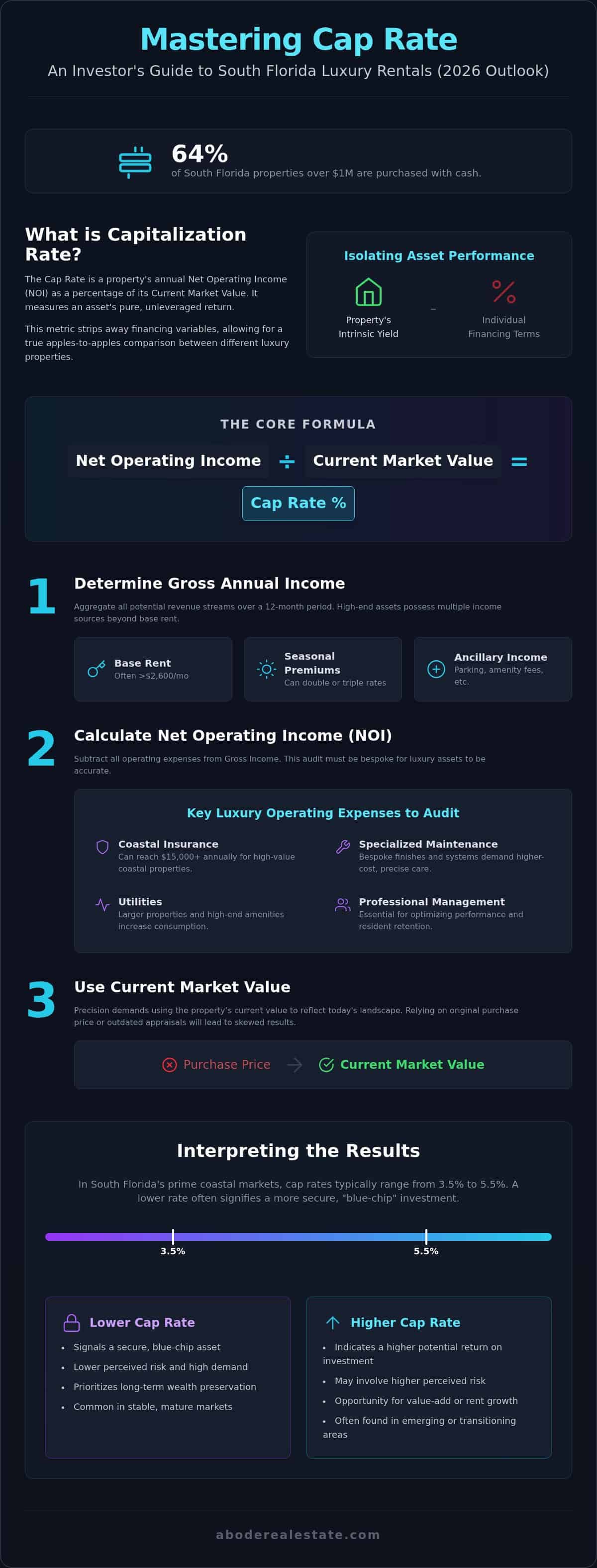
Did you know that for South Florida properties valued over $1 million, cash buyers now represent roughly 64% of all transactions? This influx of capital suggests a market of immense opportunity, but even the most seasoned investors can find their projected yields evaporating when they rely on generic formulas. You likely understand that a property's potential isn't just found in its aesthetic appeal or its proximity to the water. It's found in the numbers. Precision is the ultimate luxury.
The reality of calculating cap rates for South Florida rental properties in 2026 has become increasingly complex, as insurance premiums for high-value coastal assets can reach $15,000 and maintenance for bespoke finishes demands greater precision. This guide will help you master the essential math and market-specific nuances required to evaluate luxury rental returns in the current market accurately. We'll explore a reliable formula tailored for luxury assets, break down the impact of rising regional operational costs, and provide the clarity you need to choose a high-yield investment with total confidence.
Key Takeaways
- Master the nuances of stripping away financing variables to reveal the true operational performance of your high-end assets.
- Gain clarity on the precise three-part formula for calculating cap rate for South Florida rental properties while accounting for the unique 2026 market landscape.
- Learn to conduct a bespoke expense audit that accurately factors in the rising costs of coastal insurance and specialized luxury maintenance.
- Discover why a lower cap rate often signals a secure, blue-chip investment that prioritizes long-term wealth preservation over high-risk speculation.
- Explore how professional management acts as a safeguard for your net operating income by optimizing asset performance and resident retention.
Table of Contents
- Defining Cap Rate within the Luxury Rental Market
- How to Calculate Cap Rate for South Florida Rental Properties
- Accounting for High-End Operating Expenses and Nuances
- Evaluating Risk and Appreciation Beyond the Basic Formula
- Optimizing Your Investment Strategy through Professional Management
Defining Cap Rate within the Luxury Rental Market
A property's allure often begins with its architecture or its panoramic views, but its longevity as a successful investment is found in its math. At its core, the Capitalization Rate is the ratio of a property's annual net operating income to its current market value. While simple on paper, the process of calculating cap rate for South Florida rental properties requires an eye for detail that looks beyond surface-level aesthetics. Luxury investors lean on this metric because it provides a pure view of a property's potential. It removes the noise of individual credit scores or specific loan terms. It allows you to see the asset for what it truly is.
To better understand this concept, watch this helpful video:
In premium markets, a strong return looks different than it does in a standard residential neighborhood. Prime luxury coastal segments often see cap rates ranging from 3.5% to 5.5%, reflecting the stability and prestige of high-demand enclaves. A lower cap rate isn't a failure. It's often a sign of a blue-chip asset with lower perceived risk and significant long-term staying power. It's the difference between a nominal cap rate, which is a snapshot in time, and a real-world yield that accounts for the enduring character and spirit of the environment.
The Role of Cap Rate in Asset Comparison
Comparing a sprawling coastal estate to a sleek urban penthouse is rarely an apples-to-apples endeavor without a shared metric. The cap rate serves as that essential barometer, helping you identify cap rate compression. This occurs when high demand drives property values up faster than rents can follow. In high-demand residential sectors, this compression signals a mature, competitive market where capital preservation is as vital as monthly cash flow. It helps you understand the risk profile of the investment landscape before you commit your capital. This clarity is essential for making informed decisions in a fast-paced environment.
Why Financing is Excluded from the Basic Formula
Focusing on the asset's performance ensures you aren't masking a mediocre property with a great loan. Whether you're part of the 64% of cash buyers in the luxury segment or opting for a 30-year fixed mortgage at 6.67%, the property's intrinsic yield remains the same. Once you establish this baseline, you can layer in your specific financing to determine your cash on cash return. This transition from asset performance to personal wealth strategy is where Investment Property Acquisition becomes a refined craft. It's about optimizing the asset first and the capital structure second.
How to Calculate Cap Rate for South Florida Rental Properties
Mastering the mathematics of a luxury investment requires a departure from broad market generalizations. To find the true pulse of an asset, you must balance three specific pillars: income, expenses, and current market value. Net operating income is gross income minus all operating expenses. This figure serves as the foundation for calculating cap rate for South Florida rental properties, providing a transparent view of how efficiently a residence generates wealth before the influence of debt. Relying on original purchase prices or outdated appraisals can lead to skewed results; precision demands that you use the property’s current market value to reflect the present day landscape.
Step 1: Determining Gross Annual Income
The first step involves aggregating every dollar the property produces over a twelve month period. For long term luxury leases, this begins with the base rent, which frequently exceeds $2,600 per month for premium residences in the current market. However, high end assets often possess multiple revenue streams that must be captured for an accurate audit. If you are managing a vacation rental, you must factor in significant seasonal premiums that can double or triple standard rates during the winter months. Don't forget to include ancillary income such as parking fees, specialized amenity access, or even storage locker rentals, as these smaller figures contribute to the total gross potential.
Step 2: Calculating Net Operating Income (NOI)
Once you have your gross income, you must subtract a realistic vacancy factor to account for natural tenant turnover. Current market data shows healthy occupancy rates hovering around 95% across high demand sectors, suggesting a 5% vacancy allowance is a prudent starting point for your projections. From there, subtract recurring operational costs required to keep the residence in peak condition. This includes property taxes, which average approximately 0.75% of a home’s value, alongside insurance and general maintenance. It's vital to exclude non operating costs like mortgage interest or depreciation, as these are specific to your capital structure rather than the property's organic performance.
Step 3: Applying the Capitalization Formula
With your NOI in hand, the final step in calculating cap rate for South Florida rental properties is simple division. Divide your annual NOI by the property’s current market value. For example, a residence producing $150,000 in NOI valued at $3 million results in a 5% cap rate. You can also reverse this math to find a target purchase price by dividing your desired NOI by a target cap rate. If you are currently evaluating luxury residential sales, this formula acts as your most reliable filter, ensuring every potential acquisition aligns with your broader financial objectives and lifestyle goals.
Accounting for High-End Operating Expenses and Nuances
Luxury assets demand a departure from the generic expense ratios often cited in entry-level real estate investing. When you're calculating cap rate for South Florida rental properties, the margin for error narrows as the asset value climbs. Amenity-rich properties, while commanding higher rents, also introduce a more complex web of recurring costs that must be meticulously audited. From infinity-edge pool maintenance to the upkeep of integrated smart-home technology, every high-end feature requires a specialized line item. A standard audit ensures that your projected yields are rooted in reality rather than aspiration.
Insurance and Property Tax Considerations
Insurance is currently the most volatile variable in the regional market. For coastal residences, premiums have risen roughly 29% year-over-year, with high-value coastal properties often seeing annual costs between $8,500 and $15,000 or more. Property taxes add another layer of precision. While the 10% annual assessment cap for non-homestead properties offers a degree of protection, the initial reassessment after a transfer of ownership can reset your base costs significantly. Average effective rates hover around 0.75% of the home's value, but localized millage rates vary, making a thorough pre-acquisition analysis essential for a precise projection.
Maintenance and Concierge Services
Luxury assets require a proactive stance on upkeep to preserve their market position. Maintenance costs have climbed 24% recently, driven by the specialized labor required for bespoke finishes and high-end appliances. For waterfront homes, the environment is a constant factor; salt air necessitates frequent inspections of HVAC systems and exterior structural elements. If your strategy involves short-term stays, the expense of maintaining a curated guest experience is a non-negotiable operational cost.
Full-Service Property Management typically ranges from 8% to 12% of collected rent, but this professional oversight acts as a critical protector of your cap rate. It prevents minor maintenance issues from evolving into expensive capital expenditures that could erode your net operating income. Consistent care preserves the asset's prestige and ensures the residence remains a sanctuary for tenants. It transforms the property from a mere physical structure into a high-performing vehicle for your capital. Precision in these operational details is what separates a standard investment from a truly optimized luxury portfolio.
Evaluating Risk and Appreciation Beyond the Basic Formula
The final percentage you reach when calculating cap rate for South Florida rental properties is a vital sign, but it isn't the entire story of an asset's health. In the world of luxury real estate, there's a profound inverse relationship between yield and prestige. A lower cap rate often signals a blue-chip asset located in an area with high barriers to entry and extreme scarcity. These properties are prized for their stability and their ability to act as a hedge against broader market volatility. Investors prioritize these lower-yield entries because they represent a secure sanctuary for capital, where the risk of significant value loss is mitigated by the enduring allure of the location.
Using the cap rate as a tool for market timing requires a nuanced perspective. When you see cap rates compressing to historic lows, it often indicates that property values are rising faster than rental income, a common occurrence in coastal enclaves. This compression might suggest a peak in the market, prompting a strategic exit, or it could signal a permanent shift in the area's desirability. Understanding this rhythm allows you to move beyond the spreadsheet and make decisions rooted in the actual spirit of the market.
Cap Rate vs. Long-Term Equity Growth
Luxury investing is frequently a play for long-term equity rather than immediate, high-volume cash flow. While a Class C property in a different region might offer a higher cap rate, it lacks the appreciation potential found in Class A South Florida assets. Regional data from May 2026 shows that asking rents for premium residences continue to outpace the national average, even as the market stabilizes. This consistent demand, driven by high-wage job growth and a steady influx of professionals, ensures that the underlying value of the residence continues to climb. You're balancing the monthly check with the eventual windfall of a high-value sale.
Seasonal Vacancy and Market Volatility
Relying on a single-year snapshot can be a dangerous oversight in a market defined by seasonal ebbs and flows. With regional occupancy rates hovering around 95% as of mid-2026, the market remains robust, but savvy investors still prepare for the quiet months. Building a dedicated reserve fund is a refined strategy that protects your net operating income from being eroded by unexpected vacancies or sudden shifts in demand. This proactive approach ensures you're never forced into a reactionary position. If you're ready to explore these blue-chip opportunities, view our current luxury residential sales.
Optimizing Your Investment Strategy through Professional Management
The process of calculating cap rate for South Florida rental properties often reveals significant potential, but realizing that projected yield depends on the caliber of oversight provided after the acquisition. Professional management acts as a safeguard against operational leakage, where unmonitored maintenance or inefficient tenant placement can quietly erode your net operating income. By treating the property as a high-performing financial vehicle rather than just a physical structure, boutique oversight ensures that every potential dollar is captured and every expense is optimized for the long term. This personalized approach is particularly effective when dealing with high-net-worth residents who expect a seamless living experience.
Specialized management preserves the long-term value of luxury assets by ensuring every architectural detail and high-end finish remains in peak condition through proactive stewardship. This level of attention transforms the investment from a static asset into a thriving retreat that maintains its prestige in a competitive market. When you align your operational strategy with a trusted advisor, you gain access to market insights that allow for more precise acquisitions and tactical planning. This partnership reduces the friction often associated with high-stakes transitions, allowing you to focus on the broader growth of your wealth.
Maximizing Income through Curated Experiences
To command the premium rents required for a healthy luxury yield, a residence must offer more than just a prime location. Professional staging and high-register marketing are essential tools for attracting discerning tenants who value exclusivity and precision. High-touch concierge support and dedicated guest services significantly improve resident retention and positive reviews. These elements are the lifeblood of sustainable income. If you are ready to elevate your asset's performance, exploring full-service property management in Florida provides the infrastructure necessary to deliver these curated experiences consistently.
Tactical Planning and Portfolio Growth
Scaling a luxury investment strategy requires moving beyond a single asset to build a diversified and resilient portfolio. This growth is best achieved through a boutique approach where every new acquisition is evaluated for its strategic fit within your overall wealth goals. By leveraging proven Florida investment property acquisition strategies, you can navigate market shifts with confidence and clarity. A well-connected guide helps you identify unique opportunities that align with your lifestyle objectives. This ensures the work of calculating cap rate for South Florida rental properties remains a refined craft rather than a mere mechanical exercise.
Securing Your Legacy in the South Florida Market
Building a high-performing portfolio requires more than just a spreadsheet; it demands a deep connection to the nuances of the local landscape. We've explored how calculating cap rate for South Florida rental properties serves as the essential baseline for any acquisition, stripping away financing noise to reveal the true character of an asset. You now understand that in the luxury segment, a lower yield often reflects the security of a blue-chip location, while meticulous expense audits for insurance and maintenance are non-negotiable for protecting your bottom line.
Success in this 2026 market is a refined craft that benefits from a partner with boutique investment expertise and specialized luxury property management. Our team provides the deep local market intelligence required to turn complex transitions into frictionless moves. Contact Abode Real Estate for a personalized investment property analysis to begin your next chapter with total clarity. Your journey toward a high-yield, legacy-defining portfolio is well within reach, and we're here to guide every step of the way.
Frequently Asked Questions
What is a good cap rate for South Florida rental properties in the luxury sector?
A good cap rate in the luxury sector typically ranges from 3.5% to 5.5%. While higher yields are often found in other asset classes, premium residences prioritize stability and long-term appreciation over immediate cash flow. Lower rates often signal blue-chip assets in high-demand enclaves where scarcity drives value. Investors should view these figures as a reflection of lower risk and the prestige associated with the local environment.
Does the cap rate calculation include my monthly mortgage payments?
No, the cap rate calculation intentionally excludes mortgage payments to focus solely on the property's organic performance. By removing financing variables, you can compare diverse assets on an even playing field regardless of individual loan terms. This metric provides a pure view of the residence's efficiency. Once you establish the baseline yield, you can then calculate your cash-on-cash return by layering in your specific debt service and interest rates.
How do property taxes affect my net operating income in this region?
Property taxes are a significant operating expense that directly reduces your net operating income. In this region, the average effective tax rate is approximately 0.75% of the property's value. When calculating cap rate for South Florida rental properties, it's vital to account for the 10% annual assessment increase cap for non-homestead assets. A sudden reassessment after a luxury property transfer can shift your expenses, making precise tax projections essential for an accurate yield.
Is a higher cap rate always better for a luxury real estate investment?
A higher cap rate isn't always superior in the luxury market as it often indicates a higher level of perceived risk. Lower cap rates frequently represent stable, prestigious assets in prime locations where demand remains consistently high. These properties act as a secure sanctuary for capital and typically offer greater potential for long-term equity growth. Choosing an investment requires balancing the immediate yield against the security and appreciation potential of the specific residence.
How should I estimate vacancy rates for high-end seasonal rentals?
Estimating vacancy for high-end seasonal rentals requires a nuanced look at regional demand cycles rather than national averages. While recent data shows healthy occupancy rates hovering around 95%, savvy investors typically model a 5% to 8% vacancy factor to account for the quieter summer months. This conservative approach ensures your net operating income remains protected even during seasonal shifts. Professional management can further mitigate this risk by optimizing listing visibility and securing high-quality, recurring guests.
What is the difference between cap rate and cash-on-cash return?
The primary difference lies in how debt and initial capital are treated. Cap rate measures the property’s yield as if it were a cash purchase, focusing on the asset's intrinsic performance. Cash-on-cash return measures the annual return on the actual dollars you invested, accounting for mortgage payments and loan terms. Both metrics are essential for a complete analysis. Cap rate helps you choose the right property, while cash-on-cash return helps you choose the right financing strategy.
Can professional property management actually improve my calculated cap rate?
Professional management can improve your cap rate by optimizing every component of net operating income. Through strategic marketing and curated guest experiences, managers can command premium rents that standard listings might miss. Simultaneously, they reduce operational leakage by coordinating preventative maintenance and securing high-quality tenants. This boutique oversight ensures that the process of calculating cap rate for South Florida rental properties results in a higher, more sustainable yield through efficient asset management and reduced turnover costs.
How does hurricane insurance impact the capitalization rate of waterfront homes?
Hurricane insurance is a critical operational expense that can significantly compress the cap rate for waterfront homes. Annual premiums for high-value coastal properties often range from $8,500 to $15,000, representing a substantial portion of the total expense audit. These costs must be meticulously factored into your calculations to avoid overestimating your net operating income. While these premiums are high, they serve as a necessary safeguard for the asset's long-term value and the investor's peace of mind.
Posted by Brook Walsh onEnjoy this blog post? Click here to subscribe for updates
Leave A Comment