

What if your most resilient asset wasn't a digital entry in a brokerage account, but a physical sanctuary that builds wealth while you live your life? You've likely felt the exhaustion of watching the stock market swing while inflation, currently sitting at 3.4 percent, quietly chips away at your hard-earned cash reserves. It's a common frustration for the sophisticated investor who seeks more than just a ticker symbol. Diversifying investments with real estate offers a path toward true stability.
In this guide, you'll discover how to integrate high-end properties into your portfolio to secure durable income, hedge against volatility, and achieve long-term capital appreciation. We'll examine the strategic shift toward tangible assets that lower your correlation to the S&P 500, optimize your tax position with the updated $40,400 SALT deduction cap, and provide a unique blend of financial and lifestyle value. This is the 2026 blueprint for a legacy that is both profitable and personal. We'll move beyond basic market data to explore how curated property acquisition transforms capital into a lasting sense of belonging and security.

Key Takeaways
- Learn how real estate functions as a core alternative asset class to reduce portfolio correlation with traditional markets and protect against volatility.
- Explore the dual benefits of durable monthly income streams and long-term capital appreciation that high-end physical properties provide.
- Understand the specific tax advantages and lifestyle rewards of direct property ownership compared to passive investment vehicles.
- Discover why diversifying investments with real estate into luxury residential and vacation rental sectors is a primary strategy for growth in 2026.
- See how professional property management facilitates a seamless transition from a complex asset to a curated, passive wealth-building tool.
Table of Contents
- Understanding the Role of Real Estate in a Diversified Investment Portfolio
- The Core Financial Pillars of Real Estate Diversification
- Direct Real Estate Ownership vs. Passive Investment Vehicles
- Strategic Asset Selection: Identifying High-Growth Sectors
- Building a Resilient Portfolio through Expert Management
Understanding the Role of Real Estate in a Diversified Investment Portfolio
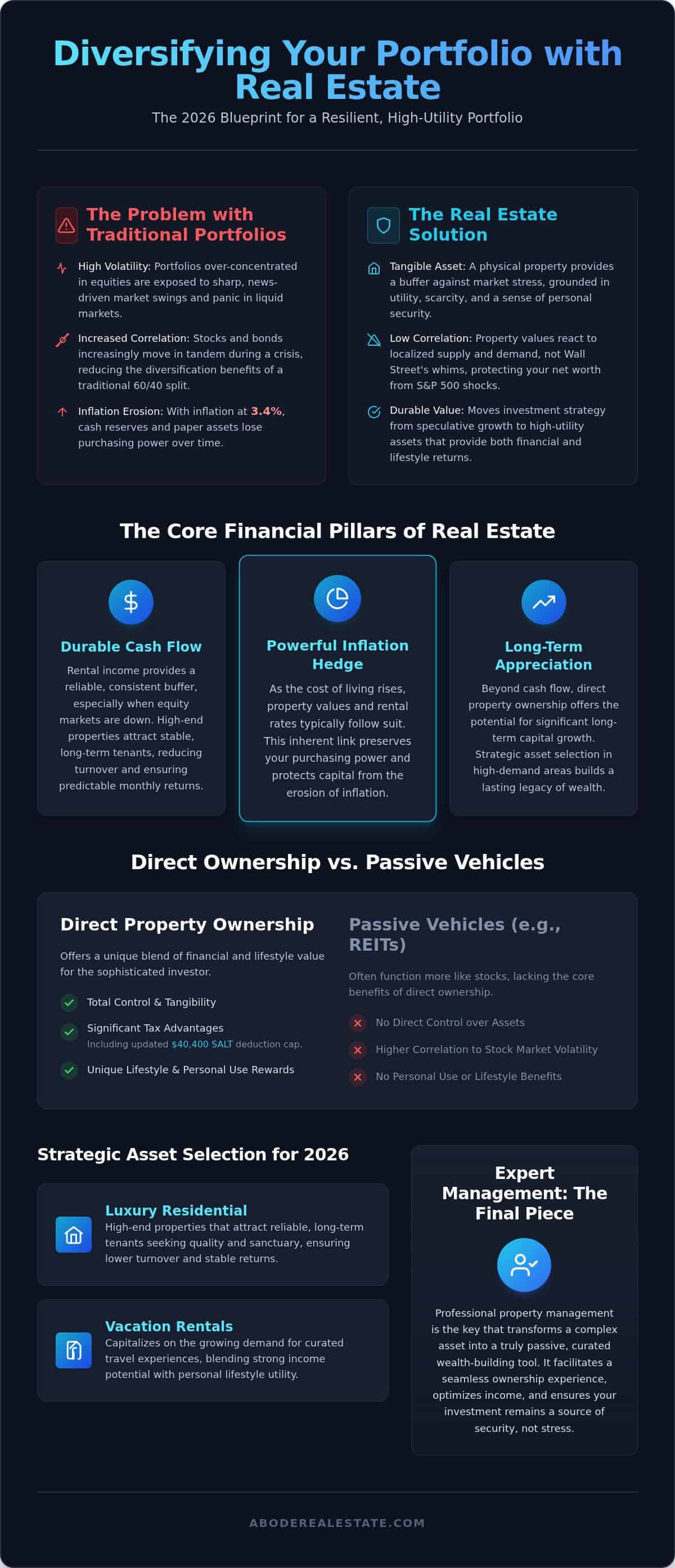
In 2026, the definition of a balanced portfolio has shifted away from the traditional 60/40 split. Sophisticated investors no longer view property as a secondary addition; it's a central pillar of wealth preservation. Diversifying investments with real estate provides a tangible counterweight to the often ephemeral nature of digital assets and paper wealth. While market stress frequently triggers panic in liquid markets, physical property has historically offered a buffer grounded in utility and scarcity. It's about moving from speculative growth to a strategy centered on durable, high-utility assets that provide both financial and lifestyle value. This approach is a hallmark of sophisticated wealth, transforming capital into a lasting legacy of stability.
The Problem with Over-Concentration in Equities
Relying solely on traditional stocks and bonds has become increasingly precarious in the modern economy. As global markets become more interconnected, the correlations between these once-distinct asset classes have tightened, meaning they often fall in tandem during a crisis. This leaves many investors exposed to significant volatility. With the annual inflation rate reaching 3.4 percent for the 12 months ending July 2026, the erosion of cash value is a very real threat that requires more than just "paper" solutions. Real estate serves as a physical anchor. It provides emotional security because it's an asset you can see, touch, and control. This sense of personal retreat and physical ownership offers a level of reassurance that a brokerage statement simply cannot match, turning a financial hurdle into a curated move toward peace of mind.
Real Estate as a Non-Correlated Asset
Low correlation is the secret to reducing total portfolio variance and protecting your net worth from sudden shocks. Essentially, it means the value of your property doesn't move in lockstep with the S&P 500. While a piece of negative economic news might cause a sharp sell-off in the tech sector, your high-end residential holdings react to localized supply, demand, and specific community trends. In the current 2026 landscape, low correlation describes how high-end property values remain anchored by localized demand and lifestyle utility even when global equity markets experience rapid, news-driven sell-offs. Engaging in strategic real estate investing allows you to capture value that is independent of Wall Street's whims. By utilizing expert investment property acquisition strategies, you ensure that your portfolio remains resilient. This non-correlated nature ensures that when one asset class retreats, your tangible holdings stand firm, protecting your overall capital and providing a steady foundation for growth.
The Core Financial Pillars of Real Estate Diversification
While the non-correlated nature of property provides a defensive shield, the true power of diversifying investments with real estate lies in its multi-dimensional financial returns. Unlike equities, which often rely on singular price movements, real estate functions through a combination of yield, appreciation, and tax efficiency. It's a sophisticated structure that turns capital into a living, breathing financial engine. By understanding the pros and cons of real estate diversification, you can move beyond simple ownership toward true asset optimization. This strategy focuses on building a foundation that thrives regardless of broader market cycles.
Generating Consistent and Durable Cash Flow
Rental income serves as a reliable buffer when equity markets enter a down-cycle. This cash flow functions much like a dividend but often with greater stability and tax advantages. It's vital to distinguish between gross revenue and net operating income; a sophisticated strategy accounts for all carrying costs to ensure the yield is truly durable. Active management is the primary driver of these stable returns. High-end properties tend to attract more reliable, long-term tenants who value the same sense of sanctuary and quality that you do. This alignment of interests reduces turnover and maintenance friction, ensuring your monthly distributions remain predictable and stress-free.
Real Estate as a Hedge Against Inflation
Physical property has an inherent relationship with rising consumer prices. As the cost of living increases, property values and rental rates typically follow suit, preserving your purchasing power in real terms. Lease structures, particularly in high-demand residential sectors, allow for periodic rent adjustments that keep pace with the 3.4 percent annual inflation rate observed in 2026. Because land is a finite and appreciating resource, its value is anchored by physical scarcity rather than monetary policy. Protecting your wealth through tangible asset ownership ensures that as the dollar's value shifts, your underlying equity remains robust. This hedge is a critical component of a resilient portfolio, providing a natural lift to your net worth during inflationary periods.
Beyond cash flow and inflation protection, real estate offers unique tax advantages that other asset classes simply can't match. Through the strategic optimization of property-related expenses and the use of depreciation, you can often shield a significant portion of your rental income from immediate taxation. When paired with safe, calculated leverage, these pillars allow you to amplify your investment capacity without compromising your financial security. If you're ready to explore how these financial mechanics can work for your specific goals, you might consider reaching out to a refined local expert to begin your transition into high-end property ownership.
Direct Real Estate Ownership vs. Passive Investment Vehicles
Choosing the right vehicle for your capital is as much an art as it is a financial decision. While many investors start with public markets, diversifying investments with real estate requires a choice between the liquid convenience of Real Estate Investment Trusts (REITs) and the tactile control of direct ownership. Sophisticated individuals often find that while funds offer a seat at the table, direct ownership provides the keys to the room. It's the difference between being a spectator and a curator of your own wealth. This precision allows you to select assets that don't just exist on a balance sheet but serve as a physical foundation for your family's future.
The Advantages of Direct Property Control
Direct ownership allows you to treat your investment as a refined craft. You have the power to make tactical improvements, from aesthetic upgrades to structural enhancements, that immediately influence the asset's value and appeal. This isn't just about spreadsheets; it's about the security of owning a high-utility dwelling that functions as both a financial pillar and a personal retreat. When you engage in luxury residential sales, you're acquiring a specific piece of the world that aligns with your lifestyle and generational goals. This path also unlocks tax benefits unique to direct holders, such as the ability to manage depreciation recapture, which is capped at 25 percent for unrecaptured Section 1250 gains. It's a vehicle for generational wealth transfer that offers a sense of pride and permanence that paper assets cannot match.
Evaluating REITs and Real Estate Funds
REITs serve a specific purpose in a broader diversification strategy. They offer high liquidity and, as of March 2026, a one-year average dividend yield of 3.98 percent. However, this liquidity comes with a trade-off. REITs often correlate more closely with the broader stock market, meaning they can experience price swings that have more to do with investor sentiment than the underlying property value. You lose the ability to influence specific management decisions or enjoy the curated use of the asset. For many, the most resilient approach involves combining the ease of passive funds with the precision of direct luxury acquisitions. This ensures your portfolio remains liquid enough for opportunities while anchored by the stability of physical assets. When paired with professional property management, direct ownership becomes a frictionless experience that mirrors the passivity of a fund without sacrificing the benefits of control.
Strategic Asset Selection: Identifying High-Growth Sectors
While institutional giants often pivot toward industrial logistics or data centers, the individual seeking a more curated approach finds greater resilience in sectors that offer personal resonance. Diversifying investments with real estate is most potent when you look beyond the obvious. It's about identifying high-barrier markets where geography or zoning limits new supply, ensuring your asset remains exclusive. This strategic selection transforms a simple purchase into a calculated move toward long-term security. Success here depends on the details. By targeting areas where demand is persistent and supply is finite, you position your capital in the path of inevitable growth.
The Luxury Residential Sector
High-end residential properties act as a unique store of value during economic shifts. Unlike mass-market housing, premium dwellings are anchored by a demographic that prioritizes quality and location over short-term price fluctuations. These homes are more than just assets; they are physical retreats that provide emotional security. By exploring our luxury residential collections, you can see how architectural excellence and prime positioning create a buffer against volatility. Balancing personal utility with capital gains turns a dwelling into a legacy asset that grows with your family. It's a transition from a financial hurdle to a curated life chapter.
Short-Term and Vacation Rental Opportunities
For those seeking higher immediate yields, the short-term rental market provides a compelling alternative for those diversifying investments with real estate. By capturing nightly rates in sought-after destinations, you can often achieve a higher return on investment than a monthly contract would allow. This sector requires a focus on the guest experience and meticulous management to ensure consistent performance through seasonal cycles. Utilizing sophisticated investment property acquisition strategies helps you identify properties with the right mix of charm and accessibility. It's a way to turn a beautiful escape into a productive financial engine that serves your portfolio year-round. Precision in selection is everything.
Integrating boutique commercial spaces or high-end residential assets requires a facilitator who understands the essential character of a market. If you're ready to identify your next high-growth asset, you can view our current investment opportunities and begin your journey toward a more resilient and lifestyle-oriented portfolio.
Building a Resilient Portfolio through Expert Management
The true success of diversifying investments with real estate isn't found just in the purchase price; it lives in the stewardship of the asset over time. For the sophisticated owner, the goal is to detach the financial rewards of property from the daily operational grind. This shift transforms a complex physical holding into a truly passive investment vehicle, allowing your capital to work while you focus on your legacy. Professional oversight is the silent engine of this process. It ensures that every tactical detail, from tenant relations to preventative maintenance, is handled with the precision of a refined craft. This intentional approach protects your asset's value while providing the peace of mind that comes with expert facilitation.
The Necessity of Full-Service Property Management
Many investors equate property ownership with a second full-time job, but this is a misconception born from a lack of professional support. By utilizing full-service property management, you remove the operational burden entirely. This includes rigorous professional screening to reduce financial risk and the coordination of high-end maintenance to preserve the asset's pristine condition. Such oversight is vital for ensuring long-term capital appreciation, as it prevents the minor wear of today from becoming the costly renovation of tomorrow. It's about creating a frictionless experience where your only interaction with the property is the arrival of your monthly distribution. Your asset remains a sanctuary of wealth rather than a source of stress.
Selecting a Boutique Advisory Partner
Selecting the right partner is the final, most critical step in diversifying investments with real estate for 2026. While large national franchises often take a clinical, transactional approach, a boutique advisory offers a relationship-based model that prioritizes your specific financial goals. A high-level facilitator acts as a well-connected guide, providing deep market insights that go beyond simple data points to capture the spirit and potential of a community. This personalized attention ensures that your portfolio isn't just a collection of properties, but a curated selection of assets that reflect your values. If you're ready to move beyond paper wealth, our team is available to provide a bespoke investment analysis tailored to your unique objectives. This marks the transition from a financial hurdle to a curated life chapter, where your wealth is both tangible and secure.
Architecting a Legacy of Enduring Value
The transition from traditional equity concentration to a resilient, property-backed portfolio is a curated move toward long-term security. We've explored how physical assets provide a non-correlated buffer against market volatility and how direct ownership unlocks unique tax efficiencies that paper assets simply cannot match. Diversifying investments with real estate allows you to capture both steady monthly cash flow and significant capital appreciation without the daily stress of active landlording. It's about choosing high-growth sectors that resonate with your lifestyle while enjoying the benefits of a tangible, finite resource. This strategy ensures your wealth is anchored by utility and scarcity.
Abode Real Estate facilitates this transition through boutique expertise in high-end property acquisition and comprehensive management services designed for truly passive ownership. Our team is dedicated to aligning every asset with your specific financial objectives, ensuring your investment serves as a physical sanctuary of wealth. You deserve a partner who views technical expertise as a refined craft and treats your goals with personalized, hands-on attention. Begin your journey into luxury real estate investment with Abode Real Estate and step into a new chapter of curated growth. The path to a more stable and meaningful financial future is waiting for you.
Frequently Asked Questions
At what point should I start diversifying investments with real estate?
You should consider adding real estate to your portfolio once you've established a solid foundation of liquid assets and are seeking to mitigate stock market volatility. This transition usually happens when you have sufficient capital for a high-end down payment without compromising your emergency reserves. Starting early allows you to capture the dual benefits of long-term capital appreciation and the compounding effect of rental yields over several market cycles.
How does real estate diversification protect against a stock market crash?
Real estate functions as a non-correlated asset, meaning its value is driven by localized supply and demand rather than Wall Street sentiment. During a crash, physical property maintains its intrinsic utility and doesn't experience the same rapid, knee-jerk sell-offs seen in liquid equities. Because real estate is a slower-moving market, it provides a stabilizing anchor that prevents your total net worth from swinging wildly during periods of financial panic.
What is a typical recommended allocation for real estate in a portfolio?
Many sophisticated investors target an allocation between 10 and 20 percent of their total net worth for physical property. This range provides enough exposure to benefit from tax advantages and durable cash flow while ensuring you maintain enough liquidity in other sectors. Your specific percentage depends on your risk tolerance and whether your primary goal is immediate monthly income or the curation of a generational legacy.
Can I invest in real estate through an IRA or 401k?
You can invest in physical property through a Self-Directed IRA, which allows you to purchase residential or commercial assets using retirement funds. This structure requires that all income and expenses flow directly through the account to maintain its tax-advantaged status. It's a powerful strategy for using tax-deferred capital to acquire high-utility assets that build wealth without the immediate friction of personal income taxes on rental revenue.
How do the tax benefits of direct ownership compare to REITs?
Direct ownership offers superior tax flexibility through depreciation and the ability to utilize 1031 exchanges for future transitions. While REIT dividends are often taxed as ordinary income, direct owners can use non-cash depreciation to shield a significant portion of their rental revenue from taxation. Additionally, the 2026 SALT deduction cap of $40,400 provides a higher threshold for deducting state and local property taxes compared to previous years.
What are the risks of diversifying investments with real estate?
The primary risks include liquidity constraints and the potential for localized economic shifts that affect property values. Unlike stocks, selling a physical asset takes time and involves transaction costs that require a longer-term holding period. Diversifying investments with real estate also requires careful selection to avoid high-maintenance properties. Partnering with a boutique advisory helps mitigate these risks through precise market analysis and professional management of the asset's lifecycle.
How do I manage an investment property if I live in a different state?
Remote ownership is most effectively handled through a full-service property management partner who acts as your refined local expert. They handle everything from tenant screening to emergency repairs, ensuring the asset remains in pristine condition without requiring your physical presence. This model transforms the property into a truly passive vehicle, allowing you to enjoy the lifestyle and financial benefits of ownership regardless of where you reside.
Is real estate still a good inflation hedge in 2026?
Real estate remains an exceptional hedge in 2026, especially with the annual inflation rate sitting at 3.4 percent as of August. As consumer prices rise, rental rates and property values typically increase in tandem, which preserves your purchasing power in real terms. Because land is a finite resource, its value is anchored by physical scarcity rather than monetary policy, making it far more resilient than currency-based assets during inflationary periods.
Posted by Brook Walsh onEnjoy this blog post? Click here to subscribe for updates
Leave A Comment