

The true cost of a rental property is rarely found on a balance sheet; it's measured in the hours spent screening applicants and the quiet anxiety of a midnight maintenance call. Many investors eventually reach a crossroads where they must ask, do I need a property manager for my rental to protect both my time and my sanity? It's a pivotal moment that transforms a demanding second job into a sophisticated investment strategy.
You likely started this journey seeking the freedom of passive income, yet you've found yourself navigating a complex web of tenant-landlord laws and rising vacancy concerns. It's exhausting to balance asset preservation with the daily grind of operations. This 2026 guide offers a strategic framework to help you decide between the hands-on DIY approach and the refined oversight of professional management, ensuring you maximize your ROI without sacrificing your lifestyle. We will examine the shifting national rental benchmarks, the latest legal protections, and the precise indicators that it's time to transition your property into a truly passive asset.

Key Takeaways
- Assess the daily operational demands of independent management to determine if you're prepared for the 24/7 commitment of maintenance and tenant relations.
- Discover a strategic framework to help you answer Do I need a property manager for my rental by analyzing how professional oversight impacts your long-term return on investment.
- Recognize the specific logistical triggers, such as property distance and portfolio complexity, that signal the need for a more sophisticated management model.
- Learn how professional marketing and proactive maintenance strategies work together to minimize vacancy rates and preserve the integrity of your real estate assets.
- Evaluate the benefits of a customized, boutique management plan that prioritizes high-touch service and strategic financial alignment over a one-size-fits-all approach.
Table of Contents
- Evaluating the True Demands of Independent Rental Management
- The Strategic Value of Professional Asset Oversight
- DIY vs. Professional Management: A Comparative ROI Framework
- Determining if a Property Manager is Essential for Your Portfolio
- Elevating Your Experience with Boutique Property Management
Evaluating the True Demands of Independent Rental Management
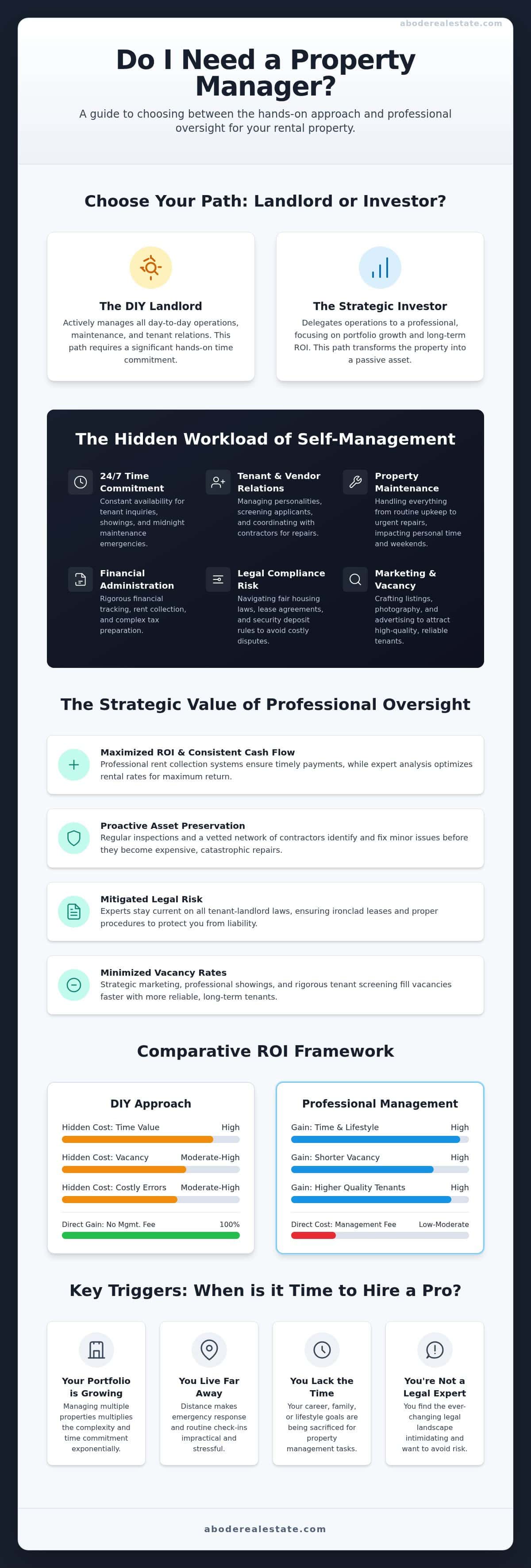
Transitioning from a passive property owner to an active professional landlord requires a fundamental shift in perspective. You're no longer just holding an asset; you're operating a high-stakes service business that demands constant attention. This reality often prompts the question, do I need a property manager for my rental, particularly when the initial excitement of ownership meets the daily friction of operations. Managing a property independently means accepting a role that is perpetually on-call, where the boundary between your personal life and your investment portfolio begins to blur.
The administrative side of landlording is equally demanding. Beyond the occasional rent check, you'll need to master detailed financial tracking and rigorous tax preparation for your rental income. Marketing your property effectively also requires a sophisticated touch. Simply posting a listing on a single site isn't enough to secure reliable, high-quality tenants in a competitive market. It takes a curated approach to photography, description, and placement to ensure your asset stands out and attracts the right audience.
To better understand the weight of these responsibilities and the alternative paths available, watch this helpful video:
The hidden time commitment of daily operations
The hours required to manage a rental property successfully are often underestimated. A self-managed property can demand significant weekly attention, from the initial hours spent responding to tenant inquiries to the long afternoons conducting property showings. Once a tenant is in place, the work doesn't stop. You become the primary coordinator for every vendor, managing the logistics of routine maintenance and emergency repairs alike. This constant coordination can interrupt your professional focus and steal away your weekends. It’s a heavy trade-off for those who originally sought a lifestyle of freedom through real estate.
Navigating the complex landscape of legal compliance
The legal environment surrounding rental properties is increasingly intricate and carries substantial risk for the uninformed owner. Staying current with evolving fair housing regulations is a non-negotiable requirement to avoid devastating legal penalties. Improperly drafted lease agreements or the mishandling of security deposits can lead to expensive disputes that erode your profits. Professional-grade tenant screening is a vital tool in this area, helping to mitigate future legal issues before they even begin. For those seeking a more secure path, exploring full-service property management can provide the legal protection and peace of mind necessary to truly enjoy the benefits of your investment.
The Strategic Value of Professional Asset Oversight
Professional property management isn't a mere administrative service; it's the comprehensive oversight of a real estate asset by a specialized third-party firm. This partnership transforms your property from a source of labor into a high-performing investment. When considering whether you need a property manager for your rental, it's vital to view the relationship through the lens of asset optimization. It's about shifting from a reactive stance to a proactive strategy that prioritizes the health of your portfolio.
Consistent cash flow is the heartbeat of any successful rental. Professional rent collection systems remove the emotional friction from the process, ensuring payments are timely and predictable. This operational excellence is paired with detailed financial reporting, providing the absolute clarity you need to refine your investment strategy and track your ROI with precision.
Beyond rent collection: proactive maintenance and preservation
Maintenance is a craft, not just a reaction to breakage. Regular, scheduled inspections serve as the first line of defense, identifying minor issues before they evolve into catastrophic, expensive repairs. A boutique management approach utilizes a vetted network of high-quality contractors who understand the unique requirements of high-end residential assets. This ensures the aesthetic and functional integrity of your home remains uncompromised. Preserving the long-term value of your investment requires this level of precision and care.
Sophisticated tenant screening and placement
Finding the right occupant is an exercise in precision. Professional methodology goes deep into background and credit evaluations, ensuring only the most reliable individuals are entrusted with your asset. High-quality placement is the most effective way to reduce turnover, which research indicates is often a landlord's highest variable cost. To attract these premium renters, we employ professional photography and curated staging, presenting your property as a lifestyle destination rather than just a dwelling. This elevated presentation is what separates a standard rental from a sought-after residence.
The right management partner doesn't just manage; they facilitate growth. If you're looking to expand your portfolio, understanding these operational metrics is the first step in successful investment property acquisition and long-term wealth building. By delegating the daily complexities, you free yourself to focus on the high-level decisions that define your financial future.
DIY vs. Professional Management: A Comparative ROI Framework
Many investors view management fees through a strictly transactional lens, seeing only a percentage of gross rent deducted each month. This perspective misses the strategic reality of wealth preservation. When you ask whether I need a property manager for my rental, the answer lies in a comparative ROI framework that accounts for both visible expenses and invisible losses. It’s a shift from counting pennies to optimizing an entire financial ecosystem.
Analyzing management fees against vacancy costs
The math of vacancy is unforgiving. For a residence commanding $3,000 in monthly rent, each day of vacancy represents a $100 loss. A three-week delay in finding a tenant costs you $2,100, a sum that often exceeds several months of management fees. Professional managers mitigate this risk through data-driven pricing and aggressive marketing strategies that ensure your asset doesn't sit idle. While a DIY owner might struggle with a slow timeline for screening and coordination, a professional team operates with a sense of urgency and a refined process that targets high-occupancy rates year-round.
The impact of professional marketing on rental yields
Professional listing optimization does more than just find a tenant; it attracts the right tenant at a premium price point. By leveraging high-resolution photography and placement on multiple listing platforms, professional managers expand the reach of your property to a broader, more affluent audience. This increased competition often leads to higher monthly rental rates that can effectively neutralize the cost of the management fee itself. Professional managers frequently achieve higher yields that offset their fees, turning the service into a self-funding investment rather than a traditional cost.
The final calculation must include the fiscal benefits of tax deductibility. Because these fees are categorized as a business expense, the net impact on your cash flow is often lower than the headline percentage suggests. Determining do I need a property manager for my rental involves more than just looking at a fee schedule; it requires evaluating the value of your own time. Reclaiming your personal weekends and removing the burden of maintenance emergencies provides a level of freedom that is rarely captured on a balance sheet but is essential for a curated lifestyle. For those seeking this level of liberation, exploring full-service property management is the first step toward a more sophisticated investment experience.
Determining if a Property Manager is Essential for Your Portfolio
Deciding whether to delegate your property's care isn't just about cost; it's about the alignment of your investment with your lifestyle. You must ask, do I need a property manager for my rental based on the physical and operational realities of my daily life? If your portfolio feels like an anchor rather than a sail, it's time to evaluate the specific factors that make professional intervention essential. This decision often hinges on your location, the number of units you hold, and the specific category of rental you operate.
Assessing your proximity and availability
Proximity is often the most practical decider in this process. Managing a property when you live more than 30 minutes away is a logistical gamble that often ends in frustration. High-end property preservation relies on rapid emergency response times, which are nearly impossible to guarantee when you're stuck in traffic or across state lines. A local representative provides the boots-on-the-ground presence necessary for regular property inspections and seamless vendor access. This physical presence isn't just a convenience; it's a vital safeguard for your asset's value.
Evaluating the scale and complexity of your assets
Complexity grows exponentially with each new acquisition. While one long-term lease might feel manageable, a growing portfolio eventually reaches a tipping point where the administrative details become overwhelming. This is especially true when you contrast the steady rhythm of a yearly lease with the high-intensity demands of vacation rentals. Short-term assets require constant guest communication, frequent turnovers, and a level of hospitality that mirrors a boutique hotel. If you're currently browsing luxury homes for rent to benchmark your own investment, you'll see the level of polish required to compete in a sophisticated market.
Your personal interest and expertise in handling maintenance or tenant disputes should also be a primary consideration. If the thought of negotiating a security deposit or coordinating a roof repair fills you with dread, you aren't just losing time; you're losing the peace of mind that your investment was supposed to provide. When you evaluate the question, do I need a property manager for my rental, the answer often reveals itself in the value you place on your own tranquility. Professional managers act as a high-level facilitator, shielding you from the friction of daily operations while ensuring your financial objectives remain on track. This allows you to maintain the role of the strategic owner rather than the harried landlord.
To see how a tailored approach can transform your ownership experience and simplify your life, reach out to Abode Real Estate to discuss a customized management plan that fits your specific needs.
Elevating Your Experience with Boutique Property Management
At Abode Real Estate, we believe every property is more than a structure; it's a unique and valuable asset that deserves a bespoke management approach. When you contemplate do I need a property manager for my rental, the decision often rests on the level of care you expect for your investment. We move beyond the clinical, volume-based models of national franchises to offer a philosophy centered on arrival and belonging. This isn't just about oversight; it's about a curated lifestyle choice that aligns your real estate holdings with your broader financial objectives through customized management plans.
Our team acts as a high-level facilitator rather than a traditional service provider. We prioritize transparent communication and high-touch service, ensuring you remain informed without being overwhelmed by the daily friction of operations. This intentional, unhurried pace of communication is designed to reduce the anxiety often associated with complex property transactions, providing you with a sense of ease and total control over your portfolio's direction.
Personalized care for high-end residential assets
The distinction between a boutique brokerage and a large franchise is found in the precision of the service and the depth of the relationship. While national companies often treat properties as numbers in a database, our high-touch model ensures that every interaction is personal and client-centric. This specialized focus is especially critical for luxury homes, where tenant screening must be tailored to match the specific caliber of the residence. By choosing full-service property management, you're opting for a partner who values the aesthetic and functional integrity of your home as much as you do.
Seamless transitions from acquisition to management
Our expertise doesn't begin when the lease is signed; it starts at the very moment of acquisition. We integrate our deep knowledge of investment property analysis directly into our management strategy from day one. This continuity ensures that the tactical planning used during the purchase phase informs the daily operations and long-term preservation of the rental. Working with a team that understands both sales and management provides a frictionless experience that protects your ROI. If you are developing your portfolio, understanding these investment property acquisition strategies allows you to build wealth with the confidence that your assets are being managed by a trusted advisor. Abode Real Estate treats technical expertise as a refined craft, elevating the mechanical aspects of the industry into a more sophisticated and reliable discipline.
Cultivating a Legacy of Passive Ownership
Choosing the right path for your investment is a decision that defines your daily life as much as your financial trajectory. By shifting from the reactive labor of self-management to a strategic partnership, you transform your property into a high-performing asset that supports your freedom. We've explored how the comparative ROI framework and your own proximity to the property often provide the clearest answer to the question, do I need a property manager for my rental? Whether you hold long-term residential leases or complex vacation rentals, the transition to professional oversight is a curated move toward long-term asset preservation.
As a boutique luxury real estate firm led by local market experts, Abode Real Estate offers specialized investment property analysis and full-service management for both long-term and vacation rentals. We invite you to contact our boutique management team today to discover how a tailored approach can elevate your experience. Your journey toward effortless ownership and optimized wealth begins with a single, intentional step. We look forward to guiding you through this next chapter of your investment story.
Frequently Asked Questions
How much do property managers typically charge for residential rentals?
Industry standards suggest monthly management fees generally range between 8% and 12% of collected rent, though some firms offer a flat-fee structure starting around $100 per month. It's important to account for the total first-year cost, which often reaches 18% to 20% of gross annual rent when including leasing and setup fees. These initial investments cover the intensive work of marketing, screening, and onboarding that secures the long-term health of your asset.
Can I still be involved in major decisions if I hire a property manager?
Yes, a professional management agreement is designed to act as an extension of your goals, not a replacement for your authority. You typically retain full control over high-level decisions, such as approving major capital improvements or selecting the final tenant from a curated shortlist. A boutique firm facilitates these transitions by providing the data and expert analysis you need to make informed choices, ensuring you remain the strategic lead of your portfolio.
What is the difference between property management and a leasing agent?
A leasing agent focuses exclusively on the front-end transaction of finding and placing a tenant, while property management provides continuous, comprehensive oversight. While a leasing agent's role ends once the contract is signed, a manager handles the ongoing relationship, including maintenance, legal compliance, and financial reporting. When asking do I need a property manager for my rental, consider whether you need a one-time placement or a long-term steward for your investment.
Do property managers handle evictions and legal disputes?
Professional managers are equipped to navigate the complexities of legal disputes and the eviction process on your behalf. They stay current with evolving fair housing regulations and local ordinances to ensure every step is handled with precision and integrity. By acting as a buffer between you and the tenant, they mitigate the emotional stress of these situations while providing the documentation necessary to protect your interests and preserve your financial standing.
How does hiring a manager affect the profitability of my investment property?
While management fees represent an immediate expense, a skilled manager often enhances overall profitability by reducing vacancy periods and securing higher rental rates. Their proactive maintenance strategies prevent minor issues from becoming costly repairs, and their rigorous tenant screening reduces the risk of non-payment. This optimization ensures that your asset remains a high-performing source of income, frequently offsetting the cost of the service through improved operational efficiency and asset preservation.
What should I look for when interviewing a property management company?
Prioritize firms that demonstrate deep expertise in investment property analysis and offer a transparent fee schedule without hidden markups. You should look for a boutique approach that values personalized, high-touch service over high-volume franchise models. Ask about their vendor network, their specific methodology for tenant screening, and how they handle emergency maintenance. A trusted advisor will project calm confidence and provide clear evidence of their commitment to long-term client relationships.
Is property management necessary for short-term vacation rentals?
Short-term assets demand a significantly higher level of operational intensity, making professional oversight almost essential for long-distance owners. These properties require constant guest communication, frequent turnovers, and specialized marketing to maintain high occupancy. Fees for vacation rental management typically range from 20% to 35% of rental income, reflecting the complexity of hospitality services. This level of care ensures your property functions as a luxury destination rather than a source of constant labor.
Are property management fees tax-deductible for landlords?
Yes, the Internal Revenue Service generally classifies property management fees as a necessary business expense for rental property owners. This means you can typically deduct these costs from your gross rental income, which effectively reduces your taxable liability. When evaluating do I need a property manager for my rental, this tax benefit is a critical factor that lowers the net impact of the fee on your annual cash flow and improves your overall return.
Posted by Brook Walsh onEnjoy this blog post? Click here to subscribe for updates
Leave A Comment