

Selling may seem like the clearest way to exit a property, but it isn’t always the move that best supports your next goal. The strongest exit strategies for real estate investors begin with a decision framework, not a single fixed outcome. Holding, refinancing, selling, or repositioning can each make sense, depending on the property, your priorities, and the conditions when you’re ready to act.
If you’re weighing potential net proceeds against future cash flow, or wondering whether continued ownership is worth the management demands, that uncertainty is understandable. A plan that works today may need an alternative if market conditions or financing options change. Flexibility matters.
This guide will help you compare principal exit options against your investment goals, time horizon, and appetite for ongoing responsibility. You’ll learn which figures and assumptions to review, where tax or legal questions call for qualified professional advice, and how to prepare a primary plan with realistic alternatives. The aim is to make a considered next move, whether that means selling an asset or continuing to make it work for you.

Key Takeaways
- Compare exit strategies for real estate investors by what changes: ownership, financing, property use, or day-to-day operations.
- Evaluate each route against your goals, time horizon, liquidity needs, workload, and uncertainty rather than relying on headline value alone.
- Use property-specific assumptions to compare scenarios, and verify market, financing, and transaction figures before making a decision.
- Document a primary plan, a feasible alternative, and the conditions that would prompt you to reassess.
- Bring in relevant real estate, tax, legal, or financial professionals to review specialized questions before you act.
Table of Contents
- What Are Exit Strategies for Real Estate Investors, and Why Plan Early?
- Which Real Estate Investment Exit Strategies Can You Consider?
- How Do You Compare Exit Strategies for Your Property and Goals?
- How Do You Build and Update a Real Estate Exit Plan?
- How Can You Move from an Exit Decision to a Confident Next Step?
What Are Exit Strategies for Real Estate Investors, and Why Plan Early?
An exit strategy is a planned route for realizing value from an investment or changing its ownership or operation. It might involve selling, continuing to own the property under a different operating approach, or considering another option that fits your circumstances. As an overview of real estate investing illustrates, investors can pursue different approaches, including selling. The right path depends on the asset and the investor’s aims. Exit strategies for real estate investors make that choice deliberate rather than a reaction to pressure.
An urgent sale can follow a sudden need for liquidity, an unexpected expense, or a change in personal circumstances. An exit plan considers options before pressure narrows them. A primary route and a credible alternative can help you prepare for changing conditions, but neither guarantees a particular price, return, or timeline.
For a concise overview of common approaches, watch Top 3 Exit Strategies Every Real Estate Investor Needs To Know About from Real Estate Wealth Coaching:
When should an investor start planning an exit?
Start before acquisition. Test whether a plausible exit fits your purchase assumptions, the property’s condition, and your objectives. For example, if your plan depends on selling after improving the property, consider whether it would still be feasible if the work took longer or buyer demand changed. Treat this as a scenario to evaluate, not a forecast.
Exit planning begins before acquisition and should be revisited as circumstances change. An initial plan isn’t a fixed deadline or a guaranteed result. Reassess it if your finances, priorities, the property’s condition, or market and financing assumptions shift. Verify current information before relying on it.
What should an exit plan aim to protect?
Define what a satisfactory outcome means before comparing strategies. Consider your investment horizon, liquidity needs, income goals, and tolerance for uncertainty. Also weigh the time and responsibility required to keep operating the property. A rental may support your income goals, but its management demands may no longer suit the time you have available.
Ownership doesn’t have to mean handling every operational task yourself. Professional property management may be one factor to assess when comparing continued ownership with a sale or operational change. For example, you could consider whether full-service property management fits your continued-ownership plan. The useful question isn’t simply, “What can I sell for?” It’s, “Which outcome best supports my goals, given the trade-offs I’m willing to accept?”
Which Real Estate Investment Exit Strategies Can You Consider?
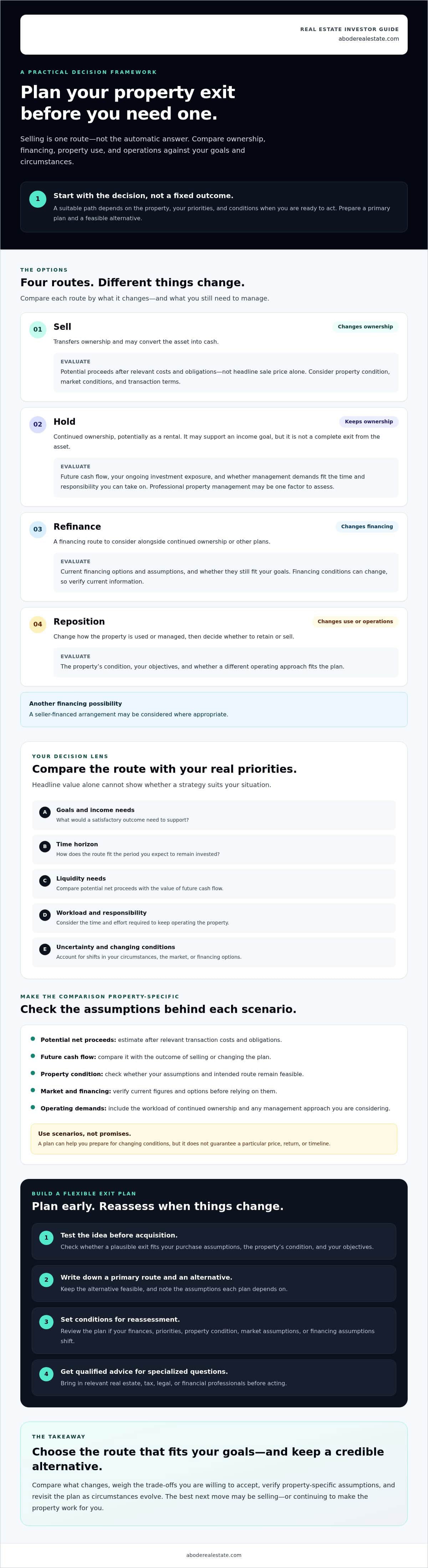
Exit options are easier to compare when you separate what changes: ownership, financing, property use, or the operating approach. A sale transfers ownership. Holding keeps you invested. Refinancing changes the financing, while repositioning changes how the property is used or managed. These routes aren’t interchangeable, and none is best for every investor. Their suitability depends on the property’s condition, your objectives, and assumptions you’ve verified.
- Ownership: Sell the property outright, or continue owning it, perhaps as a rental.
- Financing: Consider refinancing or, where appropriate, a seller-financed arrangement.
- Use or operations: Reposition the property or change its management approach, then decide whether to retain or sell.
How do selling and continued ownership differ as exit routes?
An outright sale transfers ownership and may convert the asset into cash, but assess the result using transaction-specific figures. Estimate potential proceeds after relevant costs and obligations instead of treating the sale price as the amount you’ll receive. Market conditions, property condition, and the terms of the transaction all matter.
Holding a property for rental income is continued ownership, not a complete exit from the asset. It may support an income goal, but you remain exposed to the investment’s risks and operating demands. Repositioning offers another path: change the property’s use or operations, then decide whether the revised approach justifies retaining or selling it. Assess whether the proposed changes are feasible before committing.
How can financing or structured arrangements change an exit?
Refinancing is a financing decision, not an automatic sale. Depending on available terms and your circumstances, it may change the property’s debt or the capital you can access while you remain the owner. Compare the full terms and implications with your goals. Don’t assume refinancing will be available or that it will improve the investment.
Seller financing may structure a sale so the seller provides financing to the buyer, but it also changes the transaction’s terms and risks. An exchange strategy may be relevant to some investors, but eligibility, documentation, timing, and tax treatment require careful review. Consult qualified tax and legal professionals before relying on either approach, and verify the current requirements that apply to you.
When comparing exit strategies for real estate investors, use the same property-specific facts for each route: condition, expected proceeds or income, operating effort, and the assumptions behind any financing or transaction terms. For continued ownership, you could also consider whether full-service property management aligns with your operating priorities.
How Do You Compare Exit Strategies for Your Property and Goals?
A useful comparison brings your priorities and the property’s realities together. Don’t wait until you need to sell to begin. A rushed decision can leave too little time to verify figures, assess alternatives, or understand operating and transaction costs. Build the comparison while you still have room to choose, then update it as circumstances change.
Which criteria belong in an exit-strategy comparison?
Use the same inputs for every route: estimated net proceeds, potential ongoing income, capital needs, property condition, debt obligations, your preferred timeline, and the time you can commit to operations. Label each figure as known, estimated, or uncertain. Forecasts about future income or sale conditions need verification, not false precision.
| Route | Objective | Time horizon | Liquidity | Effort and uncertainty | Professional input |
|---|---|---|---|---|---|
| Sell | Transfer ownership | Based on transaction timing | Potential proceeds, less transaction-specific costs and obligations | Preparation and sale process; outcome depends on property and market conditions | Real estate, tax, legal, and financial advisers as relevant |
| Hold as a rental | Continue ownership and pursue income | Ongoing, reviewed against your plan | Income may continue, but capital remains tied to the property | Management, maintenance, and income uncertainty | Property management and financial or tax professionals as appropriate |
| Reposition, then reassess | Change use or operations before deciding | Depends on feasibility and execution | May require capital before any later sale or income | Additional coordination, costs, and uncertainty about the outcome | Real estate, legal, tax, and financial professionals as needed |
How should you compare a sale with a hold or repositioning plan?
Choose a shared review period and compare each route across that same horizon. For a sale, estimate proceeds after transaction costs and debt obligations. For a hold, consider expected income alongside operating expenses, maintenance, management needs, and any required capital. For repositioning, account for the time and costs of the proposed change, then test whether the revised operation supports your goals.
Illustrative scenario, assumptions only: Imagine an investor whose property needs attention and who has limited time available. A sale comparison would use current, verified transaction estimates. A hold comparison would include maintenance costs and effort, with professional management considered if appropriate. A repositioning comparison would first test the change’s feasibility and capital requirements. No route can be assessed from headline value alone.
Keep assumptions consistent, including the timeline, cost categories, and treatment of debt. Ask qualified tax, legal, and financial professionals how their advice may affect the comparison. This disciplined approach helps you assess exit strategies for real estate investors against your actual constraints, not an imagined average or promised return.
How Do You Build and Update a Real Estate Exit Plan?
A practical exit plan should be specific enough to guide decisions and flexible enough to change as the investment evolves. Use this repeatable process to connect your original objectives with current property information:
- 1. Define the objective. State what a satisfactory outcome means, such as meeting an income goal, accessing liquidity, or reducing the time spent managing the asset.
- 2. Set your constraints. Record your intended ownership period, available time, capital limits, and tolerance for uncertainty.
- 3. Test the primary route. Use property-specific information to assess whether your preferred option is feasible. Include acquisition assumptions, operating needs, debt obligations, and potential transaction costs.
- 4. Choose a realistic alternative. Identify at least one other route you could pursue if the primary plan no longer fits. Check that it’s feasible, not just appealing in theory.
- 5. Document the evidence. Keep a simple record of estimates, their sources and dates, assumptions that need verification, and questions for your advisers.
- 6. Set review triggers. Note what changes would prompt reassessment, such as a shift in financing terms, property condition, operating results, or personal objectives.
What steps should an investor take before acquiring a property?
Before making an offer, write down your intended ownership period, target outcome, and constraints. Then use information specific to the property to test whether the acquisition, operating approach, and proposed exit remain plausible. For a deeper look at evaluating a potential purchase, review these strategies for acquiring investment properties. A sound plan doesn’t depend on a single optimistic assumption.
When should an investor revisit the original exit plan?
Choose review dates that suit the investment rather than relying on a universal schedule. Reassess sooner if financing, the property’s condition, operating results, or your priorities materially change. Compare your primary route with the alternative using updated information, and record what has changed and what remains uncertain. Reviewing your options before a decision becomes urgent leaves more room for careful evaluation.
Thoughtful planning makes exit strategies for real estate investors an ongoing decision process, not a document that sits untouched after closing. For a property-specific perspective, Abode Real Estate provides investment property analysis.
How Can You Move from an Exit Decision to a Confident Next Step?
Once you’ve selected a likely route, turn the decision into a practical handoff. A sale calls for organized property information and a clear understanding of transaction assumptions. Continued rental ownership calls for a workable operating plan. A change in use or management calls for a feasibility check before you commit resources. Each path raises different questions, so careful coordination can help surface them early.
What should you prepare before selling or changing property operations?
Bring together the information that will help professionals assess your situation accurately:
- Property records and information about its current condition.
- Income, expense, debt, and other financial assumptions, clearly identified as estimates or verified figures.
- Operating details, including maintenance needs, management responsibilities, and any planned changes.
- Unresolved questions about timing, transaction terms, taxes, or legal considerations.
A real estate professional can help you evaluate sale or operating considerations. A qualified tax professional, attorney, or financial adviser may also be relevant, depending on your circumstances. Ask each adviser to address questions within their expertise. Tax and legal implications should be assessed for your specific transaction, not assumed from a general example.
If continued rental ownership remains under consideration, compare self-management responsibilities with professional support. Abode’s full-service property management overview describes this operational option. If a future purchase is part of your next chapter, review its assumptions with the same care you’d bring to your current investment.
How can professional support help investors choose their next step?
Property analysis can help organize the factors behind a sale, a hold, or a change in operating approach. It can’t guarantee a particular outcome, but it may clarify what needs verification and which trade-offs deserve closer attention. Real estate expertise can inform property and transaction considerations, while tax, legal, and financial advisers can address specialized questions.
As you weigh exit strategies for real estate investors, anchor the decision to your goals and the property’s verified details. A considered next step may be a sale, continued ownership with a different management arrangement, or preparation for another acquisition. Depending on the property and your needs, Abode Real Estate offers investment property analysis and acquisition, residential and commercial sales, and property management.
If you’re ready to discuss your property’s next chapter, connect with Abode Real Estate for a tailored conversation. Bring your priorities, questions, and the information you’ve gathered.
Choose the Next Step That Fits Your Investment
A thoughtful exit plan gives you room to choose rather than forcing a decision under pressure. The right route depends on your goals, the property’s condition, your available time, and assumptions you’ve verified. Compare the likely net outcome of a sale with the income, capital needs, and responsibilities of continued ownership. Keep a credible alternative and revisit both plans when circumstances change.
That’s the value of exit strategies for real estate investors: a flexible framework for deciding whether to sell, hold, or adjust how a property operates. You don’t need to resolve every detail alone. A real estate professional can help assess property and transaction considerations, while qualified tax, legal, and financial advisers can address specialized questions.
Abode Real Estate offers investment property analysis and acquisition, residential sales, and property management as potential support for your next move. If you’re ready to explore your options, contact Abode Real Estate to discuss your investment property’s next step.
Frequently Asked Questions
What is an exit strategy in real estate investing?
An exit strategy is a planned way to realize value from an investment or change its ownership or operation. It might involve selling, continuing to own the property as a rental, refinancing, or repositioning it before deciding what to do next. A clear plan connects the property’s likely options to your goals and constraints. It isn’t a guarantee of a particular price, return, or timeline.
When should real estate investors plan their exit strategy?
Plan before acquiring the property, while you can still assess whether a plausible exit fits the purchase assumptions. Identify a primary route and a feasible alternative, then revisit both if the property’s condition, financing, operating results, or your priorities change. Review dates should suit the investment, not follow a universal schedule. Early planning gives you more opportunity to verify information before a decision becomes urgent.
What are the most common exit strategies for real estate investors?
Common options include selling the property, holding it as a rental, refinancing while retaining ownership, or changing its use or operating approach before deciding whether to keep or sell it. Seller financing or an exchange may also be considered in some circumstances, but each requires transaction-specific review. The most suitable route depends on your objectives, property condition, financial assumptions, and willingness to remain involved.
Is selling a rental property better than holding it?
Neither choice is automatically better. A sale may provide liquidity, but net proceeds depend on transaction-specific costs, obligations, and terms. Holding may continue to generate income, while keeping your capital tied to the asset and requiring ongoing attention to management and maintenance. Compare both routes over the same time horizon, using realistic assumptions. Your liquidity needs, income goals, property condition, and available time can all influence the decision.
Can a real estate investor change their exit strategy after buying?
Yes. An exit plan is a working framework, not a binding promise to follow one route regardless of circumstances. Financing terms, property condition, operating results, or personal objectives may shift after acquisition. Reassess the original assumptions, compare alternatives using current information, and document what has changed. Before acting on tax-sensitive or legal questions, seek advice from qualified professionals familiar with your specific situation.
How do you compare selling, refinancing, and holding a property?
Use the same property information and review period for each scenario. For a sale, estimate net proceeds after relevant costs and obligations. For refinancing, examine proposed terms, debt changes, and any capital that may become available. For holding, compare expected income with operating costs, maintenance, capital needs, and your time commitment. Separate verified figures from forecasts, and ask relevant real estate, financial, tax, or legal professionals to review specialized considerations.
What happens if a real estate investment exit plan no longer works?
Reassess the plan before urgency forces a decision. Identify which assumption changed, such as financing, property condition, operating performance, or your goals, then update estimates and review your alternative. Check whether selling, continued ownership, refinancing, or repositioning remains feasible under current conditions. Keep a record of updated figures, sources, and open questions. Qualified real estate, financial, tax, or legal professionals may help clarify the relevant next steps.
Posted by Brook Walsh onEnjoy this blog post? Click here to subscribe for updates
Leave A Comment