

What if a property’s appeal mattered less than how well it fits the family’s long-term goals, governance, and capacity to oversee it? A family office real estate investment can offer a distinct form of exposure, but direct ownership also brings operating demands, liquidity considerations, and the possibility of concentrated risk. The asset needs to make sense within the portfolio, not just on its own.
Comparing direct ownership with other forms of real estate exposure can be difficult. This guide provides a consistent framework for assessing objectives, property-level risks, due diligence, and ongoing oversight. It also explains how to translate investment goals into practical acquisition criteria and plan for day-to-day operations after a purchase. The aim is to bring more clarity to each stage, from deciding whether a property belongs in the portfolio to establishing how it will be managed.

Key Takeaways
- Set clear family objectives and governance expectations before deciding what role property should play in the portfolio.
- Assess a family office real estate investment through an ordered process, separating documented assumptions from forecasts.
- Compare direct ownership with other real estate exposure by weighing control, liquidity, operating responsibility, and transparency.
- Build a plan for reporting, maintenance, and tenant operations before ownership begins, not after the acquisition.
- Translate family priorities into acquisition criteria, then use property-level analysis and oversight planning to guide execution.
Table of Contents
- What Family Office Real Estate Investment Can, and Cannot, Do
- How to Evaluate a Family Office Real Estate Investment
- Direct Ownership or Other Real Estate Exposure: What Should Families Compare?
- Plan Due Diligence, Ownership, and Ongoing Property Oversight
- Turn a Family Office Property Strategy into a Thoughtful Acquisition
What Family Office Real Estate Investment Can, and Cannot, Do
A family office real estate investment is property exposure selected and overseen in line with a family’s objectives, ownership arrangements, and decision-making process. A family office coordinates resources and decisions around family priorities. For background on the concept, see What is a Family Office?
Direct ownership means holding a specific property and making or delegating decisions about its operation. Broader real estate exposure means investing through vehicles that hold or track property interests without owning that individual asset directly. The distinction matters: direct ownership brings property-level control and responsibilities, while other structures offer a more indirect way to participate.
What role can real estate play in a family portfolio?
A property might be considered for potential income, long-term ownership, or family use. These are objectives to assess, not promised outcomes. Real estate may complement other portfolio exposures, but it can also concentrate risk if the family already holds substantial property or closely connected assets. Its appropriate role depends on the family’s priorities, resources, time horizon, and capacity for oversight.
Take a portfolio-level view before considering a particular residential or commercial property. A property that supports one family’s plans may not suit another’s, even if both are interested in the same type of real estate.
Direct ownership, funds, and listed real estate exposure
Direct ownership provides the closest connection to an individual asset and its property-level decisions. It also brings oversight and operating responsibilities, whether handled by the family or delegated. Pooled private vehicles provide exposure through a shared investment structure, with control and transparency shaped by the vehicle’s terms. Publicly traded real estate exposure is indirect, and its market price can change independently of an individual property’s operations.
These routes differ in control, liquidity, operating involvement, and visibility into underlying assets. None is automatically more suitable. Compare each approach with the family’s objectives, and review its structure, terms, and risks without assuming a particular tax or legal outcome. Abode Real Estate supports property-level evaluation through investment property acquisition and analysis, and provides full-service management for tenant placement, rent collection, maintenance coordination, and financial reporting. Learn more about property management operations. Real estate execution support is distinct from wealth, tax, legal, or broader investment advice.
How to Evaluate a Family Office Real Estate Investment
A sound evaluation begins before a property tour or offering memorandum. Set investment objectives before selecting a property. A clear purpose gives the family a consistent basis for deciding whether an asset fits.
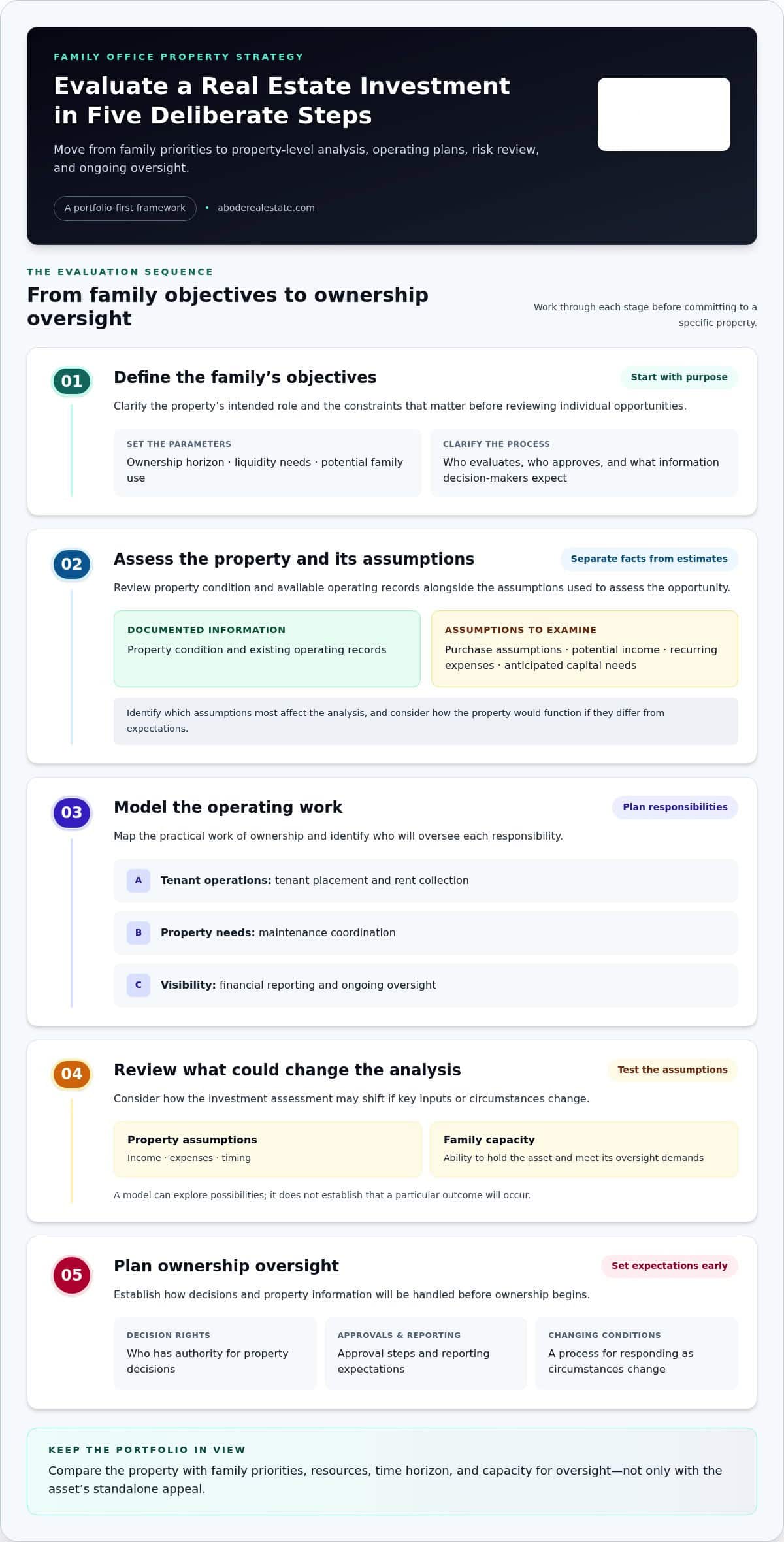
Use an ordered framework to move from broad priorities to property-level decisions:
- Define objectives: Clarify the asset’s intended role, ownership horizon, liquidity needs, and any family-use considerations.
- Assess the property: Review its condition, purchase assumptions, potential income, recurring expenses, and anticipated capital needs.
- Model operations: Consider tenant placement, rent collection, maintenance coordination, reporting, and who will oversee each responsibility.
- Review risks: Identify assumptions that could change the analysis, including income, expenses, timing, and the family’s ability to hold the asset.
- Plan oversight: Establish decision rights, approval steps, reporting expectations, and a process for responding to changing conditions.
This process makes a family office real estate investment easier to compare with the family’s other priorities. Keep projections in perspective: a model helps explore possibilities, but it does not establish that a particular outcome will occur.
Set the family’s investment objectives and decision process
Record what the family wants the property to accomplish and which constraints matter. Is the intended holding period long or flexible? How much liquidity might the family need while the asset is held? Could family use affect availability for tenants or other plans? Before acquisition, clarify who evaluates opportunities, who approves a purchase, and what information decision-makers expect. A written process helps keep those decisions consistent without prescribing a particular governance structure.
Assess the property, assumptions, and operating demands
Separate verified facts from estimates. Property condition and existing operating records may be documented; future occupancy, income, expenses, and capital requirements are assumptions to examine. Identify which assumptions have the greatest effect on the analysis, then consider how the property would function if they differ from expectations. Include the ownership horizon: a property requiring hands-on attention may be a different fit for a family planning to hold it for an extended period.
Abode Real Estate’s investment property analysis and acquisition expertise can help translate objectives into property-level evaluation. Management planning can also clarify the operational work ownership may entail. For a practical companion to this evaluation, explore investment property acquisition strategies. For additional perspective on how family offices invest in real estate, compare the approach with the family’s own objectives and decision process.
Direct Ownership or Other Real Estate Exposure: What Should Families Compare?
The choice is not simply between owning property and choosing a different investment label. When comparing direct ownership, pooled private vehicles, and publicly traded real estate exposure, consider what the family can control, how it may access or exit the investment, and how much ongoing work it entails. None is automatically the better fit.
Control: Direct ownership allows property-level decisions, such as setting maintenance priorities or planning a sale. Pooled vehicles place decisions within the vehicle’s structure and terms, while listed exposure generally does not give an investor control over an individual property.
Liquidity: Selling a directly owned property involves a property-specific transaction. Private vehicles may have terms that shape when and how an interest can be exited. Listed exposure can generally be bought or sold through public markets, though its price and trading conditions can change.
Operating responsibility: Direct owners oversee or delegate tenant and property needs. Pooled structures assign operations through their arrangements. Listed exposure does not usually require the investor to coordinate an individual asset’s day-to-day management.
Transparency of exposure: Direct ownership makes the specific property visible. A pooled vehicle provides exposure through its holdings and reporting, while a listed investment reflects an interest in a real estate company or portfolio rather than ownership of a chosen property.
What changes when a family owns property directly?
Direct ownership brings practical property decisions closer to the family. The owner evaluates the acquisition, sets oversight expectations, coordinates maintenance decisions, considers tenant operations, and plans how a future sale might fit the ownership horizon. Those responsibilities can be delegated, but they still require clear accountability and reporting. Professional property management can support tenant placement, rent collection, maintenance coordination, and financial reporting. Control also requires coordination.
How do liquidity, control, and workload differ?
Compare how each option handles entry, ongoing decisions, information, and exit. A direct owner may have detailed visibility into one asset, while also taking on operating demands and the process of selling it. An investor in a pooled vehicle may have less property-level control, with access and reporting shaped by the vehicle’s terms. Publicly traded exposure offers a different route, but does not confer authority over a specific property.
Owning property does not automatically reduce portfolio risk. A purchase could add a different exposure or increase concentration if the family already has substantial real estate holdings or related commitments. For a family office real estate investment, compare the property’s role with existing assets, liquidity needs, desired control, and capacity to oversee operations. Discuss structural, financial, tax, and legal implications with the family’s professional advisers, since terms and circumstances vary.
Plan Due Diligence, Ownership, and Ongoing Property Oversight
Due diligence should not end when a purchase decision is made. A family office real estate investment also needs a workable ownership plan: who will monitor the property, how information will be shared, and how recurring needs will be handled. Considering the operating model before acquisition can help the family decide whether to manage the asset directly or delegate operational responsibilities.
What should a property-level due diligence plan address?
Keep a clear record of what is known, what is estimated, and what still needs review. Consider the property’s condition, documented income and expenses, assumptions behind potential income, and likely operating requirements. Compare those findings with the ownership objectives and intended holding period. A property may appear suitable on paper yet require more attention or capital than the family expects.
Organize relevant records for review, including available property and operating information, purchase assumptions, and anticipated maintenance needs. The family’s legal, tax, and financial professionals can address questions about ownership structure, tax treatment, funding, and other implications specific to its circumstances. This keeps property evaluation focused while recognizing that real estate operations and professional advice serve different roles.
How can professional management support ongoing ownership?
Once a property is occupied, responsibilities become regular and practical. Tenant placement, rent collection, maintenance coordination, and financial reporting help keep ownership activity organized. Before purchase, clarify who handles each task, how decisions are escalated, and what reporting the family expects. Defined responsibilities support oversight without implying that management guarantees income or investment performance.
For a rental property, the oversight plan should account for tenant communication, rent records, maintenance needs, and a consistent flow of financial information. Families considering residential rental operations can review residential rental property options as one point of reference when considering how a property will be used.
Abode Real Estate provides full-service property management, including tenant placement, rent collection, maintenance coordination, and financial reporting. This operational support can help establish a defined rhythm for ongoing ownership. It does not replace the family’s wider investment, legal, or tax advice. Explore full-service property management to learn how property oversight can be organized beyond the acquisition itself.
Turn a Family Office Property Strategy into a Thoughtful Acquisition
A property strategy becomes more actionable when family priorities are translated into clear acquisition criteria. Before reviewing opportunities, create a brief that sets out intended use, investment objectives, ownership horizon, operating preferences, and how the family will assess a potential fit. This shared reference point keeps property review focused rather than driven by a compelling presentation or a single appealing feature.
Create a clear brief before reviewing properties
Turn priorities into requirements that can guide a consistent review. Note what the property should support, which operational responsibilities the family is prepared to oversee, and what factors would make an opportunity unsuitable. Tie requirements to the family’s actual objectives rather than assuming a particular asset type or outcome. A defined brief distinguishes essential criteria from preferences and makes opportunities easier to compare on the same basis.
A disciplined acquisition starts with clear criteria and a realistic plan for ownership after closing. Both matter.
Coordinate acquisition and long-term ownership
Acquisition analysis translates the brief into a property-level assessment. It organizes available information, surfaces assumptions for review, and clarifies how the property aligns with the stated criteria. Brokerage expertise can support the process of identifying and evaluating opportunities. These are real estate execution functions within a wider family investment process, not a substitute for wealth, tax, or legal advice.
Before making a decision, connect the acquisition plan to the ownership model. Consider who will coordinate operations, how reporting will reach family decision-makers, and how involved the family expects to be. If professional management is part of the plan, define the responsibilities it will support. Abode Real Estate’s investment property acquisition and analysis can help bring family objectives into property-level evaluation, while full-service property management supports ongoing ownership operations. Neither service guarantees investment performance.
A well-prepared family office real estate investment follows a deliberate sequence: clarify family objectives, establish acquisition criteria, assess the property and its assumptions, make a decision through the agreed process, then put the oversight plan into practice. Investment, tax, and legal decisions remain matters for the family’s relevant professional advisers. Real estate expertise can support decisions about the property itself.
Move from Property Strategy to a Clear Next Step
A thoughtful family office real estate investment begins with family objectives, not a property listing. Clear acquisition criteria make it easier to assess each opportunity consistently, while a realistic oversight plan keeps ownership responsibilities in view from the start. Direct ownership can offer property-level control, but that control comes with operating decisions and coordination.
Abode Real Estate provides investment property acquisition and analysis as real estate execution support within a family’s wider investment process. For ongoing ownership, property management can include tenant placement, rent collection, maintenance coordination, and financial reporting. These services support execution; they do not replace investment, tax, or legal advice.
With a considered brief and a plan for oversight, families can approach property decisions with greater clarity. Discuss your real estate investment goals with Abode Real Estate and take a thoughtful next step toward evaluating an opportunity against your objectives.
Frequently Asked Questions
What is family office real estate investment?
Family office real estate investment is property exposure selected and overseen in line with a family’s objectives, ownership arrangements, and decision-making process. It may involve owning a specific property directly or gaining indirect exposure through a private fund or publicly traded real estate investment. The approach may support goals such as potential income, long-term ownership, or family use, but those outcomes are not automatic. Assess each opportunity against the family’s wider portfolio and capacity for oversight.
Is real estate a good investment for a family office?
Real estate may suit a family office when its potential role aligns with family objectives, liquidity needs, ownership horizon, and appetite for operating responsibility. It is not automatically a good fit or a source of diversification or income. A property could complement existing holdings or increase concentration if the family already has substantial real estate exposure. Compare the proposed investment with other assets and consider the time and resources required to oversee it before making a decision.
How do family offices invest in real estate?
Family offices can invest by purchasing property directly, participating in pooled private vehicles, or holding publicly traded real estate exposure. The choice affects control over individual assets, visibility into the underlying property, potential liquidity, and operational workload. A practical process starts with family objectives, then sets acquisition criteria, assesses property facts and assumptions, reviews risks, and plans oversight. Property-level analysis helps organize the decision without treating forecasts as guaranteed performance.
Can a family office own investment property directly?
Yes. A family office can own an investment property directly, with the ownership arrangement and responsibilities depending on the family’s circumstances. Direct ownership brings property-level decisions into the process, including acquisition evaluation, oversight, maintenance coordination, tenant operations, and eventual sale planning. These tasks can be delegated, but clear accountability and reporting remain important. Families should discuss ownership structure and related legal, tax, and financial questions with their professional advisers.
What risks should a family office consider before investing in property?
Consider property condition, income and expense assumptions, maintenance and capital needs, liquidity, concentration, and the ongoing work required to operate the asset. Potential income and future costs are estimates, not assured outcomes, so identify which assumptions most affect the analysis. Also consider whether the family can hold the property through changing circumstances and how responsibilities will be handled. Reviewing these factors before acquisition can surface risks that a purchase price alone will not show.
How does direct real estate compare with a REIT or property fund?
Direct ownership gives the family a specific property to oversee and more influence over its property-level decisions, along with the associated operating responsibilities. A property fund pools exposure through a private investment structure, with control, reporting, and exit terms shaped by its documents. A REIT provides indirect exposure to real estate through a publicly traded vehicle rather than ownership of a chosen property. Compare liquidity, transparency, control, and workload without assuming one approach will perform better.
Does a family office need a property manager for investment real estate?
No, a property manager is not required in every case. The decision depends on the family’s capacity, desired involvement, and the property’s operating demands. A manager can support tenant placement, rent collection, maintenance coordination, and financial reporting, helping establish defined responsibilities and organized oversight. Abode Real Estate provides full-service property management for property owners. Management is operational support, not a guarantee of income or investment performance, and it does not replace the family’s wider professional advice.
Posted by Brook Walsh onEnjoy this blog post? Click here to subscribe for updates
Leave A Comment