

What if the best way to protect a high-end rental isn’t to fill it as quickly as possible, but to attract a resident whose expectations match the home? Finding tenants for high-end rental properties takes more than polished photos and a premium asking rent. When inquiries don’t feel like the right fit, each vacant day and each decision about property care can carry extra weight.
It’s natural to want a tenant who appreciates the home, meets your expectations, and is prepared to care for it. A thoughtful strategy brings those priorities together: present the property in a way that speaks to suitable prospects, then use a consistent process to assess applications.
This guide explains how to position a premium rental around the lifestyle it offers, attract suitable prospects, and move from first inquiry to lease with greater confidence. It also covers how tenant placement can connect with ongoing property management, including rent collection, maintenance coordination, and financial reporting. The goal is a considered match and a smoother transition from listing to occupancy.

Key Takeaways
- Finding tenants for high-end rental properties starts with matching the home’s features, terms, and lifestyle appeal to the needs of suitable applicants.
- Present the property with accurate details and quality photography so prospects can understand what it offers before they inquire.
- Luxury appeal can attract attention, but a deliberate placement process helps distinguish promising applicants and support a considered match.
- Use a consistent, step-by-step approach from property readiness through lease handoff, keeping screening criteria clear throughout.
- Tenant placement can connect with ongoing property management, including rent collection, maintenance coordination, and financial reporting.
Table of Contents
- Why Finding Tenants for High-End Rental Properties Requires a Different Approach
- How Property Positioning and Listing Presentation Attract Better-Fit Tenants
- Does a Luxury Property Attract Qualified Tenants on Its Own?
- A Practical Tenant-Finding Process for High-End Rental Homes
- How Abode Real Estate Supports Tenant Placement and Ongoing Management
Why Finding Tenants for High-End Rental Properties Requires a Different Approach
Finding tenants for high-end rental properties means matching a home’s value, features, and lease terms with a resident whose needs and intended use align with what it offers. The aim isn’t simply to generate interest. It’s to make sure the property and its terms are clear to prospective residents before a lease begins.
Rental demand can create opportunity, but occupancy alone isn’t a strategy. The resident’s intended use, lease terms, and expectations for care need to suit the home. Premium finishes may catch someone’s eye, but they won’t answer whether the layout suits a household, whether the lease fits a prospect’s plans, or how the home’s features support everyday life.
What makes a high-end rental distinctive?
A rental’s distinctiveness comes from the full experience of living there. Its condition signals how carefully it has been maintained. Privacy may make it feel like a retreat, while considered design, natural light, outdoor spaces, and useful amenities can shape how well it supports daily routines.
Those features matter differently to different households. One prospect may value a quiet work area; another may prioritize space for hosting or a layout that suits a particular household. There’s no single applicant profile for a premium home. Effective placement starts by identifying which needs the property’s features serve and describing that value accurately.
Why property quality alone may not find the right tenant
A beautiful home can still be difficult to place if its presentation leaves key questions unanswered. Broad descriptions such as “luxurious” or “recently updated” may leave out details that help a prospect picture daily life there. Listing features without explaining how they work together can also attract attention without making clear who the property may suit.
Terms matter, too. If the listing doesn’t explain the intended lease arrangement and other key expectations, inquiries may come from people seeking a different kind of stay. Careful placement makes the offer easier to understand and supports an informed resident experience and thoughtful stewardship of the property.
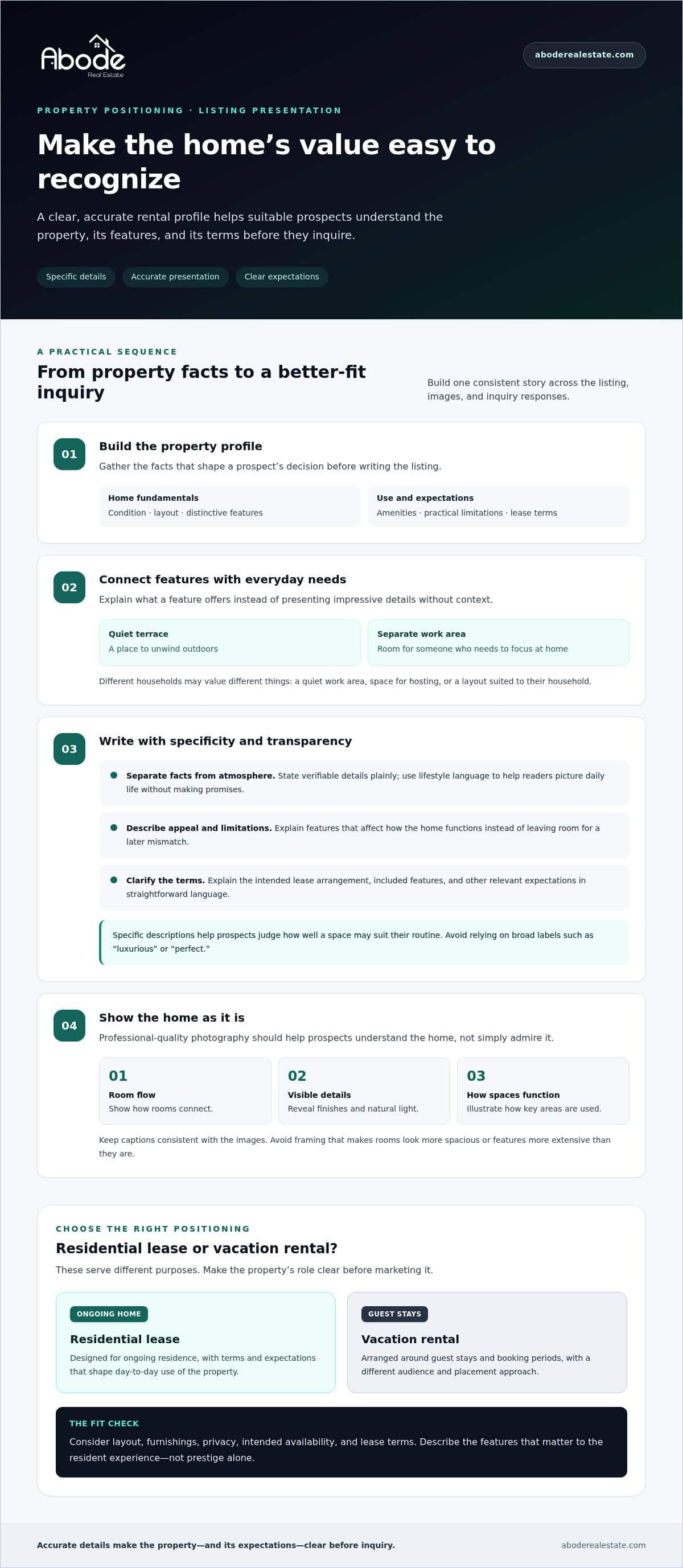
Long-term residential leasing and short-term vacation-rental bookings serve different purposes. A residential lease is designed for an ongoing home, with terms and expectations that shape a resident’s day-to-day use of the property. A vacation rental is arranged around guest stays and booking periods. The audiences, presentation, and placement approach differ, so a home positioned for short visits may not communicate the qualities that matter to someone seeking a longer-term residence.
For owners, the distinction can help clarify the property’s role before it’s marketed. Consider its layout, furnishings, privacy, and intended availability alongside the lease terms. Then describe the features that matter to the resident experience rather than relying on prestige alone. A considered match can make the path from inquiry to tenancy more coherent, while tenant placement connected with ongoing property management can support continuity after move-in.
How Property Positioning and Listing Presentation Attract Better-Fit Tenants
Once you understand what makes a property distinctive, make its value easy for suitable prospects to recognize. Positioning connects the home’s strongest features with the needs they serve, rather than presenting a list of impressive details without context. A quiet terrace, for example, may offer a place to unwind outdoors; a separate work area may suit someone who needs room to focus at home.
A useful rental listing is specific, accurate, and written for the audience it needs to reach. That clarity helps prospective tenants decide whether the home and its terms fit their plans before they inquire.
Build a clear rental profile before publishing
Before writing the listing, gather the facts that shape a prospect’s decision: the home’s condition, layout, distinctive features, included amenities, practical limitations, and lease terms. Then consider which needs its features genuinely serve. This profile keeps the message grounded and makes it easier to describe the property consistently in listing materials and inquiry responses.
- Separate facts from atmosphere. State verifiable details plainly, then use lifestyle language to help readers picture daily life without promising an experience the home can’t guarantee.
- Describe both appeal and limitations. If a feature affects how the home functions, explain it clearly rather than letting a prospect discover a mismatch later.
- Clarify the terms. Present the intended lease arrangement, included features, and other relevant expectations in straightforward language.
Specificity is more useful than a string of superlatives. Rather than calling a room “perfect for working from home,” describe its layout and features accurately so prospective residents can judge how well it suits their routine.
Present the home with care and accuracy
Professional-quality photography should help prospects understand the home, not simply admire it. A considered set of images can show how rooms connect, reveal finishes and natural light, and illustrate how key spaces function. Captions and descriptions should reinforce what the images show. Avoid framing that makes rooms appear more spacious or features more extensive than they are.
Describe amenities in context. Instead of merely naming an outdoor area, explain how it connects to the living space or what it offers residents. Keep that description aligned with the facts and the property’s intended use. This gives the listing warmth without obscuring practical details.
Consistency matters after publication, too. Use the same descriptions of features and terms in listing copy, follow-up messages, and inquiry responses. Answer questions directly, and update the materials if repeated questions reveal a point that’s unclear. A final review of the listing can help confirm that the photographs, description, and lease details present the same offer.
For finding tenants for high-end rental properties, thoughtful presentation is part of the placement strategy, not just decoration. Accurate details help suitable prospects recognize a fit, while clear expectations give every inquiry a more useful starting point.
Does a Luxury Property Attract Qualified Tenants on Its Own?
A desirable home can draw attention, but it doesn’t place itself. Strong design, privacy, and well-considered amenities may encourage prospects to inquire, yet they can’t ensure those prospects’ plans align with the property’s intended use, lease terms, or care expectations. Finding tenants for high-end rental properties calls for more than visibility: the owner needs a deliberate way to present the home, communicate consistently, and assess whether an inquiry is a plausible fit.
Inquiry volume is one signal, not the measure of success. A smaller number of relevant conversations may be more useful than a crowded inbox of prospects who misunderstood the terms or are seeking a different kind of stay. Clear communication helps everyone decide how to proceed without promising a particular applicant, vacancy timeline, or rental outcome.
More inquiries do not always mean better tenant fit
Broad exposure can bring a property to many people, but reach alone doesn’t show who the home suits. A mismatch may emerge when a prospect’s intended use differs from the lease arrangement or when an important feature or expectation wasn’t clear in the listing. Consistent responses help set expectations early, answer questions directly, and keep each conversation anchored to the same information.
Self-management and professional placement compared
Owners can manage placement themselves if they have time to prepare the listing, respond to inquiries, and coordinate next steps. Professional placement offers another structure: tenant-placement support can organize those stages and connect the transition to a broader property-management relationship. Neither approach guarantees a particular result. The practical difference is who carries the work and how placement connects with ongoing oversight.
| Consideration | Owner-led placement | Professional placement |
|---|---|---|
| Owner time | The owner prepares materials, handles inquiries, and coordinates the process. | Placement support can reduce the owner’s direct involvement in those tasks. |
| Consistency | The owner maintains the same details and expectations across conversations. | A coordinated process can keep listing information and responses aligned. |
| Management continuity | Placement and ongoing management may be handled separately by the owner. | Tenant placement can connect with rent collection, maintenance coordination, and financial reporting. |
The comparison is about fit with the owner’s capacity and objectives, not a judgment on either route. Self-management keeps decisions close to the owner, while professional support can bring placement and ongoing management into a more connected process. Abode Real Estate combines luxury real estate expertise with investment-property knowledge to tailor its approach to the home and the owner’s goals.
A luxury home may earn attention through its appeal, but thoughtful placement turns attention into a more informed conversation about fit. Owners can weigh the time they want to devote, the consistency they want prospects to experience, and whether they value continuity beyond lease signing. Those priorities help clarify the right approach.
A Practical Tenant-Finding Process for High-End Rental Homes
A clear sequence helps turn a vacant property into a well-managed transition, with fewer loose ends between preparation and move-in. Finding tenants for high-end rental properties works best when each stage has a defined purpose, from confirming the home is ready to handing the incoming resident the information they need.
Prepare the property and rental terms
Start by assessing the home’s condition and presentation, then record practical details a prospective resident will need to understand. Confirm which features are included, what the lease covers, and any property-specific considerations to communicate before a viewing. Set rental terms around the home’s facts and the owner’s objectives, not assumptions about demand or timing.
Manage inquiries through lease handoff
Once the listing is active, use a consistent process to respond, arrange viewings, and follow up. Evaluate applicants using the same lawful, relevant criteria throughout. Detailed screening mechanics deserve a dedicated guide; the essential principle is consistency, with decisions grounded in established criteria rather than shifting impressions.
- 1. Confirm readiness. Review the property’s condition, presentation, access, and details needed to answer questions accurately. Address known issues or clearly communicate practical limitations before scheduling viewings.
- 2. Set the terms. Document the intended lease arrangement, included features, and expectations in plain language. Ensure listing materials and inquiry responses describe them consistently.
- 3. Coordinate inquiries and viewings. Respond clearly, share the same core information with each prospect, and organize viewings so people know what to expect. Keep notes on follow-up items to prevent important questions from getting lost.
- 4. Evaluate applicants consistently. Apply the established criteria uniformly and follow current legal and fair-housing requirements. Keep the process focused on relevant, lawful considerations, not personal assumptions. Before publishing, verify that listing language, application steps, and evaluation criteria align with requirements that apply to the property.
- 5. Complete the agreement and handoff. Communicate the agreed terms, arrange signatures, and confirm move-in details and the property information the resident will need. A clear handoff gives the tenancy a considered beginning and helps prevent avoidable confusion.
This sequence keeps the process clear for both owner and applicant. It also creates a natural point to consider what happens after the lease is signed. Abode Real Estate provides full-service property management that connects tenant placement with ongoing oversight, including rent collection, maintenance coordination, and financial reporting. This support can extend beyond placement and bring continuity to the ongoing management of the property.
How Abode Real Estate Supports Tenant Placement and Ongoing Management
For owners of premium rentals, signing a lease is a milestone, not the end of the ownership journey. Abode Real Estate connects tenant placement with a broader property-management relationship, linking the work of welcoming a resident with the ongoing attention that helps keep ownership organized. Its approach draws on luxury real estate expertise and investment-property knowledge, tailored to the property and the owner’s objectives.
Placement with continuity beyond the lease
Coordinating placement and ongoing management can give owners a more connected experience from the start of a tenancy. Rather than treating a lease as an isolated transaction, this approach connects the resident’s arrival with the practical work that follows, while keeping the owner’s priorities in view.
That relationship can include rent collection, maintenance coordination, and financial reporting. Each service addresses a different part of ownership: tracking rental income, coordinating property needs, and providing the owner with financial information. Owners can explore how these elements fit together in Abode’s full-service property-management overview.
For finding tenants for high-end rental properties, continuity matters because the owner’s objectives don’t stop at attracting an applicant. A tailored management approach can connect the property’s needs with the owner’s investment priorities and bring greater clarity to decisions throughout the relationship. The right scope of support depends on what matters most to the owner and the home.
Choose a considered next step for your rental property
Every rental has its own character, condition, and management priorities. A useful first conversation can focus on what you want from the property, what kind of oversight would make ownership more manageable, and where tenant placement fits into those goals. The discussion can start with your circumstances rather than a one-size-fits-all package.
Whether you’re preparing a home for its next resident or considering how placement can connect with ongoing oversight, Abode offers a tailored perspective informed by investment-property knowledge. Share the priorities that matter to you and your property, then discuss an approach shaped around them.
Discuss your rental property with Abode
Set Your Rental’s Next Chapter in Motion
Turn your priorities into a clear direction for the property. Consider what a successful tenancy would look like, which aspects of ownership you want to stay closely involved in, and where added coordination would help. Those decisions can shape a plan that suits both the home and your investment goals.
Thoughtful finding tenants for high-end rental properties is ultimately about making a considered choice, not simply moving quickly. With a clear sense of what matters to you, you can approach the next stage with greater confidence and give the property a strong foundation for its future resident.
Abode Real Estate brings a tailored perspective to premium rentals, informed by luxury real estate and investment-property experience. Start a conversation about the direction you envision for your home and the support that would help you get there.
Explore property management with Abode
Frequently Asked Questions
How much should I charge for a high-end rental property?
Set rent by comparing similar available and recently rented properties, then account for meaningful differences in condition, layout, amenities, furnishings, and lease terms. A home’s acquisition cost or renovation investment alone doesn’t establish what renters will pay. If interest is limited, review whether the asking rent aligns with comparable options and whether the listing clearly communicates the property’s value. Adjust based on evidence, not simply on prestige.
Is professional photography important for a luxury rental listing?
Yes. Strong photography helps prospective residents understand the home before arranging a viewing. A cohesive set of images can show how rooms relate to one another, capture architectural details, and give a realistic sense of scale. For example, include views of a primary living area and its connection to an outdoor space if that relationship matters to daily use. Images should represent the property accurately, not create expectations a visit won’t support.
Can I find tenants for a high-end rental property without a property manager?
Yes. Owners can handle the process themselves if they have time to organize listing materials, respond to prospects, coordinate viewings, and keep communication on track. They’ll also need a consistent approach to evaluating applicants and moving from agreement to handoff. Finding tenants for high-end rental properties without management support is possible, but owners should consider how they’ll handle ongoing responsibilities after move-in as well as initial placement.
What should a high-end rental listing include?
A useful listing gives prospects enough detail to assess whether the property fits their needs. Include accurate information about the home’s layout, condition, notable features, furnishings, included items, and lease terms. Clarify practical details such as access arrangements or any restrictions that affect use, where applicable. Avoid unsupported promises or language that could leave key expectations open to interpretation. Clear details help prospects ask more relevant questions before a viewing.
What happens if a luxury rental property receives few suitable inquiries?
Review the listing from a prospect’s point of view before making a major change. Check whether the rent and lease terms are easy to understand, whether the photos represent the home well, and whether the description addresses the features that matter most. Consider whether the listing is reaching its intended audience. Targeted revisions may clarify the offer; assess the response before concluding the property itself.
Should a high-end rental be furnished or unfurnished?
Choose based on the home’s likely audience, intended lease arrangement, and the owner’s willingness to maintain the furnishings. A furnished home may appeal to residents seeking a ready-to-live-in space, while an unfurnished property lets tenants bring their own belongings and style. Whichever option you choose, state clearly what stays, what does not, and the condition of included items. The best choice supports the property’s purpose and ownership plan.
Posted by Brook Walsh onEnjoy this blog post? Click here to subscribe for updates
Leave A Comment