

Could a single administrative oversight in your paperwork cost you $1,000 a day and the right to host guests in your own sanctuary? For many property owners, the shifting landscape of Fort Lauderdale vacation rental regulations feels less like a set of guidelines and more like a high-stakes maze where one wrong turn leads to heavy fines or a suspended license. You've likely felt the weight of these multi-layered requirements, wondering if your investment is as secure as it is beautiful. It's a valid concern. The city's commitment to neighborhood harmony has made compliance more rigorous than ever before.
As a boutique firm specializing in luxury residential sales and investment property acquisition, we understand that you'd rather focus on the lifestyle of your guests than deciphering tax surtaxes or noise monitoring mandates. This guide provides the clarity you need to transform regulatory hurdles into a seamless foundation for your luxury asset. You'll gain a clear roadmap to full legal registration, a breakdown of the 13% total tax burden, and the confidence to navigate complex HOA restrictions. By mastering these details, you're not just avoiding penalties. You're elevating your property into a professional, high-end rental that stands the test of time.

Key Takeaways
- Secure your Florida DBPR license before initiating the city registration process to ensure a smooth transition into the local market.
- Master the nuances of Fort Lauderdale vacation rental regulations to balance city ordinances with the specific constraints of your HOA or condo association.
- Implement mandatory safety and noise monitoring protocols to protect your property from significant fines and maintain community harmony.
- Account for the 13% total tax burden, including the Broward County Tourist Development Tax, to accurately forecast your asset's performance.
- Partner with a professional management team to handle the technical burden of compliance while you focus on the curated lifestyle your investment provides.
Table of Contents
- The 2026 Landscape of Fort Lauderdale Vacation Rental Regulations
- The Registration Process: A Step-by-Step Path to Compliance
- Layered Governance: City, County, and Association Rules
- Operational Compliance: Safety, Parking, and Guest Management
- Optimizing Your Investment with Professional Management
The 2026 Landscape of Fort Lauderdale Vacation Rental Regulations
Fort Lauderdale remains a premier destination for global travelers, but the privilege of hosting comes with a refined set of expectations. The city's approach to Short-term rental regulations isn't about restriction for its own sake. Instead, the 2026 framework seeks a sophisticated equilibrium. It protects the quiet elegance of residential neighborhoods while allowing savvy investors to curate exceptional guest experiences. This balance ensures that the city remains a sought-after retreat rather than a transient corridor.
There's a clear legal line between a hosted stay where the owner remains on-site and the entire-home luxury rentals that dominate the high-end market. For investors, the latter category requires a more rigorous commitment to Fort Lauderdale vacation rental regulations. These rules are designed to mitigate the operational impact on permanent residents; they focus on noise, parking, and safety protocols that distinguish a professional enterprise from a casual hobby. Staying ahead of these legislative shifts is essential in the fast-moving South Florida market.
To better understand this concept, watch this helpful video:
Defining the Vacation Rental in Local Law
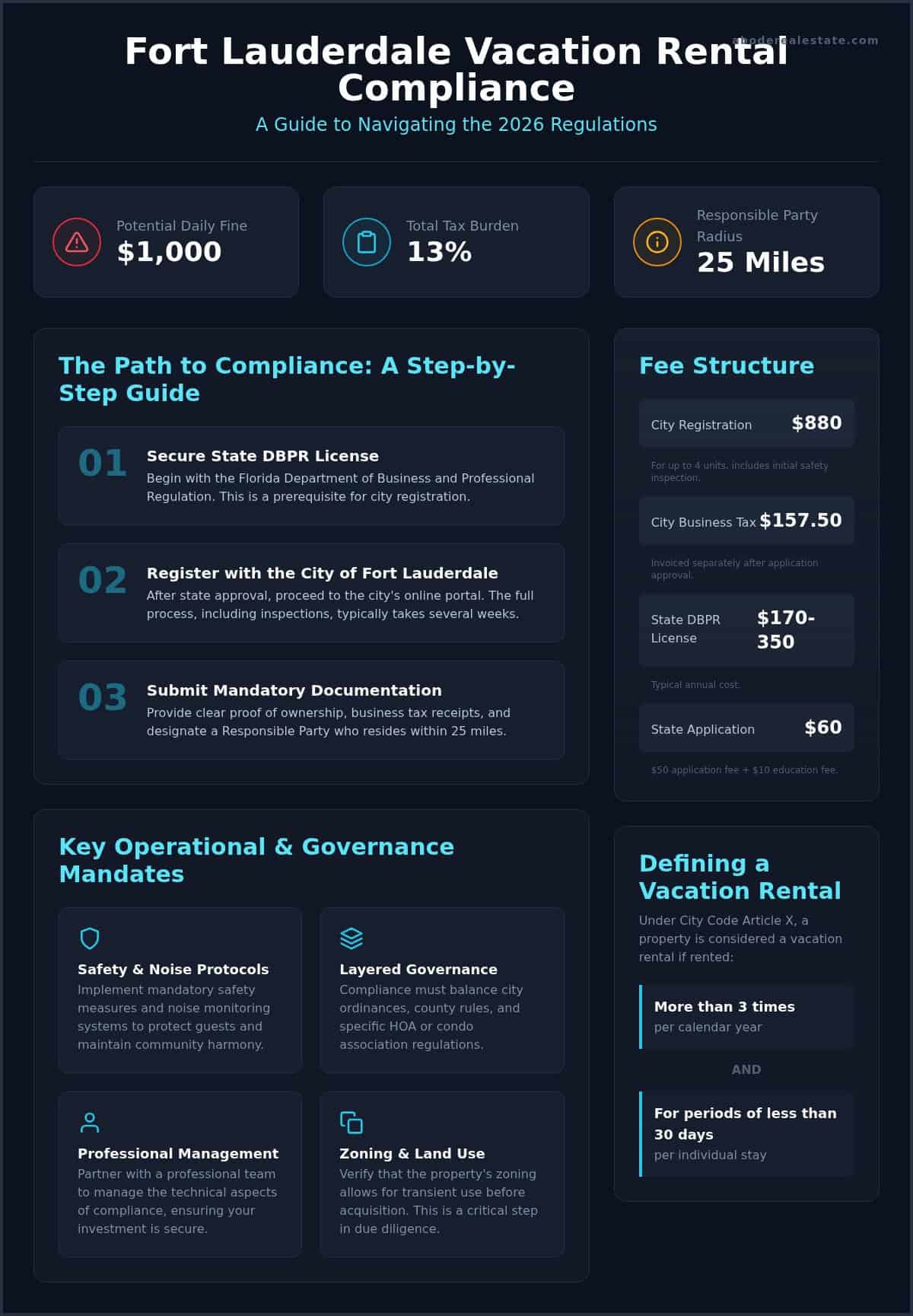
Under Article X of the city's code, a property is considered a vacation rental if it's rented more than three times a year for periods of less than 30 days. Before you finalize any acquisition, zoning and land use must be your primary focus. Not every parcel allows for transient use. Verifying these details is a cornerstone of successful Florida investment property acquisition strategies. It's the difference between a high-performing asset and a legal liability.
The Economic Impact of Compliance for Luxury Owners
For the discerning owner, compliance is an investment in the property’s long-term value. Legal status is often a prerequisite for specialized insurance coverage that protects your physical asset and liability. Beyond the legalities, transparency builds immediate guest trust. Travelers seeking a premium experience look for the reassurance of a city-certified home. As a firm specializing in luxury residential sales, we view regulatory adherence as a brand pillar. It signals to the market that your property is a managed, stable, and high-caliber retreat.
The Registration Process: A Step-by-Step Path to Compliance
The path to a fully compliant luxury rental begins with a specific sequence of state and local approvals. You can't simply list your property and wait for guests; you must first align with Fort Lauderdale vacation rental regulations by securing a license from the Florida Department of Business and Professional Regulation (DBPR). This state-level step involves a $50 application fee and a $10 education fee, with annual license costs typically ranging from $170 to $350. Once this foundation is laid, you can proceed to the City of Fort Lauderdale’s online registration portal.
For the 2026 season, the city has established a clear fee structure to maintain high standards across the market. A new registration for up to four units under a single folio costs $880, which includes your initial safety inspection. Keep in mind that a separate City Business Tax Receipt fee of $157.50 is invoiced after your application receives approval. The timeline from your initial submission to an active, legal listing generally spans several weeks, depending on inspection availability and document accuracy. This deliberate pacing ensures every property entering the market meets the city's refined expectations.
Mandatory Documentation for Your Application
Precision in your paperwork is vital to avoid unnecessary delays. You'll need to provide clear proof of ownership and your business tax receipts to verify the legitimacy of your enterprise. Perhaps most importantly, you must designate a Responsible Party. This individual must reside within 25 miles of the property and be capable of responding in person within one hour, 24/7, to address any guest issues or neighbor concerns. If you're managing a homestead property, you'll also need notarized affidavits to qualify for the reduced $200 annual renewal fee, rather than the $650 fee applied to non-owner-occupied investments.
The Inspection Phase: What to Expect
Once your application is processed, you'll schedule a life-safety inspection. This isn't a mere formality; it's a rigorous check to ensure your guests are protected within a secure environment. Common reasons for failure include missing fire extinguishers, non-functional smoke detectors, or inadequate exit signage. Failing an inspection or missing a scheduled appointment results in a $100 reinspection fee. Remember that all registrations expire on September 30 each year. To avoid a $100 late fee, ensure your renewal is submitted by August 1.
Navigating the complexities of Fort Lauderdale vacation rental regulations ensures your property remains a prestigious and protected asset. If you're still in the planning stages, our team specializes in luxury residential sales and can help you identify properties with the highest potential for compliance and ROI. For those who already own a piece of paradise, our full-service property management provides the peace of mind that every deadline and inspection is handled with boutique-level care.
Layered Governance: City, County, and Association Rules
Operating a high-end estate in South Florida requires an understanding of a complex legal hierarchy. While the state of Florida provides a broad framework that prevents local municipalities from outright banning short-term rentals, the City of Fort Lauderdale vacation rental regulations focus on the operational impact of your investment. This means that while you have the right to rent, the city governs exactly how that happens. However, the most restrictive layer often comes from private governance. For the luxury investor, success depends on navigating these three distinct tiers of authority with precision.
Tax compliance is a critical component of your financial planning. In Fort Lauderdale, the total tax burden on transient stays is 13%. This is comprised of the 6% Florida state sales tax, a 1% Broward County discretionary sales surtax, and the 6% Broward County Tourist Development Tax. While platforms like Airbnb or VRBO may collect some of these taxes automatically, the responsibility ultimately rests with the owner. You must register with the Florida Department of Revenue to ensure state and county obligations are met. Oversight of these monthly filings is a standard part of professional management, ensuring your asset remains in good standing with both state and local authorities.
Navigating Private Covenants and Restrictions
Before you commit to an acquisition, you must look beyond public law and into the private Declaration of Covenants for the specific neighborhood. Homeowners Associations (HOAs) and Condo Boards possess significant power to restrict or even prohibit short-term rentals. They often implement rental minimums, such as a 30-day or 90-day stay, or frequency caps that limit the number of times a property can be leased per year. Florida law generally protects grandfathered rights if you owned the property before a ban was enacted, but new buyers are subject to the rules in place at the time of purchase.
We recommend prioritizing communities known for their rental-friendly policies. As experts in luxury residential sales, we guide our clients through these bylaws during the due diligence phase to ensure their lifestyle goals align with the reality of the association's restrictions. Identifying these hurdles early prevents the frustration of purchasing a beautiful property only to find its use restricted by a condo board's vote. This layered approach to research is what separates a successful investment from a costly oversight in the South Florida market.
Operational Compliance: Safety, Parking, and Guest Management
Maintaining a high-end estate requires more than aesthetic excellence; it demands a rigorous adherence to safety and operational standards that protect both your guests and your investment. Within the framework of Fort Lauderdale vacation rental regulations, compliance is viewed as a hallmark of a professional, luxury operation. This begins with the physical environment. Your property must be equipped with interconnected smoke detectors, fire extinguishers on every level, and clearly marked exit signs. For homes featuring the quintessential South Florida pool, strict adherence to the Florida Residential Swimming Pool Safety Act is non-negotiable, requiring approved covers, alarms, or barriers to ensure a secure sanctuary for every visitor.
Occupancy limits are equally precise and designed to preserve the character of our coastal neighborhoods. Overnight stays are strictly capped at two people per legal sleeping room, though the city graciously allows for up to four children under the age of 13 to be excluded from this count. When it comes to daytime gatherings, the limit is set at 1.5 times the maximum overnight occupancy, with an absolute ceiling of 20 people. To manage these limits and maintain tranquility, the city now mandates the use of noise level detection devices. Owners must retain this data for 180 days, providing a factual record that protects the property against unfounded complaints while ensuring guests respect the local peace.
Parking and Nuisance Mitigation
The transition from a private residence to a curated rental involves clear communication regarding local ordinances. One of the most critical rules to convey is the "No On-Street Parking" mandate for guests. All guest vehicles must be contained within the property's driveway or designated parking spaces. To remain compliant, you must post specific signage inside the dwelling, typically near the main entrance, detailing these parking rules along with trash pickup schedules and emergency contact information. This transparency prevents friction with neighbors and reinforces the high-touch, professional nature of your rental brand.
The 24/7 Local Contact Requirement
Fort Lauderdale requires every vacation rental to have a designated local contact person available 24/7. This individual must reside within 25 miles of the property and possess the authority to resolve issues immediately. If a noise or trash complaint arises, the local contact is legally mandated to respond in person within one hour. This requirement is often the heaviest burden for individual investors, as a single missed call can result in city citations or a compromised reputation.
Entrusting this responsibility to a professional team ensures that every guest interaction and neighbor concern is handled with the calm confidence and quiet authority your asset deserves. If you are ready to elevate your property's performance while ensuring total regulatory peace of mind, explore our Short-Term Vacation Rental Management services to see how we handle the complexities of compliance on your behalf.
Optimizing Your Investment with Professional Management
Managing a luxury asset in South Florida is a sophisticated discipline that requires constant vigilance. While we've discussed the technicalities of Fort Lauderdale vacation rental regulations, the real challenge lies in consistent execution over the long term. Regulatory updates don't happen on a fixed schedule; they evolve alongside the community's needs. Entrusting your property to professional oversight removes the administrative burden, ensuring you never miss a renewal deadline or a legislative shift that could impact your standing. It's about moving from a reactive state to one of calm, quiet authority over your investment.
Beyond legal safety, full-service property management transforms a property into a high-performing business. It's about optimizing nightly rates through data-driven listing strategies and professional photography that captures the lifestyle your home promises. At Abode Real Estate, our boutique approach means we treat your investment as if it were our own, balancing the mechanical requirements of the city with the aspirational needs of the global traveler. We understand that a luxury rental is an extension of your personal brand; it requires a level of precision that national franchises simply can't offer.
Beyond Compliance: Curating the Guest Experience
The most successful rentals in our portfolio don't just meet the minimum safety standards; they exceed them. We view professional maintenance and meticulous cleaning protocols as essential forms of risk management. A well-maintained home reduces liability and fosters the positive reviews necessary for a sustainable, high-yield portfolio in South Florida. By focusing on these details, we create a frictionless experience that encourages repeat stays and protects the long-term value of your estate. This commitment to excellence ensures that compliance is the foundation of your success, not a hurdle to it.
Taking the Next Step with Abode Real Estate
We're more than just managers; we're your partners in the South Florida market. Our team provides end-to-end assistance, from initial registration and state licensing to the daily nuances of guest relations and noise monitoring. While we specialize in luxury residential sales and South Florida luxury homes, our expertise extends into the tactical planning required to turn a residence into a compliant, profitable asset. We bridge the gap between complex local codes and the seamless, curated experience your guests expect.
If you're ready to transition into your next chapter with confidence, we invite you to contact us for a personalized investment analysis. Let us handle the complexities of the local landscape while you enjoy the rewards of a perfectly managed investment. Together, we'll ensure your property remains a premier destination for years to come.
Securing Your Legacy in the Fort Lauderdale Market
The evolution of Fort Lauderdale vacation rental regulations reflects a city committed to excellence and neighborhood harmony. By prioritizing precise registration, understanding the 13% tax landscape, and adhering to strict operational safety standards, you transform a beautiful property into a resilient, high-yield asset. Compliance isn't merely a box to check; it's the framework that protects your investment from daily fines and ensures a frictionless experience for your discerning guests.
Success in this market requires more than just following the rules. It demands a proactive partner who can navigate the nuances of HOA bylaws and city inspections with ease. At Abode Real Estate, we offer a boutique luxury management model powered by deep local market insights and comprehensive investment property analysis. We handle the technical burden so you can focus on the reward of owning a piece of the South Florida coastline.
If you're ready to elevate your portfolio, partner with the luxury experts at Abode Real Estate for your management needs. We provide the clarity and expertise needed to thrive in an ever-changing regulatory environment. Your journey into the next chapter of luxury hosting begins with a single, confident step toward total compliance.
Frequently Asked Questions
Are short-term rentals legal in Fort Lauderdale in 2026?
Short-term rentals are entirely legal in Fort Lauderdale as of 2026, though they're strictly regulated to maintain neighborhood character. To operate legally, you must secure a state license and a city Certificate of Compliance. These Fort Lauderdale vacation rental regulations ensure every property meets safety and operational standards. Failing to register properly can lead to significant penalties, so it's essential to complete the formal application process before welcoming your first guest into your sanctuary.
How much does it cost to register a vacation rental in Fort Lauderdale?
For a new vacation rental registration in 2026, the City of Fort Lauderdale charges an $880 fee, which conveniently covers your initial safety inspection for up to four units. If you're renewing a non-owner-occupied property, the annual fee is $650. Homesteaded, owner-occupied properties benefit from a lower renewal rate of $200. Budgeting for these costs early helps you maintain a seamless operation without any unexpected financial hurdles during the registration cycle.
What taxes are required for vacation rentals in Broward County?
The combined tax rate for vacation rentals in Broward County is currently 13%. This total includes the 6% Florida state sales tax, a 1% Broward County discretionary sales surtax, and the 6% Broward County Tourist Development Tax. Owners are responsible for ensuring these taxes are remitted correctly, even if booking platforms handle some collections. Precise tax management is a cornerstone of protecting your investment and ensuring your luxury rental remains in good legal standing.
Can a condo association or HOA ban short-term rentals in Florida?
Yes, a condo association or HOA has the authority to ban or heavily restrict short-term rentals through their Declaration of Covenants. While Florida state law limits how municipalities can ban rentals, it doesn't prevent private associations from enforcing their own rules. We always advise our clients to review these documents during the investment property analysis phase. It's the only way to ensure your vision for a high-end rental aligns with the association's private governance.
What specific safety equipment is required for a legal vacation rental?
Every legal rental must be equipped with interconnected smoke detectors, fire extinguishers on every floor, and clearly visible exit signs. If your property features a pool, you must also comply with the Florida Residential Swimming Pool Safety Act by installing approved barriers or alarms. These safety requirements are verified during your initial and annual inspections. Meeting these standards isn't just about compliance; it's about providing a secure, premium environment that reassures your guests.
What happens if I operate a vacation rental without a license?
Operating without a valid license currently carries fines ranging from $250 to $325 per violation. However, the city is considering proposed ordinances that could increase these penalties to $1,000 per day for unregistered properties. Beyond the financial cost, repeat violations can lead to a total suspension of your rental rights for up to 365 days. Professional management is the most reliable way to avoid these risks and maintain a high-caliber, compliant operation.
How often do I need to renew my vacation rental registration?
You must renew your registration annually to stay compliant with Fort Lauderdale vacation rental regulations. All city certificates expire on September 30 each year, and your renewal application is due by August 1 to avoid a $100 late fee. Keeping track of these dates is vital for a frictionless hosting experience. Our team handles these recurring deadlines for our clients, ensuring their properties remain active and protected without any interruption in guest bookings.
Do I need a separate business license for my Airbnb in Fort Lauderdale?
Yes, you need a separate City Business Tax Receipt in addition to your vacation rental registration. Once your initial application is approved, the city will invoice you for this business tax, which currently costs $157.50. This layered licensing approach is standard for professional enterprises in the South Florida market. Ensuring you have both the state license and the city business receipt confirms your status as a legitimate, high-end facilitator in the local tourism economy.
Posted by Brook Walsh onEnjoy this blog post? Click here to subscribe for updates
Leave A Comment