

The most expensive misstep in luxury real estate is assuming a top-floor address guarantees an authentic architectural crown. High-rise marketing often attaches premium labels to standard upper residences, inflating expectations without delivering unique volume or privacy. If you want to understand how to buy a penthouse apartment properly, your evaluation must extend beyond floor-to-ceiling glass to inspect legal airspace rights, mechanical logistics, and building governance.
You deserve an elevated sanctuary that pairs horizon views with uncompromising quiet and effortless arrival. Still, sorting genuine bespoke layouts from ordinary units, while vetting complex reserve funds and roof maintenance liabilities, can test even seasoned buyers. This guide gives you the clarity to evaluate, vet, and purchase an exceptional penthouse residence with confidence. Ahead, you'll discover how to assess structural outdoor allocations, audit association financials, and secure tailored guidance for an immaculate acquisition.

Key Takeaways
- Distinguish authentic architectural penthouses from marketed upper-floor residences by verifying bespoke layouts, expanded ceiling heights, and deeded airspace rights.
- Evaluate essential structural engineering factors, including outdoor terrace weight tolerances for private amenities, acoustic dampening, and direct elevator vesting.
- Master how to buy a penthouse apartment through discreet off-market channels to safeguard your privacy and access exceptional inventory before public listing.
- Audit association reserve studies and undivided common interest percentages to protect against disproportionate liability for future capital improvements.
- Align with bespoke residential advisory to navigate complex entity compliance, negotiate favorable contract protections, and ensure a seamless closing process.
Table of Contents
- Understanding the Penthouse Asset: Architectural Exclusivity and True Market Value
- Crucial Criteria for Evaluating a Luxury Penthouse Property
- How to Buy a Penthouse Apartment: The Step-by-Step Acquisition Process
- Navigating Condominium Governance, Reserve Funds, and HOA Liabilities
- Partnering with Boutique Advisory for a Seamless Penthouse Acquisition
Understanding the Penthouse Asset: Architectural Exclusivity and True Market Value
A true penthouse represents far more than an elevated floor plan at the top of a residential tower. Historically born out of setback requirements during early skyscraper construction, an authentic crown home is an independent architectural statement. As detailed in the architectural history and features of penthouses, these properties originally emerged as specialized structures built directly into the roofscape, distinct from the uniform residences beneath them. Today, evaluating how to buy a penthouse apartment requires separating genuine engineering distinction from mere marketing language.
Authentic Penthouses Versus Marketed Top-Floor Units
Developers routinely assign premium labels to upper-level units that mirror the layout and scale of lower floors. An authentic penthouse offers distinct spatial boundaries. You should look for structural indicators that confirm genuine rarity:
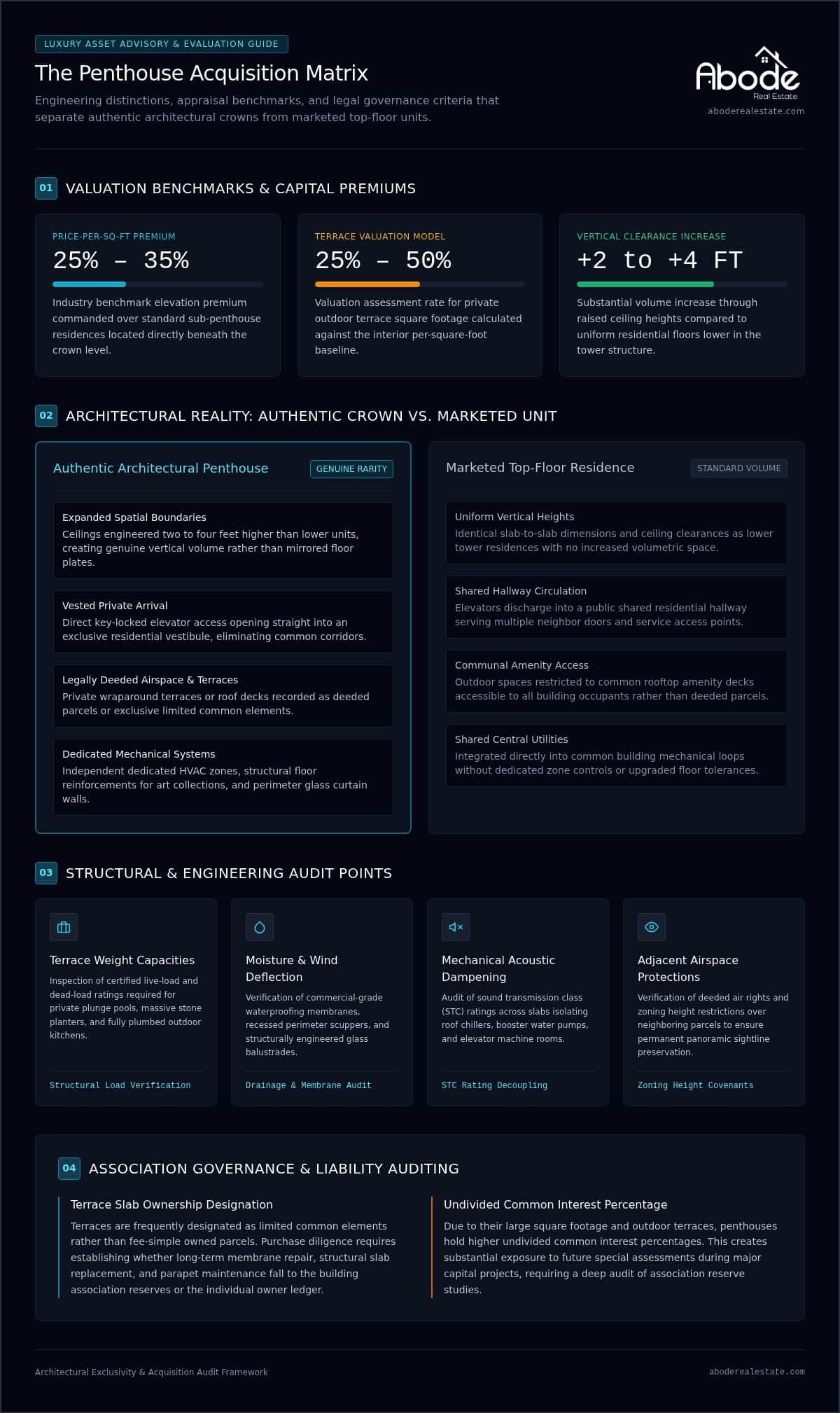
- Elevated vertical clearances: Substantial volume increases, often featuring ceilings two to four feet higher than standard tower residences.
- Direct private arrival: Key-locked, vested elevator access opening directly into an exclusive residential vestibule rather than a shared corridor.
- Deeded outdoor living: Private wraparound terraces, loggias, or private roof decks legally recorded as deeded parcels or exclusive-use limited common elements, rather than common amenity decks accessible to the entire building.
- Custom mechanical integrations: Dedicated HVAC zones, structural floor reinforcement for substantial interior art installations, and perimeter glass curtain walls.
The Distinct Lifestyle and Financial Value Drivers
The financial foundation of top-tier residential ownership rests on supply constraints. Industry appraisal benchmarks indicate that genuine penthouse residences routinely command a 25% to 35% price-per-square-foot premium over sub-penthouse residences. Meanwhile, super-luxury valuation models assess private outdoor terrace space at 25% to 50% of the interior square-foot rate. These numbers reflect structural scarcity; a multi-unit high-rise can support dozens of standard layouts, but rarely more than one or two premier crown residences.
Beyond capital preservation during broader real estate corrections, the lifestyle appeal centers on personal sanctuary. Living at the apex delivers vertical insulation from street vibrations and complete acoustic detachment. However, true long-term value hinges on legal air rights. Verifying that adjacent parcels have permanent height restrictions ensures that future towers cannot compromise your sightlines. Mastering how to buy a penthouse apartment requires auditing these exterior rights just as meticulously as interior finishes.
Crucial Criteria for Evaluating a Luxury Penthouse Property
Evaluating a premier top-floor residence requires looking past cosmetic staging to scrutinize underlying structural engineering. A discerning buyer learning how to buy a penthouse apartment must look beyond custom finishes to assess how the home performs mechanically, ensuring the space delivers a true long-term sanctuary.
Terrace Engineering, Structural Capacity, and Air Rights
Expansive outdoor space defines skyward living, but physical tolerances dictate how you can use that space. Incorporating a private plunge pool, substantial stone planters, or a fully plumbed outdoor kitchen demands verified live-load and dead-load engineering ratings. Drainage infrastructure also requires rigorous inspection, including recessed perimeter scuppers, commercial-grade waterproofing membranes, and wind-deflecting glass balustrades. Within the broader legal structure of condominium ownership, terraces are frequently categorized as limited common elements. You must clarify whether future repairs to the structural slab beneath your private decking belong to the association or your personal ledger.
Acoustic Isolation and Mechanical Proximity
Living on the top floor eliminates foot traffic from above, yet it introduces unique acoustic considerations. Central commercial chillers, domestic water pumps, and elevator machine rooms frequently reside on the building crown, directly beside or above penthouse living quarters. Acoustic tranquility relies on high sound transmission class (STC) ratings across concrete floor slabs and perimeter curtain-wall joints. Always schedule walk-throughs during afternoon peak energy cycles to test for low-frequency mechanical humming or physical vibrations before submitting an offer.
Vertical Access, Security, and Private Entry
The experience of arriving home should feel effortless, secure, and private. Biometric elevator programming and keycard-vested access protect your personal floor plate, preventing casual access from other residents or building guests. In high-density towers, transit logistics can quickly frustrate daily life; evaluate elevator cab speeds and wait intervals during morning commuter hours. Dedicated service elevators are just as vital, allowing private caterers, interior designers, and maintenance staff to move freely without encroaching on your primary entrance. When reviewing premier luxury residential sales, partnering with an advisor who audits these operational nuances guarantees an immaculate standard of daily comfort.
How to Buy a Penthouse Apartment: The Step-by-Step Acquisition Process
Acquiring a premier residence at the crown of a tower requires a methodical framework designed for confidential transactions. Standard residential playbooks fail when applied to these properties. Understanding how to buy a penthouse apartment properly means executing a private acquisition strategy that safeguards your anonymity, verifies physical building integrity, and structures resilient contractual safeguards.
Curating Discreet and Off-Market Residential Opportunities
The finest residences rarely surface on public listing portals. Sellers of marquee properties often demand discretion to protect personal privacy, opting for pocket inventory shared only through trusted networks. Accessing these crown units requires an advisory relationship with deep ties to building boards, private wealth offices, and early developer allocations. Sourcing off-market opportunities prevents public bidding frenzies while allowing you to explore exceptional residences before public discovery.
Conducting Advanced Technical and Physical Due Diligence
Standard home inspections do not address the complex engineering of high-rise crown units. Comprehensive technical due diligence demands a dedicated engineering audit across several mission-critical areas:
- Building envelope and thermal scanning: Infrared imaging across multi-story curtain walls and overhead skylights to detect seal failure, thermal transfer, or hidden water penetration.
- Roof membrane and flashing integrity: Independent assessment of parapet terminations, deck pavers, and flashing joints surrounding private exterior zones.
- Riser water pressure and dedicated infrastructure: Flow testing across primary bathroom suites and private irrigation supplies to ensure booster pumps deliver steady pressure during peak morning consumption.
Negotiating Terms, Contract Structure, and Private Escrow
Precision negotiation transforms high-value contracts into protective legal instruments. Your advisory team must pair tailored nondisclosure agreements with carefully structured deposit frameworks held in private escrow. When evaluating properties across our curated luxury residences portfolio, your legal counsel should negotiate specific inclusions, such as integrated smart-home architectural automation, custom designer millwork, and private parking bay allocations. This disciplined process ensures your acquisition transitions smoothly from signed contract to private handover.
Navigating Condominium Governance, Reserve Funds, and HOA Liabilities
Behind the prestige of skyward living lies a complex matrix of shared ownership rules and shared structural risks. In high-rise condominiums, financial responsibility connects directly to unit size. Because penthouse suites occupy the largest proportionate footprints, they carry the highest percentage of undivided common interest. If you want to understand how to buy a penthouse apartment with long-term peace of mind, evaluating association balance sheets is just as critical as examining the view.
Evaluating HOA Financial Health and Future Capital Projects
When an association faces capital shortfalls for major infrastructure overhauls, penthouse owners absorb the largest portion of any resulting special assessment. Protect your capital by insisting on a rigorous financial audit before waiving contract contingencies:
- Professional reserve study analysis: Review the most recent independent engineering reserve study to confirm the building maintains sufficient capital allocations for structural components rather than relying on baseline funding.
- Three-year board meeting minutes: Scrutinize historical records to identify recurring problems, such as elevator breakdown patterns, curtain-wall seal compromises, or pending disputes between owners and management.
- Planned capital expenditure schedules: Identify upcoming projects for facade maintenance, mechanical modernization, or complete roof replacements that could trigger substantial financial assessments shortly after closing.
Analyzing Bylaws Regarding Roofs and Terrace Modifications
Living on the top tier creates an intricate intersection between private space and common structural components. Condominium declarations draw firm legal lines separating private interior property from limited common elements. The pavers on your private outdoor terrace may belong to you, but the underlying waterproofing membrane almost certainly remains common property maintained by the association. Understanding who pays when that waterproofing reaches the end of its functional life saves significant frustration later.
Bylaws also dictate your daily freedoms within the residence. Standard declarations frequently restrict alterations to exterior perimeters, limiting your ability to install custom pergolas, high-output outdoor heating, or extensive landscape containers. Rules can also restrict private catering events, exterior evening lighting, and domestic pet sizes. To safeguard your investment and review these complex declarations before committing capital, connect with our advisory team for meticulous due diligence support.
Partnering with Boutique Advisory for a Seamless Penthouse Acquisition
High-value residential acquisitions demand an advisor who acts as a trusted facilitator rather than a traditional salesperson. National brokerages often prioritize speed and sheer volume, treating premier real estate as simple unit transfers. In contrast, mastering how to buy a penthouse apartment requires an unhurried, boutique approach focused on confidentiality, precise asset evaluation, and the quiet personal fulfillment of securing a private sanctuary.
The Strategic Advantage of Dedicated Buyer Representation
Working directly with a listing broker introduces an immediate conflict of interest. Retaining dedicated, bespoke buyer representation insulates your identity and ensures your legal and financial goals remain the sole priority. An exclusive advisory partner delivers distinct tactical benefits:
- Elimination of dual agency conflicts: Your representative focuses entirely on negotiating favorable terms, price structures, and repair covenants without allegiance to the seller.
- Proprietary off-market intelligence: Deep professional relationships uncover the motivations behind private sales, off-market builder inventory, and historical building transaction nuances.
- Transparent, disciplined pacing: Meticulous oversight replaces transactional haste, giving you the time and data necessary to evaluate complex property documentation with complete confidence.
Finalizing the Transaction and Embracing Your New Sanctuary
Closing on an elite property is never merely a financial milestone; it marks a curated arrival into a new chapter of living. A refined acquisition service extends past the contract closing date to orchestrate the myriad logistical details that define effortless ownership. This includes establishing building intake protocols with residential managers, coordinating secure transit for private interior architects, and programming biometric access credentials before your first night in residence.
True luxury real estate representation treats asset acquisition as a sophisticated craft. Whether you are expanding an investment property portfolio or seeking an architectural retreat above the skyline, aligning with seasoned advisors ensures that every legal, structural, and aesthetic detail reflects your expectations. When you are ready to explore premier residences with quiet authority and bespoke care, please contact our advisory team to begin your private search.
Stepping Into Your Skyward Sanctuary with Confidence
Acquiring a premier residence at the building summit is an art of structural discernment and meticulous patience. Understanding how to buy a penthouse apartment requires looking beyond panoramic vistas to examine deeded airspace rights, terrace load limits, and association reserve health. When you evaluate physical engineering alongside governance balance sheets, your acquisition transitions from an ordinary purchase into an enduring personal sanctuary.
Securing these rare architectural assets demands high-touch advocacy and absolute discretion. Abode Real Estate specializes in luxury residential sales and high-value acquisitions, delivering bespoke guidance from private market discovery through technical due diligence and final closing. We ensure your arrival is protected, seamless, and completely aligned with your long-term vision. When you are ready to explore exceptional unlisted inventory and claim your retreat above the horizon, Connect with Abode Real Estate to initiate your bespoke search.
Frequently Asked Questions
What is the main difference between a top-floor apartment and a true penthouse?
The primary difference lies in custom architectural design and structural independence. A standard top-floor residence mirrors the identical floor plate, window heights, and structural limits of the units below it. An authentic penthouse features a distinct architectural footprint, often offering elevated ceiling clearances, private elevator vestibules, and expansive private terraces created by building setbacks. True penthouses function as individual custom residences rather than duplicated apartment tiers.
Do penthouse owners own the roof directly above their apartment?
Penthouse owners rarely own the structural roof in fee-simple absolute terms. In high-rise condominiums, the roof almost always forms part of the building's common elements or is legally designated as a limited common element reserved for private use. This distinction means the condominium association retains legal responsibility for maintaining the underlying waterproofing envelope, while you enjoy exclusive occupancy rights across the finished surface.
Why do penthouse apartments have significantly higher monthly HOA fees?
Condominium dues connect directly to an owner's percentage of undivided common interest. Penthouse units command higher square footage, expansive outdoor terrace footprints, and specialized amenities, meaning they carry the largest proportional share in the building declaration. Whenever the community funds shared operations, mechanical maintenance, or insurance premiums, the penthouse owner pays an amount strictly proportional to that top-tier ownership percentage.
What physical inspections are most critical when buying a penthouse?
Technical due diligence must prioritize the building envelope, drainage logistics, and mechanical proximity. When learning how to buy a penthouse apartment, you should commission infrared thermal scanning across perimeter glass curtain walls, flood testing for outdoor terrace drains, and acoustic decibel audits near rooftop mechanical chillers. Verifying adequate water pressure on upper floors ensures your shower suites function properly during peak morning demand.
Are penthouse apartments more difficult to finance than standard condos?
Financing can involve stricter underwriting thresholds due to higher purchase considerations and complex building reviews. Penthouse acquisitions routinely require non-conforming jumbo financing or private portfolio lending, which demand substantial liquidity reserves and stringent appraisal comparisons. Cash purchases remain very common in this segment, helping buyers avoid extended lender reviews while navigating federal beneficial ownership reporting rules with their legal counsel.
How do protected air rights affect the future value of a penthouse?
Protected air rights guarantee that neighboring parcels cannot build vertical towers that obstruct your natural light, sightlines, or skyline panoramas. A penthouse's price premium relies heavily on protected exterior vistas. If adjacent properties hold unused development rights, a newly constructed high-rise can permanently block your view, diminishing lifestyle enjoyment and weakening resale value.
What questions should I ask the condominium board before making an offer?
Inquire directly about upcoming capital improvement plans, current reserve account balances, and any pending litigation affecting the community. Ask how terrace waterproofing membrane repairs are funded when leaks occur beneath private decking. Reviewing historical board meeting minutes also reveals recurring mechanical issues, elevator servicing intervals, and specific pet or private terrace entertainment restrictions that could impact your daily living experience.
Posted by Brook Walsh onEnjoy this blog post? Click here to subscribe for updates
Leave A Comment