

Firing an underperforming property manager requires a calculated operational protocol, not an emotional confrontation. When unanswered messages leave maintenance unaddressed and opaque accounting fees quietly chip away at your returns, learning how to fire a property management company becomes essential to protecting the value of your real estate investment.
It is completely natural to hesitate. You likely worry that severing ties will spark immediate tenant turnover, misplaced security deposits, or messy legal disputes that jeopardize your monthly cash flow. Entrusting a valuable home to an outside team is deeply personal, and watching that standard slip creates understandable anxiety.
You can master the step-by-step process of terminating your contract smoothly without inviting legal liability or disrupting tenant relationships. With the right preparation, parting ways transforms from a stressful confrontation into an orderly, professional handoff.
This guide walks you through auditing your agreement, executing a clean transition of security deposits and keys, and moving toward a high-touch stewardship model that truly supports your goals.

Key Takeaways
- Identify whether chronic communication breakdowns and opaque fee structures justify ending your current partnership before physical asset neglect compounds.
- Learn how to fire a property management company cleanly by auditing notice periods, cure provisions, and auto-renewal windows buried in your agreement.
- Execute a structured five-step separation protocol that establishes an objective paper trail while insulating you from operational liability.
- Safeguard tenant trust and rental income by coordinating seamless transfers of active leases, physical keys, and statutory security deposits.
- Transition smoothly toward a high-touch asset stewardship model designed to prioritize personalized communication, transparent accounting, and long-term portfolio value.
Table of Contents
- Recognizing the Warning Signs: When to Part Ways with Your Property Manager
- Auditing Your Property Management Agreement for Exit Clauses
- How to Terminate Your Property Management Contract in 5 Steps
- Protecting Tenant Relations and Escrow Funds During Handover
- Transitioning to High-Touch Asset Stewardship
Recognizing the Warning Signs: When to Part Ways with Your Property Manager
Entrusting an investment property to an outside team requires complete alignment on standards and accountability. While minor vendor delays happen in any market, systemic failure points toward broken stewardship. The standard duties of a property manager require proactive oversight, timely communication, and financial transparency. When these fundamentals erode, retaining the status quo exposes your portfolio to unnecessary risk. Knowing how to fire a property management company begins with identifying when operational hiccups become chronic neglect.
To gain clear legal perspective on navigating a management exit, review this helpful breakdown:
Unanswered emails, delayed owner responses, and unresolved maintenance tickets signal organizational strain. These communication gaps directly harm tenant goodwill. Quality residents leave when basic repairs languish, driving up vacancy intervals and leasing expenses. If your manager acts as a barrier rather than a facilitator, it is time to reassess the engagement.
Chronic Maintenance Lapses and Asset Degradation
Deferred maintenance quietly drains equity from your property. A slow leak or an unserviced HVAC system easily escalates into structural damage when work orders sit unassigned. Audit routine inspection reports to ensure physical walk-throughs actually happen. Vague checklists with generic notes often indicate drive-by visits that overlook critical preventative care, leaving your real estate vulnerable to compounding wear.
Financial Inconsistencies and Opaque Accounting
Fiduciary trust rests on transparent accounting. Discrepancies between tenant rent payments and owner disbursements are glaring red flags. Watch for these specific financial warnings:
- Unexpected administrative surcharges and unexplained miscellaneous fees that dilute net yields.
- Vendor invoices that reflect steep markups without supporting documentation or prior owner approval.
- Delinquent month-end distributions and repeated errors in year-end tax documentation.
Unraveling how to fire a property management company protects your financial standing before accounting oversights cause lasting tax or legal entanglements.
Auditing Your Property Management Agreement for Exit Clauses
Emotional frustration rarely terminates a binding contract cleanly. Long before sending formal correspondence, you must dissect your Property Management Agreement with clinical precision. Most contracts favor the management agency, yet every legal agreement outlines clear off-ramps. Aligning your exit strategy with established professional property management practices transforms an intimidating dispute into a straightforward administrative process. Mastering this contractual language is the first vital step when learning how to fire a property management company safely.
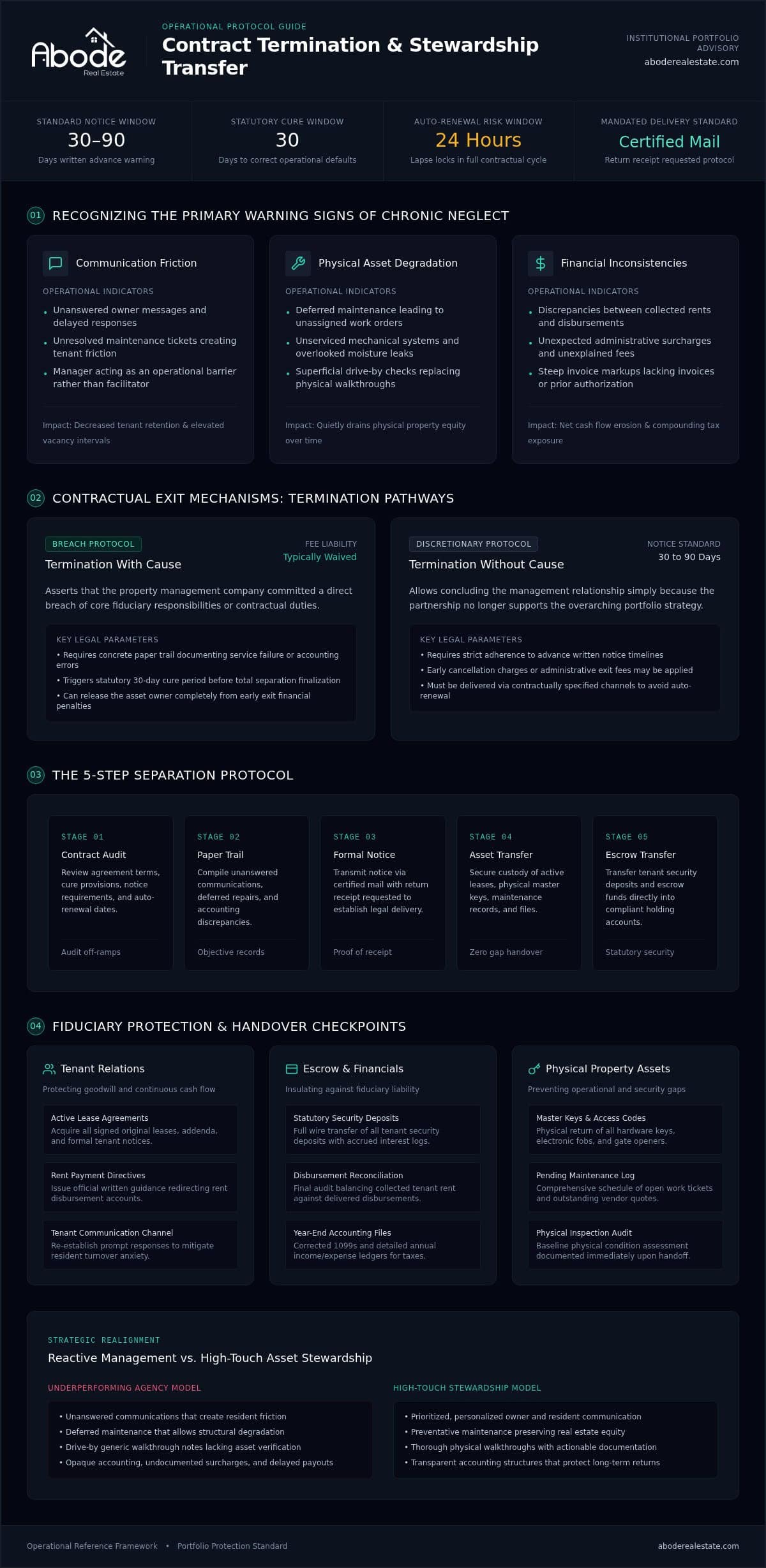
Agreements split into two primary mechanisms: termination with cause and termination without cause. A termination without cause allows you to conclude the relationship simply because the partnership no longer serves your investment goals. This route typically requires strict advance notice and may trigger early cancellation penalties. Conversely, terminating with cause asserts that the firm breached its core fiduciary duties, which can release you from termination fees entirely.
Decoding Termination Notice Windows and Deadlines
Notice windows usually demand between thirty and ninety days of advance written warning. Missing this window by even twenty-four hours can activate an automatic renewal clause, locking your property into another full contractual cycle. Examine the delivery requirements outlined in the agreement. Many firms mandate formal delivery via certified mail with return receipt requested rather than a standard email. Note whether the terms include a cure period, which grants the manager thirty days to correct defaults before you can finalize the separation.
Establishing Material Breach for Termination with Cause
Ending a contract for cause requires undeniable documentation of a material breach rather than subjective disappointment. Viable grounds include mishandling security deposits, violations of fair housing mandates, or chronic failure to address critical habitability repairs. Compile every unanswered email, dated tenant complaint, and unverified invoice into an organized digital ledger.
Always weigh the cost of an early termination fee against the ongoing revenue lost to vacant units, unvetted residents, and deferred maintenance. Paying a contractual fee to regain operational control is often far less costly than enduring perpetual mismanagement. If you want objective support auditing your current operational status, you can always connect with experienced advisors to plan a frictionless, professional transition.
How to Terminate Your Property Management Contract in 5 Steps
Ending a management relationship successfully comes down to method, not emotion. Without an organized roadmap, sudden terminations can trigger misplaced records, uncollected rents, or disputes over security deposits. Executing an orderly handover protects both your cash flow and your tenants. When determining how to fire a property management company, follow this sequential five-step procedure:
- Step 1: Secure comprehensive archives. Download all current rent rolls, financial ledgers, and open repair records from your owner portal before signaling your departure.
- Step 2: Issue formal termination. Transmit written notice conforming strictly to your agreement's contractual delivery stipulations and required notice windows.
- Step 3: Revoke administrative access. Restrict third-party control over digital locks, surveillance feeds, gate codes, and payment gateways.
- Step 4: Reconcile financial accounts. Audit final utility payments, return reserve balances, and transfer tenant security funds according to state deadlines.
- Step 5: Execute professional intake. Hand over onboarding files, inspect physical property conditions, and reassure current residents about the transition.
Drafting the Formal Notice of Termination Letter
Your termination correspondence should remain purely professional, objective, and brief. Explicitly reference the termination section in your agreement, cite the official handover date, and request formal written acknowledgment within forty-eight hours. Instruct the outgoing manager to freeze all non-emergency maintenance authorizations and outline instructions for forwarding upcoming rent payments. Establishing this written trail removes ambiguity.
Securing Physical Keys, Digital Codes, and Smart Access
Loss of access control creates substantial liability. Request an exhaustive physical inventory including front door keys, deadbolts, mailbox keys, and amenity fobs. Coordinate an in-person exchange on the final effective date at a neutral office. Concurrently, remove outgoing administrative permissions from smart thermostats, digital keypads, and building intercoms. Change master codes immediately to preserve tenant privacy and home security.
Reclaiming Leases, Tenant Records, and Operating Funds
Recovering complete tenant documentation guarantees an unbroken management record. You need the original executed leases, addenda, move-in inspection photographs, and tenant contact details. Demand undistributed monthly rental receipts along with maintenance reserves held in operating accounts.
Obtaining historical repair documentation and active vendor warranties prevents paying twice for past maintenance. Knowing how to fire a property management company cleanly means closing out every ledger entry, protecting your capital as you transfer operations to a more attentive management standard.
Protecting Tenant Relations and Escrow Funds During Handover
Tenant retention often hinges on how gracefully you navigate administrative changes. When residents sense operational friction between an owner and a management company, uncertainty quickly leads to withheld rent or lease abandonment. Preserving resident trust requires calm authority and transparent coordination. Successfully mastering how to fire a property management company involves treating tenant relations as a delicate asset that requires continuous, white-glove care throughout the transition.
A management change never invalidates an existing residential lease. The underlying contractual agreements, monthly rental amounts, and tenant protections remain intact. Your duty is to ensure that operational handoffs feel reassuring rather than disruptive, creating immediate confidence in your ongoing asset stewardship.
Transparent Communication with Current Residents
Misunderstandings happen when communication arrives late or lacks clarity. Provide a formal, written notice introducing the incoming management team at least two weeks before the official handover date. Reassure residents that their original agreements stand unchanged, their deposits remain secure, and pending service requests will receive prompt, personalized attention. Deliver explicit instructions detailing where and how to remit upcoming rent payments to prevent missed deadlines or confusion.
Auditing Security Deposit Transfers and Trust Accounts
Mishandling escrow funds carries severe legal exposure. Security deposits belong to your tenants and must transfer directly between segregated trust accounts without commingling. Safeguard this transfer by executing these precise steps:
- Reconcile the outgoing manager's security deposit balance sheet against executed initial lease agreements and recorded move-in receipts.
- Obtain a certified ledger of accrued statutory interest where required by applicable state or municipal property mandates.
- Deposit all funds directly into a dedicated escrow account compliant with regional banking regulations.
- Issue formal written notifications to tenants within mandated statutory deadlines confirming the name and branch address of the new holding institution.
Audit vendor contracts alongside escrow balances to prevent interruptions in municipal utility accounts, landscaping visits, or routine preventative maintenance. If your priority is protecting tenant trust and securing seamless accounting oversight, discover how full-service property management delivers high-touch stewardship that elevates your portfolio.
Transitioning to High-Touch Asset Stewardship
Leaving an unresponsive corporate franchise often tempts owners to manage properties themselves. True wealth preservation, however, rarely benefits from trading passive investment for late-night maintenance calls. The solution is not self-management; it is elevating your expectations. Learning how to fire a property management company frees your assets from high-volume corporate factories so you can transition toward boutique stewardship that treats real estate with refined care.
High-volume operators survive on sheer scale, assigning hundreds of doors to single, overburdened coordinators. In contrast, high-touch management emphasizes deliberate portfolio curation, calm authority, and hands-on attention. This personalized focus turns routine property oversight into a strategic discipline centered on long-term appreciation.
Key Criteria for Selecting a Boutique Management Partner
Selecting your next management partner requires looking beyond basic sales pitches to evaluate operational discipline. Ask direct questions to assess their commitment to transparency and asset preservation:
- What is your current property-to-manager ratio, and how does that support proactive, same-day owner communication?
- Do you provide real-time ledger accounting with itemized vendor receipts and zero administrative surcharges?
- Does your team possess comprehensive market expertise spanning luxury sales, leasing, and strategic investment acquisition?
Prioritizing low portfolio density ensures your properties receive dedicated attention rather than superficial oversight.
Executing a Frictionless Management Onboarding Plan
The onboarding phase sets the standard for your new engagement. A dedicated team begins by conducting a comprehensive physical baseline audit, cataloging architectural finishes, mechanical lifespans, and existing maintenance deferrals. This baseline assessment establishes an uncompromised standard for future inspections, ensuring accountability across every square foot.
Equally critical is direct resident outreach. A boutique team introduces themselves personally to each resident, taking time to hear lingering grievances left behind by previous managers. Repairing this rapport immediately restores tenant trust, lowering turnover risks while stabilizing predictable cash flow. Understanding how to fire a property management company is ultimately about creating this positive turning point. Connecting with premier full-service property management specialists elevates your real estate from a source of friction into an optimized, high-performing asset.
Reclaiming Control of Your Real Estate Investment
Ending an unproductive management partnership isn't a setback; it's a strategic realignment. By methodically auditing your contract, preserving crucial digital records, and shielding tenant relationships, you safeguard your portfolio's revenue and stability throughout every phase of the transfer. Navigating how to fire a property management company cleanly allows you to replace operational friction with genuine peace of mind.
You don't have to settle for opaque statements or delayed responses from high-volume corporate franchises. Your properties deserve tailored stewardship marked by calm authority, proactive preservation, and personal accountability. With dedicated client attention across luxury leasing, asset care, and acquisition advisory, a boutique model transforms property ownership from a recurring headache into an effortless, rewarding endeavor.
Elevate your real estate portfolio with refined property stewardship at Abode Real Estate. Reclaiming your standards is the first step toward long-term asset growth, and your journey toward exceptional management begins today.
Frequently Asked Questions
Can you fire a property management company before the contract ends?
Yes, you can terminate an agreement before its expiration date. Most standard contracts allow for early cancellation either without cause by paying a stipulated early termination fee or with cause if the firm fails to uphold its obligations. Reviewing your agreement's default clauses will determine whether you can exit immediately without financial penalty or if you must provide advance notice and pay an early termination assessment.
What constitutes a material breach of contract by a property manager?
A material breach occurs when a manager fails to perform core contractual duties that directly impact property operations or legal compliance. Common examples include mismanaging security deposits, failing to disburse monthly owner rental proceeds, neglecting critical habitability repairs, or violating fair housing regulations. Documenting these specific operational lapses provides legal grounds to terminate the agreement for cause without incurring early cancellation penalties.
How much notice must an owner give before terminating management services?
Most residential management agreements require between thirty and ninety days of formal written notice. The specific window depends on your executed contract terms and local statutory standards. When planning how to fire a property management company, always verify the required delivery method, such as certified mail, to ensure your notice is legally binding and prevents triggering unwanted automatic renewal clauses.
What happens to tenant security deposits when switching property management companies?
Security deposits must transfer directly between segregated trust accounts to comply with statutory escrow regulations. The outgoing manager cannot simply release these funds to an owner's personal checking account. Once the new firm or dedicated escrow account receives the balance alongside an itemized accounting ledger, you or the incoming manager must send written notification to residents stating where their funds are currently held.
What should an owner do if a property manager refuses to hand over keys or records?
If a firm unlawfully withholds access or documentation after receiving proper notice, issue a formal demand letter via legal counsel immediately. Remind them of their statutory fiduciary responsibilities and licensing accountability. Concurrently, rekey property exterior locks, update digital keypads, and contact residents directly to reconstruct lease files, payment ledgers, and maintenance histories while lodging an administrative complaint with the state real estate licensing commission.
Will firing a property management company disrupt current tenant leases?
Terminating a property manager never alters or invalidates active tenant leases. Lease agreements remain legally binding contracts between the property owner and the resident, with the management firm acting merely as an agent. The only structural changes tenants experience involve where they submit monthly rent payments and who coordinates their maintenance requests. Proactive, transparent communication ensures the operational handoff remains smooth and reassuring for residents.
How do high-touch boutique property managers handle the takeover process?
Boutique firms manage the transition through tailored onboarding designed to eliminate operational friction. Rather than using impersonal automated portals, they conduct on-site physical baseline audits, inventory keys and documents, and engage residents individually to establish rapport. Understanding how to fire a property management company smoothly culminates in partnering with dedicated specialists who prioritize low property-to-manager ratios, pristine financial reporting, and long-term asset preservation.
Posted by Brook Walsh onEnjoy this blog post? Click here to subscribe for updates
Leave A Comment