

What if the greatest risk to your luxury real estate investment isn't the market's volatility, but the very handshake that started the deal? Most high-net-worth investors understand that a shared vision is the foundation of any successful venture, yet the transition from a shared dream to a legally sound structure often feels like a hurdle of overwhelming complexity. You likely feel the weight of ensuring equitable profit distribution while protecting your personal assets from unforeseen liabilities. It's a delicate balance between ambitious growth and careful preservation.
This guide will help you master the intricacies of high-end real estate partnerships to maximize your ROI and mitigate the risks inherent in the national market. You'll gain a clear roadmap for partnership formation that prioritizes both tax efficiency and liability protection. We'll examine how to select the right legal entities, such as state-specific LLCs or Limited Partnerships, and how to align investor goals to create a scalable, frictionless investment model for the most prestigious properties.

Key Takeaways
- Understand why pooling resources is the most effective way to scale your luxury real estate investment in South Florida while distributing risk across high-value assets.
- Compare the protective benefits of Limited Liability Companies against the specialized structure of Limited Partnerships for institutional-grade investments.
- Define clear governance through a comprehensive Operating Agreement that establishes protocols for decision-making and mitigates potential friction between partners.
- Explore sophisticated capital contribution strategies and the "waterfall" profit distribution model used to optimize returns for high-end portfolios.
- Establish a secure exit plan with detailed buy-sell provisions and liquidation triggers to protect your equity and ensure a graceful transition.
Table of Contents
- Understanding the Foundations of a Luxury Real Estate Partnership
- Selecting the Optimal Legal Entity for Your Investment
- Key Components of a Robust Partnership Agreement
- Capital Contributions and Profit Distribution Strategies
- Risk Mitigation and Exit Strategies for Luxury Portfolios
Understanding the Foundations of a Luxury Real Estate Partnership
A real estate partnership is more than a shared bank account; it's a strategic alliance designed to capture the essence of high-tier living. In the context of luxury real estate investment in South Florida, these collaborative vehicles allow investors to pool their resources to acquire high-value assets that command attention. This method isn't just about purchasing power. It's about the sophisticated management of risk and the pursuit of long-term capital appreciation through a curated move into a new chapter of asset growth.
Pooling resources also provides a vital avenue for diversification. Instead of concentrating wealth into a single residence, a partnership allows for the acquisition of a curated collection of properties. This strategy not only maximizes potential ROI but also secures the tax advantages and social prestige associated with owning premier assets in one of the world's most sought-after regions. It transforms the investment from a mere financial hurdle into a sophisticated discipline.
To better understand this concept, watch this helpful video:
Why Investors Choose Partnerships for High-End Assets
The regional market is defined by its exclusivity and its pace. Investors often choose partnerships to gain access to trophy properties that might otherwise remain out of reach. By combining liquid capital with localized technical expertise, partners can navigate high-stakes transactions with quiet authority. This collaborative approach offers several distinct advantages:
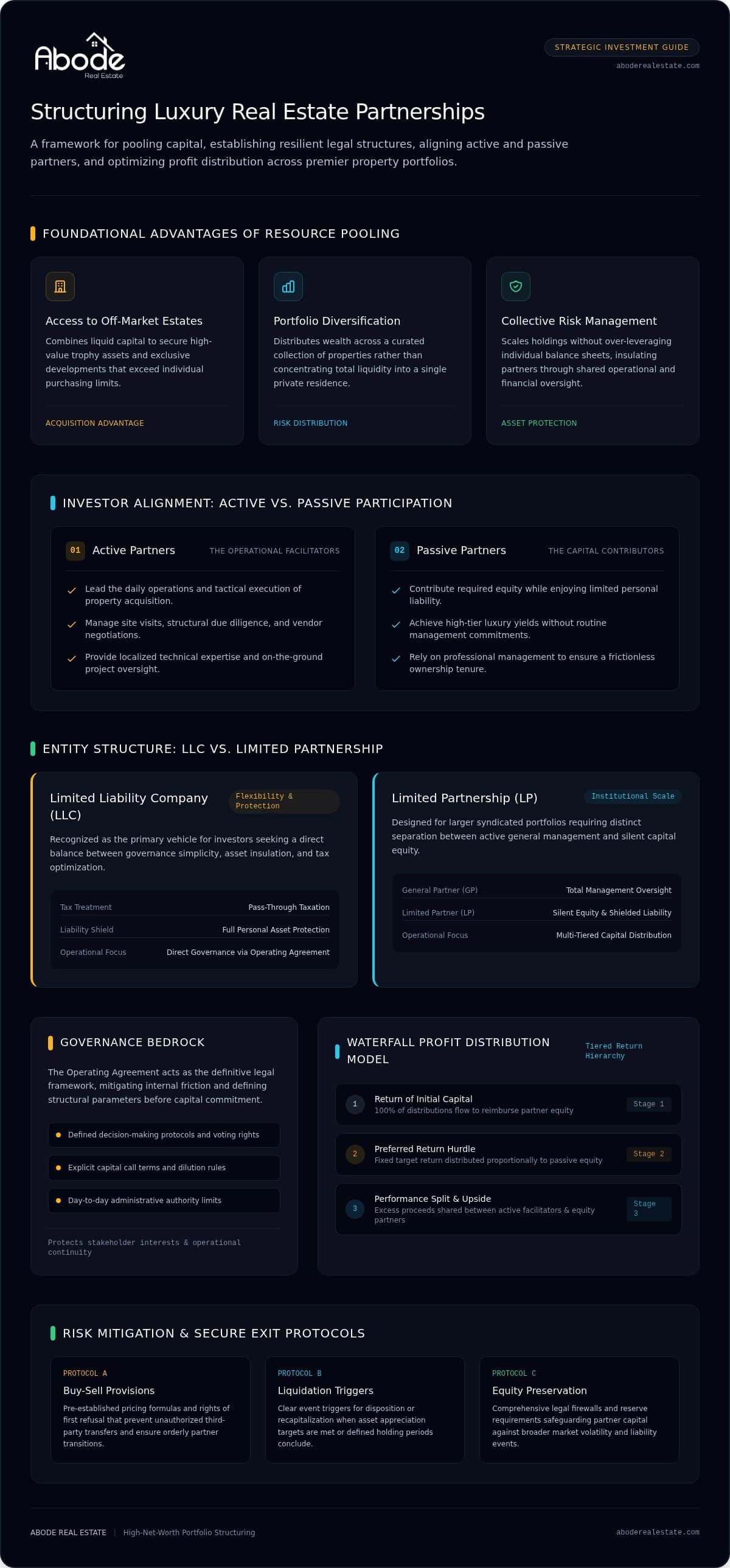
- Access to off-market estates and exclusive developments that require significant capital.
- Professional risk management through shared liability and collective oversight.
- Enhanced scalability for growing a high-end portfolio without over-leveraging personal liquidity.
A well-structured limited liability company operating agreement ensures that these advantages are clearly defined and legally protected. This document acts as the bedrock for the venture, providing a sense of calm confidence for every stakeholder involved in the process.
Active vs. Passive Participation Models
Determining your level of involvement is a crucial step in the planning process. Active partners take on the role of the high-level facilitator, managing the daily operations and tactical execution of investment property acquisition. They handle the mechanics of the trade, from site visits to vendor management. They're the guides who ensure the vision remains grounded in reality.
Conversely, passive partners provide the necessary capital while benefiting from limited liability protections. This model allows for the rewards of luxury ownership without the demands of constant oversight. It's a preferred choice for those who value their time as much as their returns. For these investors, professional property management becomes the bridge between their capital and a frictionless ownership experience, turning a complex asset into a serene personal retreat.
Selecting the Optimal Legal Entity for Your Investment
Choosing the right legal structure is where the vision of a luxury real estate investment in South Florida meets the reality of asset protection. It's the silent framework that supports your entire portfolio. For many, this process begins with a choice between operational flexibility and institutional scale. High-net-worth individuals often prioritize privacy and tax efficiency, making the selection of an entity a refined craft rather than a mere administrative task. It's about ensuring that your arrival into this market is as secure as it is prestigious, allowing you to focus on the lifestyle value of your acquisitions rather than the mechanics of liability.
The LLC: Flexibility and Protection
The Limited Liability Company (LLC) remains the gold standard for those seeking a balance of simplicity and security. It offers a sophisticated blend of pass-through taxation and robust protection from personal liability. You can manage your holdings with clear governance while keeping your personal assets insulated from the risks associated with property ownership. This structure allows the financial benefits of the property to flow directly to the partners without the burden of double taxation. When you're ready to formalize your venture, following the Florida Division of Corporations LLC guidelines ensures your entity is compliant with state statutes from the very beginning. It's a foundational step that provides a sense of ease and clarity for everyone involved.
Limited Partnerships and Joint Ventures
Limited Partnerships (LP) and Joint Ventures (JV) serve more specialized needs. A JV is often ideal for a single-asset acquisition where two partners bring unique strengths to one specific property. It's a targeted, intentional strike on a high-value opportunity. LPs, however, are better suited for multi-property portfolios or institutional-grade investments. In these structures, the General Partner (GP) handles the daily facilitation and tactical planning while Limited Partners (LP) enjoy a more passive role with capped liability. This separation of duties allows for a scalable model that mirrors the frictionless experience you expect from high-end management. It’s an unhurried way to grow wealth across several high-end properties simultaneously without over-extending your personal time.
Beyond liability, these entities provide a vital layer of anonymity. In the high-stakes world of luxury property, keeping your name off public records can be as valuable as the land itself. It's about creating a personal retreat that remains truly personal, away from the clinical gaze of the public eye. If you're looking to refine your approach, exploring a comprehensive investment property acquisition plan can help you align your legal structure with your long-term lifestyle goals.
Key Components of a Robust Partnership Agreement
The operating agreement is the silent architect of your venture. While your choice of entity provides the legal shell, the agreement provides the internal logic that governs every high-stakes decision. Luxury real estate investment in South Florida demands a level of precision that transcends basic contract law; it requires a bespoke document that anticipates the unique pressures of the high-end market. Relying on a generic template is a risk that few sophisticated investors are willing to take. Instead, a tailored agreement ensures that every partner understands their role, their rights, and the shared vision for the asset's future.
Before finalizing these details, reviewing the Florida Division of Corporations guide to business entity structures can provide a helpful baseline for how your agreement should align with state expectations. This alignment is the first step toward a frictionless partnership that prioritizes long-term integrity over quick wins.
Defining Decision-Making Authority
Clarity in governance is the antidote to anxiety. Your agreement must clearly distinguish between major decisions that require unanimous consent and the daily operational autonomy of the managing partner. Selling a trophy property or securing significant new financing are typically reserved for the collective group. Conversely, the managing partner needs the freedom to handle routine maintenance and vendor relations without a board meeting. When disagreements arise, having a pre-defined dispute resolution protocol prevents a temporary deadlock from becoming a permanent financial hurdle. It's about establishing a cadence of trust that allows the partnership to move with quiet authority.
The Role of Professional Property Management
A luxury asset is more than a line item on a balance sheet; it is a living retreat that requires meticulous care to maintain its value. Integrating Full-service property management into your partnership framework ensures that the guest experience and property maintenance are never compromised. This oversight acts as a third-party buffer, providing objective reporting on the asset's health and performance. It allows the partners to remain high-level facilitators rather than getting lost in the mechanical aspects of the trade. For a luxury real estate investment in South Florida to truly thrive, the partnership must prioritize a high-touch service model that preserves both the physical dwelling and the investor's peace of mind.
The agreement should also outline the process for capital calls. Luxury properties often require sudden, significant funding for upgrades or emergency repairs. Defining exactly how and when partners must contribute additional capital prevents confusion and ensures the portfolio remains resilient. It's a pragmatic approach to a sophisticated discipline that keeps the investment grounded while the returns remain aspirational.
Capital Contributions and Profit Distribution Strategies
The financial architecture of a luxury real estate investment in South Florida is where the partnership's vision is translated into tangible results. It's an intentional process that ensures every contributor feels valued, and every dollar is optimized. While the legal entity provides the shell, the distribution strategy provides the incentive. Most partnerships begin with clear capital contributions, but the way profits are harvested requires a more nuanced approach that balances immediate cash flow with long-term capital appreciation.
Designing the Equity Split
Establishing an equitable split is about more than just matching bank statements to ownership percentages. While pro-rata distributions based on initial capital are the standard, sophisticated partnerships often account for the unique value a managing partner brings to the table. This sweat equity recognizes the tactical planning and localized expertise required to source and manage exclusive assets. It's also vital to outline how equity might shift if future capital infusions are needed. A well-defined agreement ensures that if one partner provides additional funding for a renovation, their ownership reflects that commitment without creating friction among the group.
The Waterfall Distribution Model
For high-end portfolios, the waterfall model is the preferred method for aligning interests in a luxury real estate investment in South Florida. This tiered profit-sharing structure rewards performance by hitting specific Internal Rate of Return (IRR) hurdles. It provides a sense of ease and clarity by defining exactly when and how funds are dispersed:
- Preferred Return: Investors receive a baseline percentage, often 7% to 10%, before other splits occur.
- GP Catch-up: The managing partner receives a portion of profits to align their total share with the agreed percentage.
- Promoted Interest: Higher profit tiers that reward the manager for exceeding IRR targets, often referred to as the carry.
This level of financial precision turns the investment into a refined craft, providing transparency through detailed reporting. It ensures that the rewards of the venture are shared in a way that reflects both the capital at risk and the expertise applied to the asset's growth.
Beyond profit, the partnership must address the unhurried reality of maintaining a trophy asset. Ongoing expenses and robust reserve fund requirements should be clearly established to handle the high-touch care these properties demand. This proactive stance prevents sudden financial hurdles and preserves the lifestyle-oriented value of the dwelling. If you're ready to explore how these structures apply to specific opportunities, reach out to speak with a boutique investment specialist today.
Risk Mitigation and Exit Strategies for Luxury Portfolios
A successful luxury real estate investment in South Florida is defined not just by how you enter the market, but by how gracefully you can depart. It's about protecting the social bonds and financial legacy you've built through a curated move into a new chapter of asset management. While the focus is often on the arrival and the acquisition, a sophisticated partnership prioritizes the preservation of capital through every stage of the property's lifecycle. Establishing a clear roadmap for the end of the venture is a refined craft that ensures every partner's exit is as unhurried and professional as their entry.
Buy-sell provisions and a "right of first refusal" act as the primary safeguards for the partnership's integrity. These clauses ensure that if one member decides to liquidate their interest, the remaining partners have the first opportunity to acquire it, preventing the intrusion of unvetted third parties into a private venture. Professional valuation plays a critical role here, providing an objective baseline that reduces the friction often associated with high-stakes transitions. By integrating these Investment property acquisition strategies into your initial planning, you create a sense of calm confidence that lasts until the final sale.
Planning for the Unforeseen
Integrity and transparency are most vital when life takes an unexpected turn. Your agreement must address the clinical realities of partner death, disability, or bankruptcy with quiet authority. Shotgun clauses serve as a decisive, albeit final, mechanism for dispute resolution, allowing one partner to name a price at which they will either buy out the other or be bought out themselves. This ensures that a deadlock never becomes a permanent financial hurdle. Complementing these legal triggers with robust insurance requirements protects both the physical dwelling and the partnership's liquid capital, providing emotional security for all stakeholders.
The Strategic Exit
A strategic exit is rarely a reaction to market whims; it's a planned event triggered by specific performance hurdles or timeline milestones. Whether you're targeting a five-year hold or a specific internal rate of return, having a pre-defined trigger for asset liquidation allows the partnership to move with intention. For those looking to reinvest, navigating a 1031 exchange within a partnership context is a specialized skill that can defer significant tax liabilities and facilitate a move into even more prestigious holdings.
Abode Real Estate acts as your trusted advisor throughout this process, facilitating seamless luxury transitions that prioritize your long-term goals. We provide the localized market data and high-touch service models required to optimize the value of your asset when the time comes to sell. Our team ensures that the final stages of your luxury real estate investment in South Florida are handled with the same precision and care as the initial purchase, turning a complex transaction into a frictionless success.
Securing Your Legacy in the South Florida Market
Structuring a successful venture requires more than just capital; it demands a strategic alignment of vision and protection. By selecting the optimal legal entity and crafting a robust operating agreement, you transform a high-stakes transaction into a sustainable model for growth. Mastering these complexities ensures that your luxury real estate investment in South Florida remains a source of both financial reward and personal pride. Whether you're navigating tiered profit distributions or establishing clear exit triggers, a well-defined framework is the bedrock of a frictionless ownership experience.
Since 2018, Abode Real Estate has served as a trusted advisor for sophisticated investors seeking boutique expertise. We provide comprehensive investment property analysis and luxury residential sales tailored to your specific lifestyle goals. Our team acts as high-level facilitators, ensuring every detail of your partnership is managed with precision and quiet authority. When you're ready to move beyond market data and into tactical execution, we are here to guide you. Contact Abode Real Estate for a Curated Investment Strategy and begin your next chapter with confidence. Your future in this exclusive market is waiting to be built on a foundation of integrity and expert care.
Frequently Asked Questions
What is the most common legal structure for a luxury real estate partnership?
The Limited Liability Company (LLC) is the most frequent choice for a luxury real estate investment in South Florida because it balances asset protection with tax flexibility. This structure allows for pass-through taxation while shielding partners from personal liability. It's an intentional framework that accommodates various equity splits and management roles. High-net-worth investors often prefer this model for its ability to maintain privacy through specialized filing strategies that keep personal names off public records.
How do you structure a real estate partnership with no money?
Structuring a partnership without capital typically involves contributing sweat equity as the managing partner. In this model, you provide the technical expertise, localized market knowledge, and daily facilitation while your partner provides the necessary liquidity. This arrangement recognizes that specialized skill is as valuable as cash. It's a refined craft that requires a clear operating agreement to define how your time and results translate into ownership over the long term, ensuring the venture remains grounded.
What should be included in a real estate partnership operating agreement?
A robust operating agreement must detail governance protocols, capital contribution requirements, and clear exit strategies. It acts as the internal logic for your luxury real estate investment in South Florida, covering everything from daily decision-making authority to the triggers for asset liquidation. You should also include provisions for dispute resolution and the management of reserve funds. Establishing these rules early provides a sense of ease and clarity for every stakeholder involved in the high-stakes venture.
How are profits usually split in a high-end real estate partnership?
High-end partnerships often use a waterfall distribution model to ensure equitable returns for both capital and expertise. This tiered approach typically begins with a preferred return for investors before moving into a catch-up phase for the managing partner. Finally, profits are split based on performance hurdles, often rewarding the manager with a promote for exceeding specific internal rate of return targets. It's a sophisticated discipline that aligns everyone's financial interests with the asset's long-term success.
What happens if one partner wants to sell the property and the other doesn't?
When partners disagree on a sale, the operating agreement's buy-sell provisions or right of first refusal take precedence. These clauses allow one partner to purchase the other's interest at a professionally appraised value, ensuring the property remains within the group if desired. If a resolution can't be reached, a shotgun clause may be triggered, requiring one partner to name a price at which they will either buy or sell. This prevents permanent deadlocks from becoming financial hurdles.
How do capital calls work in a luxury real estate investment?
Capital calls are formal requests for additional funding from partners to cover unforeseen expenses or planned property enhancements. Your agreement should define the specific triggers for these calls and the notice period required for contributions. If a partner fails to meet the call, their equity may be diluted according to a pre-set formula. This proactive stance ensures the portfolio remains resilient and that the property continues to provide a serene personal retreat for guests or residents.
What is the difference between a general partner and a limited partner?
A general partner acts as the high-level facilitator with full management control and personal liability for the venture's obligations. In contrast, limited partners provide the capital and enjoy liability capped at their investment amount, but they've no say in daily operations. This separation allows for a scalable investment model where passive investors can benefit from the expertise of a refined local expert without the burden of constant property oversight or the mechanical aspects of management.
How does professional property management impact partnership ROI?
Professional property management enhances ROI by optimizing guest experiences and maintaining the asset's physical integrity. By utilizing high-touch service models, managers can command premium rental rates and ensure the dwelling remains a sought-after destination. This oversight also provides partners with objective financial reporting and tactical planning, reducing the anxiety often associated with multi-member holdings. It transforms a complex physical asset into a high-performing financial vehicle that preserves long-term value and secures your professional arrival in the market.
Posted by Brook Walsh onEnjoy this blog post? Click here to subscribe for updates
Leave A Comment