

What if a property rises in value yet still leaves you poorer in real terms? That’s the question at the heart of inflation hedging with real estate. In August 2026, U.S. inflation was 3.4% year over year, according to the Bureau of Labor Statistics. Property may respond to rising prices through rental income, asset values, and the potential advantage of a fixed-rate mortgage, but these mechanisms don’t work automatically or on the same timeline. A headline gain doesn’t tell the whole story.
A tangible asset and rental income can seem like a natural counterweight to rising costs. Yet higher financing expenses, maintenance, vacancies, and property taxes can narrow or erase the potential advantage. Other investments come with different trade-offs. This guide explains how rents, property values, and fixed-rate financing may support a hedge, where that logic can break down, and how real estate compares with alternatives. You’ll also find a practical way to weigh income, expenses, financing, and management needs before committing, without treating inflation protection as a promise.

Key Takeaways
- Inflation hedging with real estate depends on how rental income, ownership expenses, financing, and property demand interact, not on property ownership alone.
- Compare direct property ownership with REITs, stocks, and inflation-linked bonds by considering liquidity, management effort, income, and risk.
- Test an investment using conservative, base, and adverse scenarios to see how changes in income, expenses, or financing could affect its resilience.
- Review lease terms, property condition, and management requirements alongside projected income before deciding whether an opportunity fits your goals.
- Acquisition analysis and ongoing property oversight can help you examine assumptions and track income, maintenance, and financial reporting.
Table of Contents
- What Does Inflation Hedging With Real Estate Actually Mean?
- How Inflation Can Affect Rents, Property Values, and Ownership Costs
- Real Estate vs. Other Inflation-Hedging Approaches: What Should You Compare?
- How to Assess a Property’s Potential Inflation Resilience
- Where Professional Property Guidance Fits Into an Inflation-Hedging Plan
What Does Inflation Hedging With Real Estate Actually Mean?
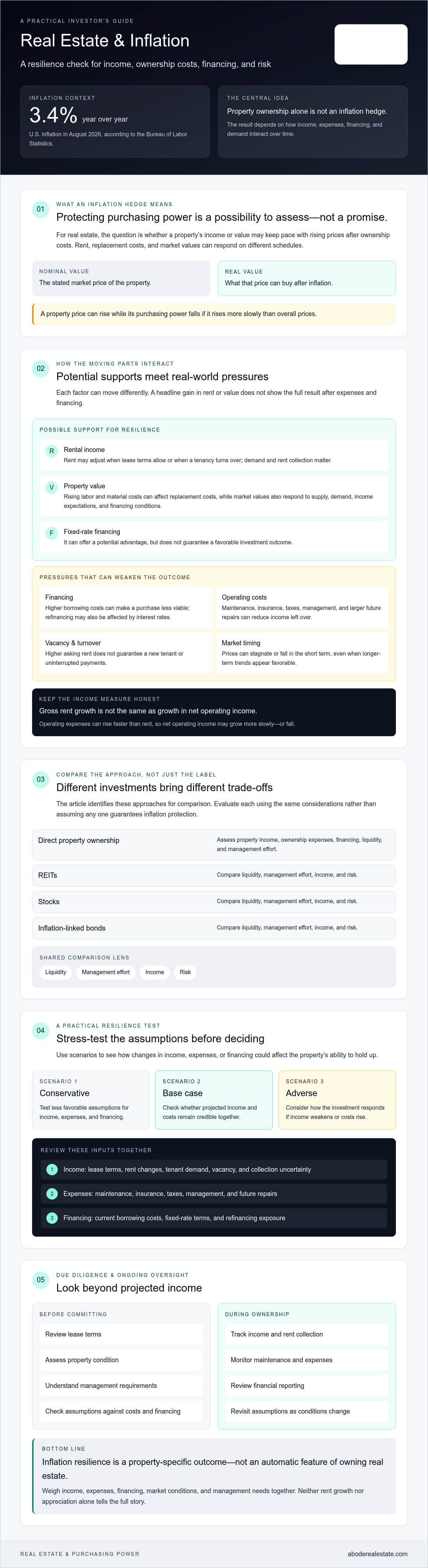
Inflation hedging means trying to limit the effect of rising prices on purchasing power. In real estate, it means assessing whether a property’s income or value may keep pace with inflation over time, after accounting for ownership costs. It’s a possibility to evaluate, not a promise of protection.
Property is sometimes viewed as inflation-sensitive because rents may adjust and rising construction costs can affect the value of existing homes. But these forces don’t move in lockstep. A property’s nominal value is its stated market price; its real value reflects what that price can buy after inflation. If a property’s price rises more slowly than overall prices, for example, its nominal value has increased while its purchasing power has declined.
A useful starting point is the general idea of an inflation hedge: an asset or strategy intended to reduce inflation’s impact, rather than eliminate investment risk. For a property owner, that means looking beyond the listing price to rental income, operating expenses, financing, and the time horizon for holding the asset.
How can real estate respond to inflation?
Rents, replacement costs, and property values can respond on different schedules. Replacement costs may rise as labor and materials become more expensive. Rental income depends on lease terms, tenant demand, and the owner’s ability to adjust rents. Property values also reflect supply and buyer demand, so they may not track inflation in any given period.
Over a longer period, income or values may rise, but prices can stagnate or fall in the short term. A possible long-term trend doesn’t guarantee a favorable result at the time you need to sell.
What does an inflation hedge not guarantee?
Inflation hedging with real estate doesn’t guarantee that a property will preserve purchasing power, appreciate, or produce positive returns. Potential rent growth is only one part of performance. Appreciation is another, and neither alone shows the full result after expenses and financing.
Inflation can also raise maintenance and other ownership costs, potentially outpacing income. Owners considering ongoing oversight can review what full-service property management includes, such as rent collection, maintenance coordination, and financial reporting. The practical test is whether the property’s income and value assumptions remain credible after costs are included.
How Inflation Can Affect Rents, Property Values, and Ownership Costs
Inflation can influence several parts of a property’s financial picture, but not at the same pace. Rent may change when a lease allows it or when a tenancy turns over. Labor and materials may become more expensive, raising maintenance or replacement costs. Borrowing costs can also shift, particularly for buyers taking out new loans or owners refinancing. The result depends on timing, financing structure, lease terms, and demand for the property.
Property values are shaped by more than construction costs. Supply, buyer demand, expected income, and financing conditions can all affect what buyers are willing to pay. Even if replacement costs rise, a property’s market value may not follow immediately, or at all. Inflation hedging with real estate therefore means examining income and expenses alongside potential resale value.
Can rental income keep pace with inflation?
Lease terms determine when rent can change. A fixed rent may remain unchanged until renewal, while other lease structures may allow adjustments at specified times. Strong demand may give an owner room to raise rent when a unit becomes available, but a higher asking rent doesn’t guarantee a new tenant or uninterrupted payments.
Vacancy, turnover, and uncertainty about rent collection can reduce the income actually received. Gross rent growth is not the same as growth in net operating income, which accounts for operating expenses. Net operating income can rise more slowly than rent, or even fall, as costs increase.
Why can financing and expenses weaken the hedge?
Interest rates influence the cost of new borrowing and may affect whether refinancing is attractive. An owner with fixed-rate financing has different exposure from a buyer who must borrow at current rates, but neither structure guarantees a favorable investment outcome. Higher borrowing costs can make an acquisition less viable even if projected rents are rising.
Operating and capital costs also deserve careful review. Maintenance, insurance, taxes, management, and larger future repairs can all reduce the income left after expenses. A property may collect more rent yet deliver weaker net returns if costs rise faster. Model both sides of the ledger, including vacancy periods and anticipated capital needs, rather than relying on revenue growth alone.
For a more tailored review of acquisition assumptions, investment property acquisition guidance can help bring income, expenses, and financing into one assessment. The central question is not simply whether rents might rise, but whether the property’s overall cash flow and value can withstand changing conditions.
Real Estate vs. Other Inflation-Hedging Approaches: What Should You Compare?
To compare inflation hedges, look beyond what an asset owns or how it’s described. Consider how you gain exposure, how easily you can sell, how much effort it requires, how income is generated, and what could cause a loss. The options below have different structures and risks. None guarantees that your purchasing power or investment value will be preserved.
| Approach | Exposure | Liquidity and effort | Income and principal risks |
|---|---|---|---|
| Direct property ownership | A specific property and its rental income, if leased | Sale can take time; ownership involves operating and management responsibilities | Rent may provide income; vacancy, expenses, financing, property condition, and market value can affect results |
| Publicly traded real estate investment trusts (REITs) | Shares in a company or trust holding or financing real estate | Publicly traded shares can generally be bought and sold through a brokerage account; market prices fluctuate | May distribute income; share prices and distributions can change, and principal can fall |
| Stocks | Ownership in companies across different industries | Publicly traded shares are generally easier to trade than direct property; no property operations to manage | Returns may come from price changes and dividends; business performance and market conditions create risk |
| Inflation-linked bonds | Debt with principal or payments linked to an inflation measure, subject to the bond’s terms | Tradability varies by bond; investors should review its structure and maturity | Payments follow the bond’s terms; market prices and the issuer’s ability to meet obligations remain relevant risks |
Direct property ownership versus publicly traded real estate
Direct ownership offers more control over a particular asset, along with responsibility for its operations. Publicly traded real estate can provide exposure without managing a building, but investors have less control over individual properties and face visible, changing market prices. A private property’s value may not be repriced daily, but that doesn’t make it more stable or easier to sell. Neither structure is assured to outperform during inflation.
Property compared with stocks and inflation-linked bonds
Property ties results to real estate income, costs, and market conditions. Stocks reflect company and broader market performance, while inflation-linked bonds follow specified terms tied to an inflation measure. Because these risks differ, diversification may help avoid relying on one source of return, though it can’t eliminate loss. Suitability depends on your goals, resources, and risk tolerance. For portfolio-specific decisions, consider qualified financial advice. This comparison provides a broader lens for assessing inflation hedging with real estate, not a promise that any one approach will prevail.
How to Assess a Property’s Potential Inflation Resilience
Assess a property’s potential to withstand inflation by examining its assumptions, not relying on a single forecast. Review the income it could reasonably produce, the costs required to operate it, and how financing and ownership needs may change. Then test whether the investment remains workable under less favorable conditions.
- Examine income assumptions. Base rent estimates on the property and its lease terms. Account for possible vacancy, turnover, or delayed rent adjustments, and don’t assume rents will automatically keep pace with inflation.
- Map operating and capital expenses. Include maintenance, insurance, taxes, management, and potential larger repairs. Consider how rising costs could affect cash flow, even if gross income grows.
- Review financing. Understand the current loan terms and whether future refinancing could expose the investment to different borrowing costs. Discuss financing questions with a qualified adviser.
- Assess condition and future needs. Review the property’s condition and likely maintenance requirements before relying on projected income. An attractive rent estimate may not account for work needed to keep the property in service.
- Check management capacity and time horizon. Consider how much oversight you can take on, how long you expect to hold the property, and whether you may need access to your capital sooner.
Stress-test income, expenses, and financing assumptions
Build three scenarios: conservative, base, and adverse. In the adverse case, test lower collected rent, longer vacancy, higher operating costs, or less favorable refinancing terms. Use cautious assumptions in the conservative case, and make sure the base case reflects your best-supported expectations. Avoid using market averages or projected returns without relevant, verified evidence. If a scenario only works when every assumption is favorable, treat that as a signal to reconsider the risk.
Assess condition, ownership horizon, and management capacity
Management is an operating choice, not a performance guarantee. Decide whether you have the time and systems to oversee rent collection, maintenance coordination, and financial reporting, or whether professional property management better fits your capacity. Investment property acquisition analysis can also help organize the practical details you’ll want to consider before buying.
Property-specific underwriting can help organize assumptions, but it isn’t a substitute for legal, tax, or financial advice. For tailored acquisition guidance, contact Abode Real Estate about an investment property. A careful review can clarify the decision, but it can’t guarantee the outcome.
Where Professional Property Guidance Fits Into an Inflation-Hedging Plan
Even a careful model depends on the quality of its assumptions. A property adviser can help assess whether a particular home or investment property fits your objectives, examine acquisition details, and bring expected income, expenses, condition, and management needs into one clear picture. That can make the decision more informed, but it can’t guarantee returns or determine whether a property will keep pace with inflation.
What an experienced property adviser can help evaluate
Ask how an analysis accounts for rent assumptions, possible vacancies, operating costs, financing terms, property condition, and ongoing oversight. A useful discussion should make uncertainties visible, not simply present an optimistic projection. Abode Real Estate offers investment property analysis and acquisition services to help buyers consider how a property’s practical details align with their plans.
A real estate professional’s role is distinct from personalized tax, legal, or financial advice. Those questions belong with qualified professionals in the relevant fields. Keep that distinction clear as you build a broader plan for inflation hedging with real estate.
Choosing a next step that fits your objectives
Before discussing an opportunity, clarify your intended ownership horizon, liquidity needs, and preferred level of involvement. Gather available financing information, property-condition details, lease or income assumptions, and expected operating expenses. These materials can focus the conversation on what matters to you, including how the property might perform if income or costs differ from expectations.
Ongoing oversight is another choice to weigh. Property management can include rent collection, maintenance coordination, and financial reporting. Review the scope of full-service property management to understand how these responsibilities may be handled. Management can support day-to-day ownership, but it doesn’t guarantee income, appreciation, or inflation protection.
If you’re ready to explore a potential acquisition, discuss your property goals with an advisor. A thoughtful conversation can help identify what to investigate next, while leaving room for independent legal, tax, and financial guidance.
Make Your Next Property Decision With Clarity
Inflation hedging with real estate is not automatic. A property’s potential depends on how income, operating costs, financing, condition, and management demands work together. Compare those details against other investment options, then test your assumptions under less favorable scenarios before committing.
Thoughtful analysis can help you see where an opportunity may fit and where uncertainty remains. Abode Real Estate offers investment property acquisition analysis, along with property management that includes rent collection, maintenance coordination, and financial reporting. These services can support informed ownership decisions, but they can’t guarantee investment performance or replace personalized financial, tax, or legal advice.
If you’re considering a property, take the next step with a clear view of your goals and the questions you still need answered. Explore property guidance from Abode Real Estate and move forward with care and confidence.
Frequently Asked Questions
Does real estate hedge against inflation?
Real estate can help limit inflation’s effect on purchasing power, but it isn’t a reliable or automatic hedge. Rents or property values may rise over time, yet operating expenses, financing costs, vacancies, and market conditions can offset those gains. Inflation hedging with real estate depends on a particular property’s income, costs, financing structure, and ownership horizon. Assess those factors together rather than assuming a home will preserve its real value.
How does inflation affect property values and rents?
Inflation may raise construction and maintenance costs, which can influence replacement costs, while rental prices may change as leases renew or units turn over. Property values also respond to buyer demand, available supply, financing conditions, and expected income. These factors move on different timelines. A property’s listed price can increase while its purchasing power falls if it rises more slowly than the general price level.
Can rental income keep up with inflation?
It can, but there’s no guarantee. Lease terms determine when rent can be adjusted, and market demand affects what tenants may be willing or able to pay. Vacancy, turnover, and missed or delayed payments can reduce collected rent. Even if gross rent increases, higher maintenance, insurance, taxes, or management expenses may leave less income after operating costs. Compare net income, not rent growth alone.
Is real estate better than stocks or inflation-linked bonds for hedging inflation?
There isn’t one best choice for every investor. Direct property offers exposure to a specific asset and may involve hands-on responsibilities; stocks reflect company performance, while inflation-linked bonds follow the terms of their inflation measure. Publicly traded real estate can offer property exposure without directly managing a building, but share prices fluctuate. Compare liquidity, income, effort, and principal risks, and seek qualified financial advice for portfolio-specific decisions.
What happens to real estate when interest rates rise during inflation?
Higher interest rates can increase borrowing costs for new purchases and may make refinancing less attractive. They can also affect what buyers can afford and how investors value expected property income, potentially putting pressure on demand or prices. The effect varies with market conditions and financing structure. A property with rising rent isn’t necessarily more profitable if debt costs and other expenses rise as well.
How can I assess whether an investment property may withstand inflation?
Review realistic rent and vacancy assumptions, operating and maintenance costs, financing terms, property condition, and the time and attention ownership will require. Test conservative, base, and adverse scenarios, including lower collected income or higher expenses, rather than relying on one forecast. Consider whether the property remains workable if assumptions disappoint. Acquisition analysis can help organize these questions, but it doesn’t guarantee returns or replace legal, tax, or financial advice.
Posted by Brook Walsh onEnjoy this blog post? Click here to subscribe for updates
Leave A Comment