

What if the most attractive multi-family property on paper is the weakest investment once you account for vacancies, repairs, and day-to-day operations? Investing in multi-family properties takes more than comparing unit counts or asking rents. Each building is an operating business. Its income potential depends on what it earns, what it costs to run, and how reliably it can serve its residents.
When properties differ in condition, expenses, financing needs, and management demands, a consistent evaluation process can help you compare them. This guide explains how to assess income and operating costs, compare property types and ownership approaches, and investigate risks such as vacancies and maintenance. It also covers what to verify before making an offer and how acquisition analysis and professional management may support your ownership plans. The goal is to help you decide whether a property fits your criteria, not simply whether its numbers look appealing at first glance.

Key Takeaways
- Assess a building by its operating history, not its unit count alone. Separate documented performance from projections.
- Compare condition, layout, tenant profile, and operating demands to identify which property fits your objectives and capacity.
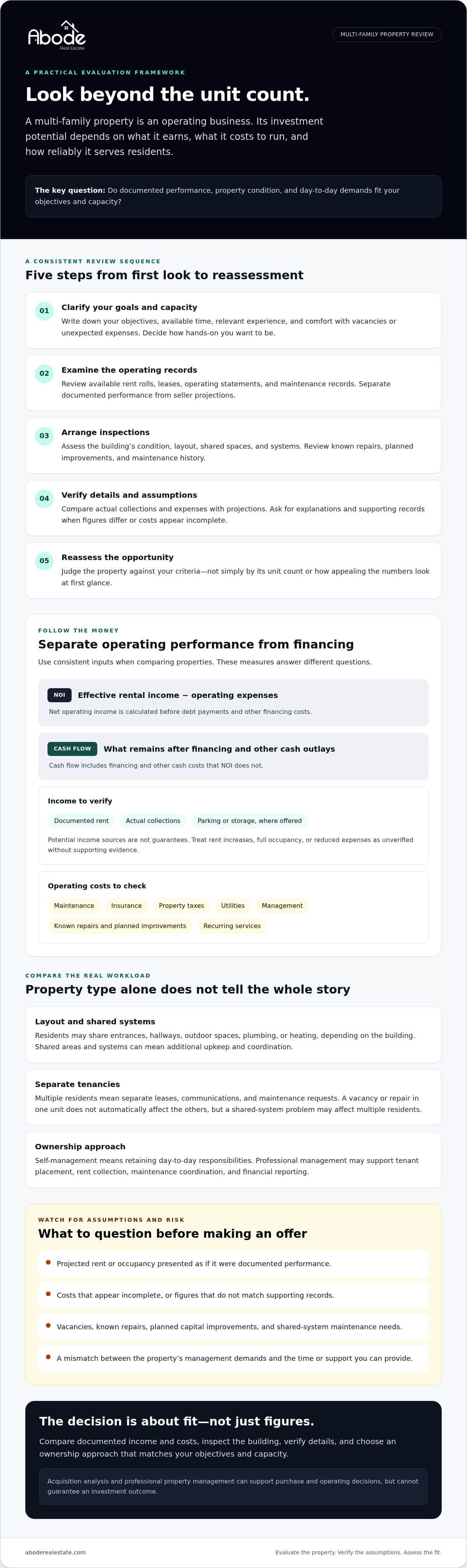
- Use a consistent review sequence: clarify your goals, examine records, arrange inspections, verify details, and reassess the opportunity.
- Investing in multi-family properties involves choosing an ownership approach as well as a building. Consider how hands-on you want to be.
- Acquisition analysis and professional property management can support purchase and operating decisions, but cannot guarantee an investment outcome.
Table of Contents
- What Investing in Multi-Family Properties Involves, and Who It May Suit
- How to Assess Income, Expenses, and Multi-Family Property Performance
- Compare Multi-Family Property Types and Ownership Approaches
- A Due-Diligence Checklist Before Buying a Multi-Family Property
- Plan Your Multi-Family Investment: Acquisition Support and Next Steps
What Investing in Multi-Family Properties Involves, and Who It May Suit
Investing in multi-family properties means buying a residential property with multiple separate homes or units and operating it as a rental asset. Income may come from tenant rent and, where offered, other documented sources such as parking or storage. These are potential income sources, not guarantees. Occupancy, collected rent, and operating costs can change, so assess the individual property rather than relying on its unit count.
Multi-family properties range from duplexes and triplexes to apartment buildings. The Multifamily residential overview provides a foundational description of these property types. The category alone, however, doesn’t tell you how much work ownership will involve. A smaller building may still require close coordination, while a larger asset may have established operating systems or more complex needs.
How Multi-Family Properties Differ from Single-Family Rentals
A standalone rental home generally has its own building systems and grounds. In a multi-unit property, residents may share entrances, hallways, outdoor spaces, or systems such as plumbing and heating, depending on the layout. Shared areas can require additional upkeep and coordination. Multiple tenancies also mean separate leases, communications, and maintenance requests. Inspect the actual design and operating arrangements rather than assuming all buildings work the same way.
Several tenancies may provide rent from more than one unit, but they also create more tasks to manage. A vacancy or repair in one unit doesn’t automatically affect the others, though a problem with a shared system may affect multiple residents. Review the property’s layout and maintenance history before estimating income or workload.
Which Investor Goals Could Fit This Approach?
This approach may suit someone looking to build a property portfolio or take an active role in overseeing a residential asset. Fit depends on more than ambition. Consider the time you can devote to resident communication, leasing decisions, upkeep, and financial review, as well as your experience and comfort with uncertainty.
Some owners prefer hands-on involvement; others want to delegate day-to-day operations. Professional full-service property management may help owners who want operational support, including tenant placement, rent collection, maintenance coordination, and financial reporting. Compare that option with self-management before deciding how much responsibility to retain. Abode Real Estate provides full-service property management.
Before pursuing a property, write down your objectives, available time, relevant experience, and tolerance for vacancies or unexpected expenses. Use those criteria to judge whether a particular building and ownership approach fit your plans. Not every multi-unit opportunity will be appropriate.
How to Assess Income, Expenses, and Multi-Family Property Performance
When investing in multi-family properties, separate what a building has earned from what a seller or marketing package expects it to earn. Start with documented rents and operating costs, then list projections as assumptions to test. Treat a rent increase, full occupancy, or reduced expense as unverified unless supporting evidence is available.
Review recurring costs and confirm which apply to the property, including maintenance, insurance, property taxes, utilities, and management. Account for known repairs, planned capital improvements, and recurring service costs as well. The IRS guide to Residential Rental Property provides information about rental income and expenses for tax purposes. Consult a qualified tax professional about how it applies to your circumstances.
Net operating income (NOI) is effective rental income after operating expenses, before debt payments and other financing costs. Cash flow reflects what remains after financing and other cash outlays are considered. Return measures, such as a capitalization rate or cash-on-cash return, relate income or cash flow to a property’s value or invested capital. These measures answer different questions, so use consistent inputs when comparing properties.
Which Financial Records Should Buyers Review?
Request available rent rolls, leases, operating statements, and maintenance records. Compare actual collections and expenses with seller projections. If figures differ or costs appear incomplete, ask for an explanation and supporting records. A comparison table can keep the review consistent while making clear which figures are estimates:
| Input | Property A | Property B |
|---|---|---|
| Documented rent and collections | Record verified figure and period | Record verified figure and period |
| Vacancy or collection assumption | State assumption and basis | State assumption and basis |
| Operating expenses | List costs and records reviewed | List costs and records reviewed |
| Repairs and capital needs | Note known items and estimates | Note known items and estimates |
| NOI and financing assumptions | Show separately | Show separately |
Ask qualified professionals to address tax, legal, lending, or accounting questions. A property comparison is not a substitute for specialized advice.
How Do Vacancy and Operating Costs Affect the Analysis?
Test how results change under clearly stated vacancy and collection assumptions based on the specific property. Include repair needs, insurance, utilities, taxes, management, and recurring services where applicable. Check figures against records and relevant quotes. Projected income is not profit: expenses, vacancies, collection shortfalls, and financing costs can reduce the cash available to an owner.
If you want support evaluating an opportunity against your investment objectives, Abode Real Estate offers investment property acquisition guidance.
Compare Multi-Family Property Types and Ownership Approaches
Choosing between a smaller multi-unit property and a larger apartment asset is not simply a question of scale. A smaller building may offer a more direct ownership experience, while a larger property can involve more units, shared spaces, and operational coordination. Neither is automatically easier or more suitable. When investing in multi-family properties, compare the work and information each opportunity requires with your objectives, resources, and preferred level of involvement.
Which Property Characteristics Matter Beyond Unit Count?
Look closely at the building’s condition, major systems, common areas, and deferred maintenance. Review lease status and tenant mix, then check whether operating records clearly describe current performance. Straightforward layouts and well-organized records may make a property easier to assess than complex systems or incomplete documentation. An inspection and records review are still needed to understand the actual demands.
Consider how the layout affects resident access, shared-area upkeep, and maintenance coordination. Ask what needs attention now and what may require ongoing oversight. Unit count is only one part of the picture. Condition, complexity, and the quality of available information can also shape the ownership experience.
Self-Management or Professional Property Management?
With self-management, the owner handles tenant communication, rent collection, and maintenance coordination. This may suit an investor with the time, experience, and systems to oversee daily operations. It also means planning for resident requests and property needs alongside other commitments.
Professional management delegates some or all operating tasks, but confirm the scope rather than assuming what is included. Ask which services are covered, how communication and decisions work, and what fees and agreement terms apply. Abode Real Estate provides full-service property management, including tenant placement, rent collection, maintenance coordination, and financial reporting. Its full-service property management overview offers more detail on the service.
Weigh the options against your available time, experience, distance from the property, and desired level of oversight. Delegating operations doesn’t remove the need to review performance or make ownership decisions. It changes how those responsibilities are handled.
Before choosing a property type or management approach, compare the building’s condition, tenancy, records, and operating demands with your own capacity. LoopNet’s multifamily investing guide offers additional context on the broader investment process. Use it as a starting point, then confirm property-specific details and management terms directly.
A Due-Diligence Checklist Before Buying a Multi-Family Property
A disciplined review helps turn an appealing listing into a decision grounded in evidence. When investing in multi-family properties, follow a clear sequence: define your objectives, examine available records, inspect the building, verify property-specific details with qualified professionals, and reassess the opportunity. Each step should answer a question, not simply add documents to a file.
What Should You Verify About the Building and Its Operations?
Start by checking whether the records support the seller’s description. Review available leases, income records, expense documentation, maintenance history, and service agreements. Look for gaps, unclear repair histories, or projections without a documented basis. Ask focused questions: Are listed rents supported by leases? Do recorded expenses cover the services the property uses? What explains missing maintenance information?
Arrange professional inspections to assess the building’s condition and relevant technical concerns. An inspection can identify items for further evaluation, but it doesn’t replace specialist advice when a concern requires it. Confirm insurance, tax, financing, and regulatory considerations with appropriate advisers familiar with the property and your circumstances. Don’t assume a seller’s summary or an earlier review answers every question.
How Can Buyers Test Whether an Opportunity Fits?
Test the investment with transparent scenarios rather than relying on a single optimistic forecast. For example, compare an expected case with a less favourable case that assumes slower leasing, collection shortfalls, or higher operating needs. State each assumption and its basis. Consider whether your available reserves and capacity to respond could cover unexpected repairs or interruptions without undermining other financial priorities.
Use this final review sequence before deciding:
- Clarify: Revisit your investment goals, time horizon, and preferred level of involvement.
- Review: Match key claims against leases, income and expense records, service agreements, and maintenance history.
- Inspect and verify: Seek qualified assessments and confirm property-specific questions with the appropriate advisers.
- Reassess: Compare scenarios, reserve needs, and unresolved issues with your original criteria.
Missing records, unsupported projections, or an unclear repair history aren’t automatic reasons to reject a property, but they are reasons to pause and seek answers. If a material question remains unresolved, be prepared to step back rather than let enthusiasm replace careful judgment. Abode Real Estate’s investment property acquisition strategies offer related perspective on evaluating opportunities. For support assessing an acquisition against your objectives, contact Abode Real Estate.
Plan Your Multi-Family Investment: Acquisition Support and Next Steps
A considered plan connects your investment criteria to the realities of a specific property. When investing in multi-family properties, move from defining your objectives to reviewing potential buildings, verifying key assumptions, planning the acquisition, and deciding how operations will be handled after closing. A clear process keeps the search focused without assuming every promising opportunity will prove right for you.
What to Prepare Before Speaking with an Acquisition Professional
You don’t need every answer before an initial conversation, but outlining your priorities can make it more useful. Prepare notes on:
- Investment objectives: What you hope to accomplish and what would make a property a poor fit.
- Ownership preferences: How involved you want to be in leasing, resident communication, and operating decisions.
- Experience and concerns: Your familiarity with rental ownership and the risks or responsibilities you want to understand better.
- Financing parameters: The terms and limits you’re considering, confirmed with an appropriate lending professional.
- Property criteria: The building characteristics you’re seeking and questions about records, condition, and ongoing operations.
Bring questions as well as criteria. If you’re comparing a specific property, identify which income assumptions, repair items, or operating details need clarification. This gives an acquisition professional a practical starting point for considering how the opportunity aligns with your goals.
How Abode Real Estate Can Support an Investor’s Process
Abode Real Estate provides investment property acquisition services, including property analysis and acquisition support. An acquisition professional may help assess an opportunity against your objectives and coordinate the purchase process. The firm also offers commercial real estate sales. These services can inform a buying decision, but they don’t assure occupancy, income, appreciation, or a particular investment result.
Plan for operations as well as acquisition. Owners who prefer professional support can consider full-service property management, which includes tenant placement, rent collection, maintenance coordination, and financial reporting. Management is optional. Confirm the scope, fees, and agreement terms directly, then decide what level of involvement suits you.
A practical next step is to gather your criteria, questions, and financing parameters, then discuss how a potential acquisition might fit. Contact Abode Real Estate to discuss your investment objectives and whether acquisition support could be relevant to your plans.
Move Forward with a Clear Investment Plan
Investing in multi-family properties starts with evaluating a building as an operating asset, not simply counting its units. Compare verified income and expenses with clearly labelled assumptions, then weigh the property’s condition and management needs against your goals. Careful due diligence helps uncover unanswered questions before you decide whether to proceed.
Organize your criteria, financing parameters, and key questions, then compare potential opportunities against them. Abode Real Estate offers investment property acquisition and analysis to help investors assess opportunities. For owners who want operational support, its property management includes tenant placement, rent collection, maintenance coordination, and financial reporting. These services can support your process, but they don’t guarantee investment performance.
Discuss your multi-family investment goals with Abode Real Estate and explore an approach that reflects your objectives and preferred level of involvement.
Frequently Asked Questions
What counts as a multi-family property?
A multi-family property contains multiple separate residential units within one property or building. Examples include duplexes, triplexes, and apartment buildings. Layouts, shared spaces, and building systems can differ considerably, so the label alone doesn’t show how much oversight a property requires. Review the individual units, common areas, leases, condition, and available operating records rather than relying on unit count alone.
Is investing in multi-family properties a good idea for beginners?
Investing in multi-family properties may suit a beginner who understands the responsibilities and evaluates each opportunity carefully, but it isn’t automatically a good fit. Consider your experience, available time, risk tolerance, financing parameters, and capacity to respond to vacancies or repairs. Distinguish documented income and expenses from projections, and seek qualified advice where needed. A property’s suitability depends on your circumstances, not simply its number of units.
How do you evaluate a multi-family property investment?
Review documented income, operating expenses, leases, maintenance history, and physical condition. Compare verified records with seller projections, label assumptions clearly, and consider how vacancies or unexpected repairs could affect results. Calculate net operating income by subtracting operating expenses from effective property income, then assess financing and cash flow separately. Professional inspections and qualified advice can help address issues that records alone may not reveal.
What is the difference between gross income and net operating income?
Gross rental income is rent received or projected before operating expenses are deducted. Net operating income, or NOI, is the property’s effective income after operating expenses such as maintenance, insurance, property taxes, utilities, and management costs are accounted for. NOI is measured before debt payments and isn’t the same as cash flow or profit after every cost. Use consistent records and assumptions when comparing properties.
Can you manage a multi-family property yourself?
Yes. An owner can self-manage if they have the time, systems, and experience to handle responsibilities such as tenant communication, rent collection, and maintenance coordination. The workload depends on the property’s condition, layout, and operating needs. Before choosing this approach, consider how you’ll handle routine tasks and unexpected issues, and whether the property’s location and your other commitments make hands-on oversight practical.
What should you check before buying a multi-family property?
Review available leases, rent and expense records, maintenance history, and service agreements, then arrange a professional inspection. Compare documented operating history with seller projections and investigate missing records, unclear repairs, or unsupported assumptions. Confirm property-specific insurance, tax, financing, and regulatory questions with appropriate professionals. Before proceeding, revisit your investment goals, consider less favourable operating scenarios, and decide whether unresolved issues affect the property’s fit.
Is professional management necessary for multi-family investing?
No, professional management isn’t necessary for every investor. Some owners handle operations themselves; others choose support to delegate responsibilities. Abode Real Estate’s full-service property management includes tenant placement, rent collection, maintenance coordination, and financial reporting. Before engaging a manager, confirm the service scope, fees, and agreement terms directly. Consider your available time, experience, distance from the property, and desired level of involvement before deciding.
Posted by Brook Walsh onEnjoy this blog post? Click here to subscribe for updates
Leave A Comment