

What if a home that feels exceptional is still an ordinary investment? Is luxury real estate a good investment, or does its appeal rest more on prestige and lifestyle than on financial fundamentals? The answer depends on the specific property, the market it serves, and how well it fits your plans. A beautiful residence may be appealing, but that alone can’t establish its income potential or resale flexibility.
It’s reasonable to weigh potential rental income and long-term value against a substantial commitment, ongoing ownership responsibilities, and the challenge of selling when you choose. Luxury real estate can be rewarding for the right investor, but it isn’t automatically a dependable or easy-to-exit asset. Clear-eyed analysis matters.
This guide offers a practical framework for evaluating a property’s income potential, costs, rental demand, liquidity, and risks alongside your financial goals and investment horizon. You’ll learn which questions to ask before proceeding, when property-specific analysis may help, and how to decide whether to move forward, refine your plan, or seek expert advice. The aim is a considered decision, not a purchase driven by prestige alone.

Key Takeaways
- Whether luxury real estate is a good investment depends on the property’s fundamentals and your financial goals, not its prestige alone.
- Assess potential rental income alongside operating expenses and vacancy periods to form a clearer view of possible returns.
- Compare direct ownership with diversified investments by considering control, liquidity, income potential, and management responsibilities.
- Investigate property condition, rental assumptions, resale prospects, and the time and attention ownership may require.
- Before making an offer, write down your investment thesis, downside scenario, time horizon, and possible exit plan.
Table of Contents
- Is Luxury Real Estate a Good Investment, or Primarily a Lifestyle Choice?
- How to Evaluate Luxury Real Estate Returns, Expenses, and Resale Potential
- Luxury Real Estate vs. Other Investments: What Should You Compare?
- What Risks Should You Investigate Before Buying Luxury Real Estate?
- How to Decide Whether a Luxury Property Belongs in Your Portfolio
Is Luxury Real Estate a Good Investment, or Primarily a Lifestyle Choice?
Luxury real estate can fit some investment strategies, but the label guarantees nothing. A property’s merit depends on its expected income, ownership expenses, resale prospects, risks, and fit with your goals. Prestige may shape how a home feels to own, but it doesn’t establish how the property will perform financially.
A sound luxury property investment is one whose potential benefits, costs, and risks make sense for the investor’s objectives and time horizon, without relying on assured returns. Personal enjoyment can be part of the decision, too. Recognize it as a separate benefit rather than treating lifestyle appeal as proof of investment quality. For a neutral foundation, review the principles of real estate investing, then apply them to the specific property and market.
What makes a property “luxury” for investment analysis?
Luxury is relative to its market, not defined by a universal price threshold. A property may stand apart through its construction quality, considered design, distinctive amenities, scarcity, or appeal to buyers and tenants seeking a particular experience. Those qualities can attract interest, but they don’t guarantee demand, rental income, or resale value.
Look beyond the asking price. Ask who is likely to want the property, why it might appeal to them, and whether comparable homes support that view. A high purchase value alone says little about whether expected income and resale prospects justify the commitment.
When can luxury real estate fit an investor’s goals?
Start by naming the purpose. An income-oriented buyer may prioritize rental demand and operating performance. Someone focused on long-term appreciation may weigh the property’s resale audience and holding period. Others may seek diversification, personal use, or a blend of financial and lifestyle benefits. Each objective calls for different measures of success.
Your time horizon should reflect your liquidity needs and circumstances, not a broad rule of thumb. Consider how long you could hold the property if a sale took time, and how much uncertainty you can comfortably accept. Decide, too, whether you’re prepared to oversee ownership yourself or would prefer professional support. Reviewing a property management approach may help you assess the time and coordination involved.
Before reviewing listings, write down your objective, acceptable level of risk, and desired degree of involvement. That brief can keep an alluring residence in perspective and help you assess whether its fundamentals support the role you want it to play.
How to Evaluate Luxury Real Estate Returns, Expenses, and Resale Potential
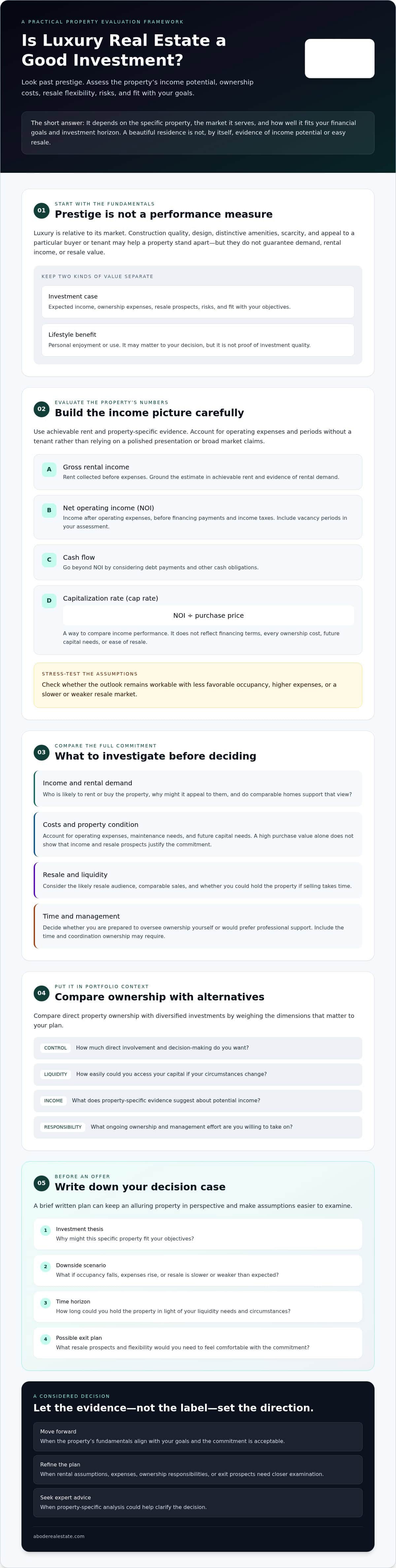
To answer “is luxury real estate a good investment,” assess a specific property’s numbers rather than relying on broad claims about the luxury market. Build an income estimate from achievable rent, then account for operating expenses and periods without a tenant. Use current, property-specific evidence for rental demand, comparable sales, maintenance needs, and likely resale interest. A polished presentation is no substitute for tested assumptions.
Which financial measures help compare luxury properties?
Start with gross rental income, the rent collected before expenses. Subtract operating expenses, such as routine property costs, and account for vacancy to estimate net operating income (NOI). NOI is income after operating expenses, but before financing payments and income taxes. Cash flow goes further by considering debt payments and other cash obligations. These measures answer different questions, so compare them consistently.
The capitalization rate, or cap rate, is NOI divided by the property’s purchase price. It can help compare income performance across properties, but it doesn’t reflect financing terms, every ownership cost, future capital needs, or ease of resale. Test your projections against less favorable occupancy, higher expenses, and a slower or weaker resale market.
For a forward-looking perspective, Luxury Outlook 2026 offers industry context. Treat broad trends as background, not as a substitute for evidence tied to the property under consideration.
| Factor | What to assess | Key question |
|---|---|---|
| Projected cash flow | Income after operating and financing obligations | Does it remain workable if occupancy falls? |
| Long-term value | Comparable sales, condition, and buyer appeal | Does demand rest on lasting qualities or a passing preference? |
| Liquidity | Likely buyer pool and time to sell | Could you hold the property if a sale takes longer? |
| Investor effort | Oversight, upkeep, and tenant coordination | Can you manage the work or arrange suitable support? |
How do resale potential and liquidity change the assessment?
A luxury property may appeal to a narrower pool of qualified buyers or tenants than a more broadly priced home. That can affect how quickly you can exit, especially if the property’s appeal depends on highly specific features. Consider whether the design and amenities meet durable preferences, and whether comparable properties show genuine demand. Exclusivity alone doesn’t ensure appreciation.
For a deeper look at evaluating an opportunity before acquisition, review this guide to investment property acquisition strategies. A property-specific analysis can help organize the assumptions behind an offer.
Luxury Real Estate vs. Other Investments: What Should You Compare?
To decide whether luxury real estate is a good investment for you, compare ownership with alternatives by looking beyond potential returns. Consider how much control you want, how readily you may need access to your capital, how much concentration you can accept, and whether you’re prepared to manage a physical property. The right comparison depends on your objectives and circumstances, not on a universal ranking of investments.
Direct ownership or a real estate investment trust?
Buying a property directly gives you control over a specific asset and the opportunity to pursue rental income or personal use. It also concentrates capital in one property and brings responsibilities such as oversight, upkeep, and decisions about tenants and management.
A real estate investment trust (REIT) offers exposure to real estate through an investment structure rather than direct ownership of a home. Some REITs are publicly traded, while others have different access and liquidity terms. Review the specific structure and its documents, and confirm relevant legal and tax details with qualified professionals.
- Control: Direct ownership gives you property-level decisions; a REIT investor doesn’t manage an individual property.
- Income: A directly owned home may generate rent, while a REIT’s distributions depend on its structure and performance.
- Diversification and liquidity: A REIT may provide exposure to multiple real estate assets, while a direct purchase ties more capital to one property. Liquidity varies by investment type and market conditions.
- Effort: Direct ownership involves property responsibilities, whether handled personally or with professional support. A REIT shifts property-level management away from the individual investor, but still requires investment oversight.
Neither route removes risk. Compare how each fits your financial capacity, time horizon, and need for flexibility before choosing.
Luxury property or a broader residential investment?
A luxury residence and a more conventional rental property may attract different tenants and resale audiences. A distinctive home could appeal strongly to a specific group, while that narrower audience may also make demand harder to estimate. Assess features, maintenance needs, operating requirements, and likely periods without tenants for the individual property rather than assuming they follow from its category.
For example, a home designed around specialized amenities may offer a compelling experience but require more detailed planning for upkeep and tenant expectations. A simpler property may have a different operating profile. Neither is automatically more profitable or easier to sell. Compare evidence about achievable rents, expenses, and likely buyers for each property, and consider the intended use.
The most useful comparison reflects your full portfolio, not just the appeal of a single residence. If a purchase would leave you overly concentrated or limit access to funds you may need, that trade-off deserves as much attention as potential rental income. Let property-specific evidence guide the decision.
What Risks Should You Investigate Before Buying Luxury Real Estate?
An impressive residence can still underperform if rental demand is overstated, ownership expenses are underestimated, or resale takes longer than expected. Before deciding whether luxury real estate is a good investment, test the assumptions behind the purchase, not just the property’s presentation. A disciplined review can reveal where the opportunity is sound and where more evidence is needed.
Due-diligence principle: Validate every investment assumption with current, property-specific evidence before committing.
Which property-level assumptions need verification?
Have qualified professionals assess the property’s condition, likely maintenance needs, insurance availability, and operating assumptions. Ask for evidence that supports projected rents and occupancy, rather than relying on broad luxury-market trends or optimistic estimates. If you plan to rent the home, confirm that the intended use is permitted under requirements that apply to that specific property.
Legal, tax, lending, and insurance considerations can depend on the property and your circumstances. Seek advice from relevant independent professionals, and verify current requirements with appropriate authoritative sources. Don’t treat general guidance as a substitute for property-specific review.
- Condition: Identify known defects and areas that may require further inspection or specialist review.
- Expenses: Confirm recurring operating costs and plan for repairs, upkeep, and periods without rental income.
- Rental assumptions: Check comparable rental evidence, likely tenant demand, and permitted use.
- Resale: Consider who the likely future buyer could be and whether demand depends on a narrow set of preferences.
How can investors reduce concentration and management risk?
A single property can represent a substantial share of an investor’s resources. Consider how that concentration might affect your flexibility if income falls, expenses rise, or a sale takes longer than planned. Keep enough capacity to respond to unexpected needs without relying on a quick exit.
Ownership also takes time. Self-management may involve reporting, tenant communication, coordinating maintenance, and responding to changing property needs. Professional oversight can reduce some day-to-day involvement, but you should understand the scope of management and how decisions and reporting will work. Abode Real Estate offers full-service property management. Its full-service property management guide outlines considerations for owners.
Before proceeding, compare the property’s projected performance with a less favorable scenario and decide whether the added responsibility and concentration suit your plans. For a property-specific acquisition assessment, explore investment property analysis with Abode Real Estate.
How to Decide Whether a Luxury Property Belongs in Your Portfolio
A measured decision starts before an offer. Put your goals, evidence, and limits in writing so an exceptional home is judged on its role in your portfolio, not its ability to impress. This process won’t remove uncertainty, but it can make the trade-offs clearer.
A practical decision sequence before making an offer
- Define your objectives. Decide whether you’re seeking rental income, potential long-term appreciation, diversification, personal use, or a combination. Set your acceptable risk and the level of ownership involvement you’re prepared to take on.
- Set your time horizon and exit conditions. Consider how long you could hold the property if a sale takes longer than expected, and what circumstances might prompt you to sell. Note any liquidity needs that could affect your plans.
- Write an investment thesis. State why this property may fit your objectives, what evidence supports its income and resale assumptions, and what could weaken the case. Include a downside scenario, such as lower occupancy, higher expenses, or slower resale.
- Compare alternatives consistently. Assess the property using the same measures you’d apply to other investments, including potential income, expenses, risk, liquidity, diversification, and the time required to manage it.
- Complete independent diligence. Ask qualified legal, tax, lending, inspection, and insurance professionals to review the matters relevant to your circumstances and the property. Confirm current requirements and assumptions with appropriate sources before proceeding.
- Review the decision against your limits. Before making an offer, check whether the downside scenario remains manageable and whether the property still fits your written objectives. If key assumptions remain unverified, pause and seek clarity.
When can an advisor or property manager help?
Property-specific acquisition analysis can help organize the home’s details, financial assumptions, and your priorities in one decision framework. It can inform your judgment, but it can’t guarantee performance or replace independent professional advice. Abode Real Estate offers investment property acquisition and analysis. Learn more about investment property acquisition.
After purchase, professional property management may support oversight and coordination, while the owner remains responsible for deciding whether the arrangement suits their needs. If you’re weighing whether luxury real estate is a good investment for your goals, first complete the written review above. Then discuss your investment property goals with Abode Real Estate.
Make Your Next Move With Clarity
So, is luxury real estate a good investment? It can be when a property’s income potential, ownership demands, resale prospects, and risks align with your financial goals. Prestige and personal enjoyment may add value to your experience, but neither replaces a careful review of the numbers and your ability to hold the asset.
Before making an offer, put your investment thesis in writing, test a less favorable scenario, and seek independent advice on the property-specific questions that matter. A clear time horizon and exit plan can help you decide whether to proceed, pause, or look for a better fit.
Abode Real Estate offers investment property acquisition and analysis, along with full-service property management. These services can support a considered purchase and ongoing oversight, without guaranteeing performance.
Explore your property investment options with Abode Real Estate and take the next step with a well-informed plan. A thoughtful decision can bring you closer to an investment that feels right both on paper and in practice.
Frequently Asked Questions
Is luxury real estate a good investment for beginners?
Luxury real estate can suit beginners, but it may require substantial capital, careful research, and comfort with property-level responsibilities. Whether it’s a good investment depends on your goals, financial capacity, risk tolerance, and the specific property, not your experience alone. Start by reviewing rental demand, expenses, resale prospects, and a less favorable scenario. Independent professional advice can help clarify questions before you commit.
Can luxury real estate generate rental income?
Yes, a luxury property can generate rental income if there’s suitable tenant demand and the intended rental use is permitted. Estimate achievable rent using evidence for comparable properties, then account for vacancy, operating expenses, maintenance, and management. Gross rent alone doesn’t show what you may retain. Demand can vary by property and market, so verify assumptions rather than relying on broad claims about luxury rentals.
How much does luxury real estate appreciate?
There’s no reliable universal appreciation rate for luxury real estate. Value changes with the individual property, market conditions, buyer demand, and the period you hold it. Past sales can offer context, but they don’t guarantee future results. Review comparable transactions and consider a scenario where the property’s value grows more slowly than expected, stays flat, or declines before deciding whether the potential fits your plans.
What makes a luxury property a good investment?
A luxury property may be a sound investment when its potential income, ownership expenses, condition, resale audience, and risks align with your financial objectives. Desirable design or amenities may help attract buyers or tenants, but don’t guarantee demand or appreciation. Look for property-specific evidence, test rental and resale assumptions, and assess whether you can manage the investment through less favorable conditions. Personal enjoyment can matter, but it’s distinct from financial performance.
Are luxury homes harder to sell than other properties?
Some luxury homes may take longer to sell because the pool of buyers who can afford and want a distinctive property can be narrower. That isn’t true of every home, and prestige alone doesn’t determine liquidity. Consider comparable sales, the property’s condition, likely buyer audience, and how flexible you could be on timing. If you may need to sell quickly, account for that possibility before buying.
Is a luxury property better than investing in a REIT?
Neither option is universally better. Direct ownership gives you control over a specific property and potential rental income, along with concentrated risk and management responsibilities. A real estate investment trust (REIT) offers exposure to real estate through a different investment structure; diversification and liquidity depend on the specific REIT and its terms. Compare both with your goals, time horizon, financial capacity, and need for access to your capital.
Should I hire a property manager for a luxury investment home?
A property manager may be helpful if you don’t want to coordinate tenant communication, reporting, and property oversight yourself. Before choosing, understand the management scope, how decisions are handled, and what responsibilities remain yours. Management can support oversight, but it doesn’t guarantee rental income or investment performance. Abode Real Estate offers full-service property management, which can be discussed as part of your ownership plan.
Posted by Brook Walsh onEnjoy this blog post? Click here to subscribe for updates
Leave A Comment