

What if the real cost of managing a rental isn’t just the fee, but the hours, interruptions, and decisions you handle yourself? It’s reasonable to ask whether professional property management is worth the cost when fees affect your returns, especially if you’re unsure what the fee covers. A fair comparison weighs more than the monthly bill: consider your time, the demands of tenant communication and maintenance, and the value of consistent oversight.
This guide will help you assess those trade-offs without assuming one approach suits every owner. You’ll see what full-service management covers, how to compare managed and self-managed ownership, and which practical factors shape the value for your rental. With tenant placement, rent collection, maintenance coordination, and financial reporting in one service, professional oversight can reduce day-to-day administration and support clearer investment decisions. The right choice depends on whether that support delivers enough value for your property and priorities.

Key Takeaways
- Assess whether professional property management is worth the cost by weighing the service scope against your time, property needs, and desired level of involvement.
- Identify which recurring responsibilities, from tenant placement to rent collection, take the most attention away from your other priorities.
- Compare managed and self-managed ownership by who handles tasks, coordination, and reporting, not just by the fee.
- Use your management agreement and property records to evaluate the trade-off rather than relying on generic fee assumptions.
- Match your management choice to your goals, whether you value hands-on control, less administration, or clearer investment reporting.
Table of Contents
- Is professional property management worth the cost for rental owners?
- Where professional property management can create measurable value
- Professional management vs. self-management and software
- How to calculate whether property management is worth the fee
- How to decide on professional management and take the next step
Is professional property management worth the cost for rental owners?
Professional property management is worthwhile when the services, time saved, and level of oversight fit an owner’s needs and support satisfactory net results. It means delegating agreed rental operations to a manager, not handing over every decision. To answer “is professional property management worth the cost” for your rental, consider both its financial performance and the work you want to keep handling. There’s no universal answer: a hands-on owner with a straightforward routine may weigh the trade-offs differently from someone balancing multiple responsibilities.
Assess management fees separately from property expenses, then consider them together. A management fee pays for the agreed oversight; expenses such as maintenance are costs of operating the rental itself. Combining them can obscure where money is going, while looking at the fee alone leaves out the value of coordinated tasks and clear records. The broader What is property management overview describes different roles and management models, but your agreement defines the actual service scope.
For a broader look at evaluating management, watch this discussion:
What does professional property management usually cover?
Full-service management covers tenant placement, rent collection, maintenance coordination, and financial reporting. These responsibilities span different stages of a rental’s operation: tenant placement is a leasing task, while collecting rent, coordinating maintenance, and providing reports support ongoing management. Review the agreement to see how each responsibility is handled and identify any tasks or expenses that remain yours.
When can the value extend beyond the monthly numbers?
Value can show up in fewer recurring tasks: less time tracking rent, relaying maintenance requests, and following up across separate conversations. A clear operating routine makes those responsibilities easier to oversee, while consistent financial reporting helps you review income and expenses and make informed investment decisions. The benefit is personal as well as practical. Owners differ in how they value their time and the relief of having fewer details to coordinate.
For one owner, the fee may be justified by a more manageable routine and useful reporting, even if the financial benefit isn’t immediate. Another may prefer direct control and handle the work personally. Compare the services with your priorities and the rental’s operating demands. Management does not guarantee higher returns.
Where professional property management can create measurable value
Management can create value by taking recurring coordination off the owner’s schedule and bringing key rental activity into a clear routine. Assess the specific work: who handles tenant placement, how rent collection is tracked, how maintenance requests are followed through, and how property activity is reported. These are practical value drivers, not guarantees of higher income or lower expenses.
How tenant and rent administration affect an owner's workload
Placing a tenant and collecting rent involve communications, recordkeeping, and follow-up. Delegating these responsibilities can reduce your administrative workload, especially when inquiries, placement steps, payment records, and routine questions would otherwise need separate attention. It won’t ensure a shorter vacancy or on-time payment every month. The measurable question is how much time and follow-up you no longer need to manage personally.
To evaluate the difference, track the time you spend on rental administration over a representative period. Note the hours used for tenant communication and rent tracking, and how often those tasks interrupt other priorities. Compare your notes with the responsibilities handled under the management arrangement. This gives you a more useful picture than simply counting the tasks delegated.
Why maintenance coordination and reporting matter
Maintenance coordination is more than relaying a request. It involves organizing information, communicating with the relevant parties, and following up so you have a clearer view of progress. That structure can make issues easier to oversee, but it doesn’t guarantee a particular repair cost, timeline, or outcome.
Regular financial reporting adds another layer of visibility. Property-level records help you review income and expenses, notice operating patterns, and consider decisions with a more complete picture of activity. The National Association of REALTORS® offers additional context on professional property management practices. For your rental, the practical test is whether reporting is clear and useful enough to inform decisions, not whether it promises appreciation or savings.
Assess these benefits through indicators such as time spent on administration, the clarity of maintenance updates, and how readily you can review property activity. Compare the responsibilities and reporting in your agreement with the work you currently handle. For a closer look at coordinated oversight, explore full-service property management. This comparison can help you judge whether the support addresses your workload and priorities.
Professional management vs. self-management and software
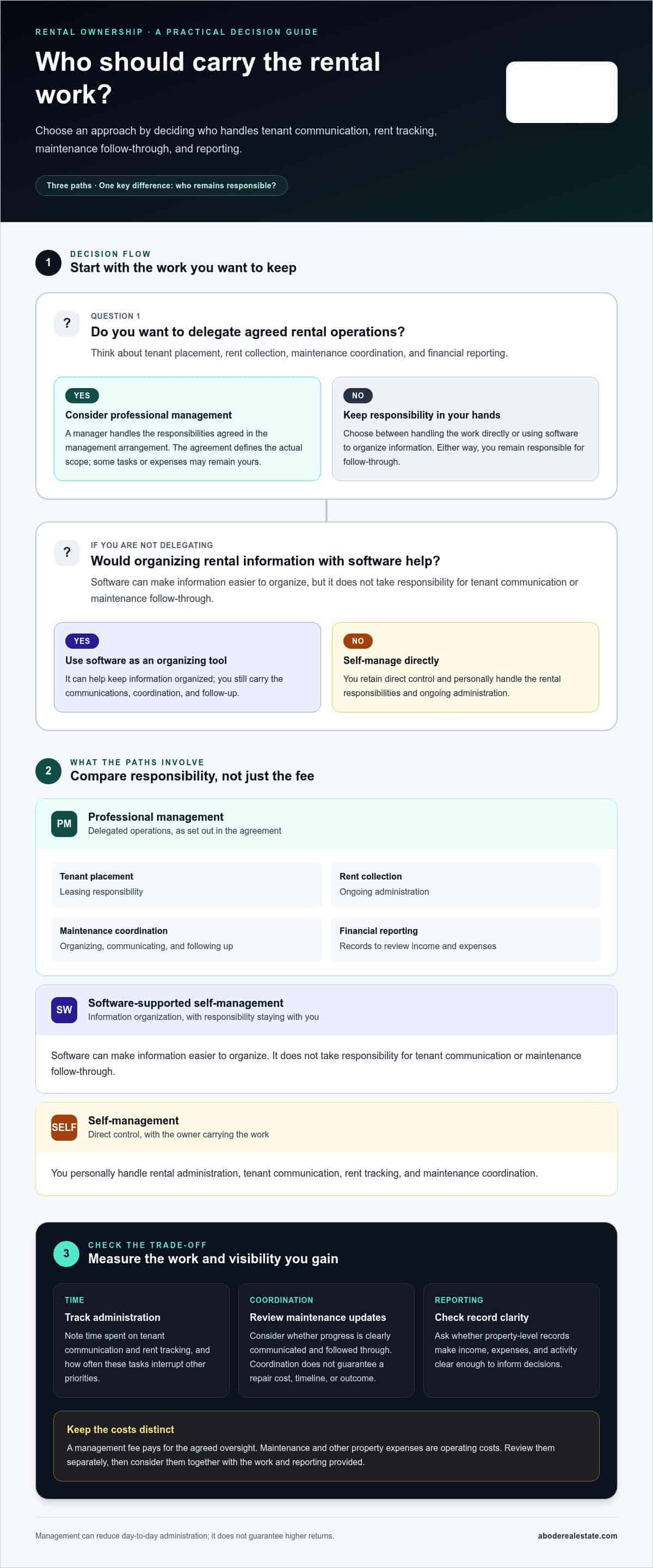
Choosing between managing a rental yourself, using software, or delegating to a professional comes down to who carries the work. Software can make information easier to organize, but it doesn’t take responsibility for tenant communication or maintenance follow-through. A manager’s fee isn’t automatically worthwhile for every property, either. Compare what each approach handles, what remains yours, and how that fits your time and priorities.
| Consideration | Self-management with software | Professional management |
|---|---|---|
| Task ownership | You oversee tenant matters, rent records, and maintenance follow-up; software may help organize tasks. | The manager handles the responsibilities agreed in the management arrangement. |
| Time commitment | You set aside time for routine administration and unexpected follow-up. | Some recurring tasks are delegated, though you remain involved in owner decisions. |
| Coordination | You communicate with tenants and coordinate next steps yourself. | The manager coordinates agreed rental operations and keeps communication moving. |
| Reporting | You maintain records and review property activity using your chosen process or tools. | Financial reporting is provided as part of the agreed service scope. |
| Fee considerations | You avoid a professional management fee, while contributing your own time and attention. | You pay for the contracted service, so value depends on what it covers and what you need. |
What software can support, and what it does not replace
Rental software can help record income and expenses, organize documents, and track tasks or maintenance requests. Those tools support workflows; they don’t communicate with tenants, arrange next steps, or follow a request through to resolution on their own. A well-kept system can make self-management more orderly, but someone still needs to act on the information and coordinate the work.
When self-management may be a reasonable choice
Self-management can suit an owner with available time, relevant experience, a manageable workload, and a preference for direct involvement. If the rental’s routine is straightforward and you’re comfortable maintaining records and handling communication, paying to delegate may add less value for you. The trade-off is that you retain the responsibility and interruptions. Consider whether the time you spend is a worthwhile exchange for avoiding a management fee.
If you’re asking, “Is professional property management worth the cost?” the answer may change as circumstances do. A new tenant, a busier schedule, or more involved coordination can shift the balance. Compare your actual workload with the responsibilities a manager would take on, rather than assuming software or professional oversight is the better choice by default.
How to calculate whether property management is worth the fee
A useful comparison considers net outcomes, owner effort, and service coverage. Rather than rely on a generic fee estimate, use the management agreement and your property records to compare what you pay with the work you delegate. This makes the question “is professional property management worth the cost” specific to your rental and priorities.
A practical five-step owner value assessment
- Step 1: List the work. Record the rental tasks you currently handle, such as tenant communication, rent tracking, maintenance follow-up, and financial recordkeeping. Estimate the time each takes using your calendar or notes instead of guessing from memory.
- Step 2: Map the service scope. Review the management agreement and mark which tasks the manager handles, which are billed or arranged separately, and which remain yours. A task isn’t a delegated benefit if you still own the coordination.
- Step 3: Compare like with like. Use actual property records and consistent time periods. Compare rental income and operating expenses alongside management charges, keeping routine property expenses distinct from management fees.
- Step 4: Account for your effort. Consider the time and attention you’d reclaim, including interruptions and follow-up. Value that time according to your own priorities; there’s no standard hourly rate that fits every owner.
- Step 5: Revisit the decision. Reassess if your workload, ownership goals, or property needs change. A choice that suits a simple routine today may not fit a more demanding rental or a change in your available time.
Which costs and benefits belong in the comparison?
Include the management fee stated in the agreement and any separately documented property expenses, but don’t treat ordinary operating costs as management charges. Then compare the service coverage with the tasks you’d otherwise perform yourself. Organized coordination, continuity, and clear reporting can have real value even when they don’t appear as extra income. Weigh them as benefits, not guaranteed profit, savings, or improved performance.
If the rental is part of a wider portfolio or long-term plan, consider its role alongside broader investment property acquisition insights. For a closer look at delegated responsibilities, review Abode’s full-service property management. Use the comparison to decide whether the service scope addresses your workload and supports the way you want to own the property.
How to decide on professional management and take the next step
The decision is less about choosing a universally better way to own a rental and more about matching support to your priorities. Recurring time pressure, frequent coordination, a preference for consolidated reporting, and your investment goals can all point toward professional oversight. If you value direct involvement and the workload remains manageable, self-management may still suit you. The right fit depends on what you want to delegate and what the property requires.
Signs that a management relationship may fit
Delegated management may be worth exploring if tenant communication and operational follow-up repeatedly compete with your other responsibilities, or if you want a more structured view of property activity. A coordinated arrangement can bring together tenant placement, rent collection, maintenance coordination, and financial reporting. The value depends on whether those services address your actual needs, not simply on whether the offering is labeled full-service.
Before deciding, consider which of these signals reflects your ownership experience:
- You regularly postpone tenant or administrative tasks because other priorities take precedence.
- Maintenance requests require repeated communication and follow-up that you would prefer to delegate.
- You want financial reporting that makes it easier to review rental activity and consider next steps.
- Your ownership goals favor less hands-on administration, while you remain involved in key decisions.
One signal alone doesn’t settle the question. Consider the pattern, the time it takes, and whether the service scope would meaningfully address it.
What to clarify before moving forward
Read the management agreement with your assessment in hand. Identify the services included, your continuing responsibilities, how reporting is arranged, and any documented charges beyond the management fee. Pay particular attention to tasks you expect to hand off: clear responsibility for each one helps prevent a mismatch between what you need and what the arrangement provides.
Abode’s full-service property management brings tenant placement, rent collection, maintenance coordination, and financial reporting together in a tailored approach for rental owners. Compare those responsibilities with the needs you’ve identified, then decide whether the coverage and structure suit your property and ownership priorities. A clear arrangement sets out how the work is handled without implying guaranteed financial results.
If you’d like to discuss how your rental’s needs may align with professional oversight, start a property management conversation with Abode. Bring your assessment and questions, then consider the service scope in light of how you want to manage your investment.
Choose the level of support that fits your rental
So, is professional property management worth the cost? The answer depends on whether the service scope and oversight justify the fee for your property, your available time, and the responsibilities you want to retain. Compare the agreement and property records, then weigh management charges against the administrative work, coordination, and reporting you’d otherwise handle yourself. Software can organize information, but it doesn’t replace hands-on management.
For owners who want to delegate key rental operations, full-service management brings tenant placement, rent collection, maintenance coordination, and financial reporting into one arrangement. Abode Real Estate is a boutique firm with a tailored approach to property management. The right fit should feel clear and aligned with your priorities, not based on a promise of guaranteed returns.
If you’re ready to explore support for your rental, discuss a tailored property management approach with Abode Real Estate. A thoughtful next step can bring greater clarity to your ownership decisions.
Frequently Asked Questions
Is professional property management worth the cost for one rental property?
It can be worthwhile for one rental, but there isn’t a universal answer. The decision depends on the services you need, your current workload, the agreed fee, and how much you value delegated oversight. Compare the agreement’s responsibilities with your property records and the time you spend on tenant communication, rent collection, and maintenance follow-up. If those tasks feel manageable and you prefer direct control, self-management may suit you better.
How much does professional property management cost?
Charges depend on the management agreement and service scope, so there isn’t one reliable figure for every rental. Review documented charges alongside the tasks included, and keep those charges separate from property expenses such as maintenance. Note which responsibilities remain yours, too. Then compare the arrangement with the time you currently spend coordinating tenants, payments, records, and property needs. This provides a grounded assessment without relying on generic fee assumptions.
What does a professional property manager do for landlords?
A professional property manager handles tenant placement, rent collection, maintenance coordination, and financial reporting as part of full-service management. These tasks organize rental operations and reduce the owner’s day-to-day administration. Review the agreement to understand what the manager handles and what remains yours. Consider whether those services address your property’s needs and the tasks you most want to delegate.
Can property management fees reduce rental property returns?
Yes. A management fee is an operating cost and can reduce net rental income. The question “is professional property management worth the cost?” depends on what the fee covers and the value you place on delegated work, coordination, and reporting. No specific return is guaranteed. Compare documented fees with actual property records over consistent periods, and consider the time and responsibilities you would otherwise carry before deciding whether the trade-off works for you.
Is it better to self-manage a rental property or hire a property manager?
Neither approach is best for every owner. Self-management may fit if you have time, prefer direct involvement, and can comfortably handle the rental’s tasks. Hiring a manager may better suit an owner who wants to delegate recurring tenant and operational coordination. Compare the workload and complexity with your available time and desire for oversight. Include your own effort in the decision, not only the management fee.
Can property management software replace a professional property manager?
Software can support accounting, recordkeeping, and task workflows, but it doesn’t provide hands-on management. Tools may help an owner track rent and expenses or organize maintenance requests; a manager coordinates tenant placement, rent collection, and maintenance responsibilities under an agreed service arrangement. Software can make owner-led management more organized, but the owner still handles the actions and communication unless those duties are delegated.
What should I compare before hiring a property manager?
Review the written service scope, your responsibilities, documented charges, communication arrangements, maintenance coordination, and financial reporting. Check that the coverage matches the tasks you want to delegate and your property’s needs. Separate management charges from property expenses, and clarify which duties remain yours. A careful comparison helps you understand the arrangement before deciding whether its level of oversight aligns with your priorities and ownership goals.
Posted by Brook Walsh onEnjoy this blog post? Click here to subscribe for updates
Leave A Comment