

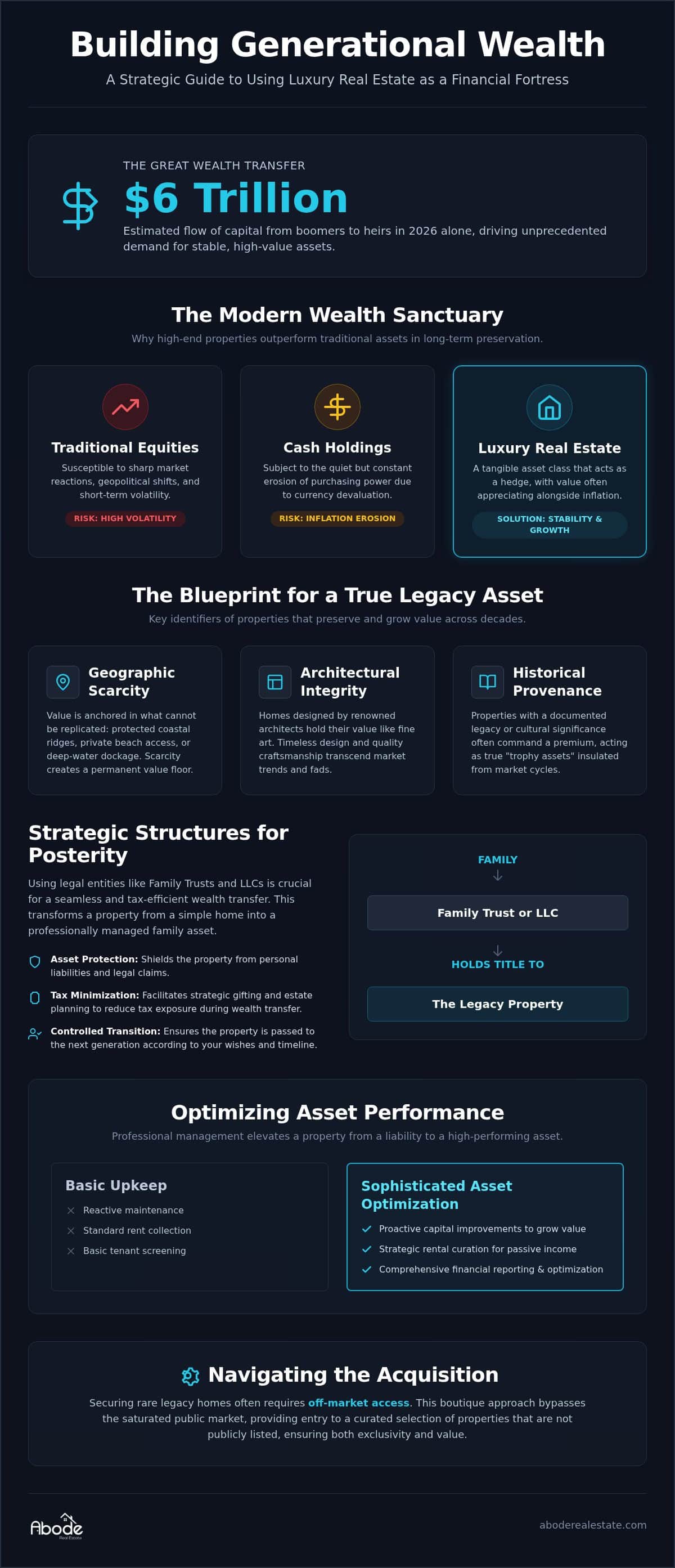
In 2026 alone, an estimated $6 trillion is flowing from the Silent Generation and baby boomers to their heirs, marking a pivotal moment for family legacies across the country. You likely recognize that traditional equities often feel too volatile in the current climate, and the quiet erosion of cash by inflation remains a constant, nagging concern for your portfolio. Finding a true sanctuary for your capital means looking toward tangible assets that offer both deep emotional resonance and exceptional financial durability. This guide explores the sophisticated art of using luxury real estate to build generational wealth, transforming high-end residential properties into enduring pillars of your family's future. It is about more than just a home. We'll examine how strategic acquisition and meticulous, professional management allow you to grow long-term capital, generate passive income through curated rentals, and minimize tax exposure during critical wealth transfers. Precision matters in these high-stakes transitions. Your journey toward a lasting legacy begins with assets that are as beautiful as they are functional.

Key Takeaways
- Discover why high-end residential properties act as a vital hedge against equity market volatility and the persistent erosion of cash assets.
- Learn to identify properties with geographic scarcity and architectural significance that preserve value across multiple decades.
- Explore the strategic advantages of using luxury real estate to build generational wealth through the use of family trusts and LLCs.
- Understand how professional property management transitions from basic upkeep to a sophisticated craft of asset optimization.
- Gain insights into the acquisition process, including the importance of off-market access for securing rare legacy homes.
Table of Contents
- The Fundamental Role of Luxury Real Estate in Wealth Preservation
- Identifying Scarcity and Value in the High-End Market
- Strategic Mechanisms for Generational Wealth Transfer
- Optimizing Asset Performance through Professional Management
- Navigating the Acquisition of Generational Assets
The Fundamental Role of Luxury Real Estate in Wealth Preservation
Luxury real estate is far more than a collection of high-end finishes and prestigious zip codes; it represents a distinct asset class that behaves differently than traditional equities or bonds. For those focused on understanding wealth and its long-term preservation, these properties serve as a foundational anchor. While the stock market might react sharply to quarterly earnings or geopolitical shifts, high-value residential assets often show a remarkable resistance to such volatility. These are frequently referred to as trophy assets, properties so rare and architecturally significant that their value is driven by scarcity rather than just market trends. In 2026, where selective buyers are looking for stability, these assets provide a sense of calm confidence. With $6 trillion currently moving from older generations to their heirs, the demand for stable, high-value assets has never been higher. Scarcity creates a floor.
Choosing the right property requires a shift in perspective. Instead of viewing a house as a liability, sophisticated investors see it as a strategic tool for capital growth. By using luxury real estate to build generational wealth, families can secure their capital in a physical form that offers both utility and appreciation. This decoupling from the general housing market is a primary trend this year. The luxury market is showing resilience, with many professionals reporting that properties over $10 million continue to see price increases even when the broader market slows down. The value is real. It's about finding a home that serves as a financial fortress while providing a sanctuary for your family.
Hedging Against Inflation with Tangible Assets
Property values have a long history of outpacing currency devaluation. When the cost of labor and materials rises, the replacement cost of a luxury estate climbs along with it, naturally pushing the property's value higher. This makes high-end homes a preferred haven for global capital. In uncertain times, the permanence of land and brick provides financial security that digital numbers on a screen simply cannot match. It's a reliable way to ensure your purchasing power remains intact for your heirs. High-end residential real estate remains one of the few places where capital can rest and grow simultaneously.
The Psychology of the Legacy Home
A family estate offers social and emotional utility that goes beyond a simple price point. It acts as a central hub where multiple generations can gather, fostering the cohesion necessary for a successful wealth transfer. These use-asset investments provide immediate lifestyle benefits while quietly growing in value over decades. When you focus on using luxury real estate to build generational wealth, you aren't just buying a building. You're securing a sanctuary for your family's future story. This emotional security is just as valuable as the financial return. By pursuing investment property acquisition through a boutique lens, you ensure that your portfolio reflects your values as much as your financial goals.
Identifying Scarcity and Value in the High-End Market
Value in the high-tier market isn't just about an appraisal number; it's about the inherent scarcity that prevents an asset from becoming a commodity. While the national entry point to the luxury housing market reached approximately $1.2 million in August 2026, true wealth-building assets often sit far above this baseline. Using luxury real estate to build generational wealth requires a discerning eye for what cannot be replicated. A modern mansion in a sprawling development might offer more square footage, but a historic estate on a protected coastal ridge offers something finite. It's this rarity that sustains value when broader markets become saturated. These assets provide a psychological anchor for a family, representing a permanent retreat in an ever-changing world.
Successful acquisition involves analyzing several key factors that define long-term durability:
- Land-to-Structure Ratio: A high land value relative to the building cost ensures that the underlying asset appreciates even as the home ages.
- Non-Replicable Amenities: This includes deep-water dockage, private beach access, or proximity to historical landmarks that cannot be built elsewhere.
- Historical Provenance: Properties with a documented legacy often command a premium that transcends market cycles, acting as a true trophy asset.
The Importance of Architectural Integrity
The intersection of art and real estate is a powerful driver for high-net-worth demand. Homes designed by renowned architects hold their value with a tenacity that mass-market luxury simply cannot match. While design trends like ultra-modern minimalism might fluctuate in popularity, timeless aesthetic appeal remains a constant. It's the difference between a property that is merely expensive and one that is culturally significant. This architectural pedigree creates a pricing floor, as there is always a global audience of collectors seeking these specific dwellings. These homes aren't just buildings; they're curated masterpieces that heirs will be proud to preserve.
Evaluating Land Scarcity and Zoning
Inventory in established, high-demand residential enclaves is naturally limited by geography. When you invest in a property with unblockable views or unique natural features, you're buying a piece of the earth that no one else can manufacture. Zoning protections further preserve this exclusivity; they ensure that the character and spirit of the neighborhood remains unchanged for decades. These regulations act as a shield against over-development, maintaining the privacy that defines a premium retreat. Understanding these local nuances is essential when identifying investment property acquisition opportunities that align with long-term legacy goals. Using luxury real estate to build generational wealth is a steady, intentional process of selecting assets that time only makes more precious.
Strategic Mechanisms for Generational Wealth Transfer
High-end real estate serves as a remarkably efficient vessel for transferring prosperity across decades. While liquid assets are often subject to the whims of the market, a carefully selected residential portfolio offers a level of control and tax efficiency that few other asset classes can match. Moving beyond simple ownership, sophisticated families view their holdings as structured entities. By using luxury real estate to build generational wealth, you can move value from one generation to the next while maintaining the integrity of the family estate. This process requires more than just a deed; it demands a specialized investment property analysis to ensure each asset aligns with a multi-generational timeline. It's about creating a frictionless path for your heirs.
Holding Structures for Family Estates
The architecture of how you hold a property is just as vital as the home's physical design. Qualified Personal Residence Trusts (QPRTs) are a primary tool for high-value homes, allowing owners to gift a residence to heirs at a reduced gift tax value while retaining the right to live there for a set term. For 2026, the federal estate and gift tax exemption stands at $15 million per individual, or $30 million for married couples. Integrating properties into family limited partnerships or LLCs further facilitates the gradual transfer of interests. These structures protect the asset from external liabilities and ensure that the management of the estate remains a cohesive family endeavor. It's a curated approach to legacy preservation that minimizes tax exposure during critical transitions.
Leveraging the Stepped-Up Basis
One of the most powerful advantages of long-term property holding is the "stepped-up basis" provided by current tax codes. When a luxury asset is passed to an heir upon death, its cost basis is reset to the current market value. This reset effectively eliminates the capital gains tax liability on years or even decades of appreciation. If you were to sell a highly appreciated property during your lifetime, the tax burden could be substantial; however, passing it to the next generation preserves that capital in its entirety. The financial impact of this reset is profound for estates that have seen significant growth. To complement this, the 2026 annual gift tax exclusion allows you to give up to $19,000 to any number of individuals without touching your lifetime exemption. By using luxury real estate to build generational wealth, you ensure that the full value of your success remains within the family circle, providing a stable foundation for your children and grandchildren.
Optimizing Asset Performance through Professional Management
Acquiring a high-tier property is only the first step in a decades-long journey of capital preservation. To truly succeed in using luxury real estate to build generational wealth, the focus must shift from simple property maintenance to sophisticated asset optimization. A legacy home is a living entity that requires a refined craft to maintain its value and prestige. Without professional oversight, even the most exquisite estates can suffer from deferred maintenance that erodes their market position. Professional management acts as a guardian of your family's capital, ensuring that the dwelling remains a high-performing component of your overall portfolio. It's about proactive stewardship rather than reactive repairs.
The ROI of Full-Service Property Management
High-value residential assets often feature complex mechanical systems, specialized materials, and custom finishes that demand precise care. Implementing a rigorous preventative maintenance schedule protects the structural integrity and long-term resale value of the home. Beyond the physical structure, learn more about the value of professional property management and how it safeguards the property's reputation. Professional tenant screening is essential for long-term rentals; it ensures that those occupying the space respect the prestige of the estate. Self-management often leads to oversight, which can be a costly mistake when dealing with multi-million dollar assets. Experts handle the details so you can focus on the bigger picture of your legacy.
Luxury Vacation Rentals as a Revenue Stream
One of the most effective ways to offset the significant carrying costs of a secondary estate is through a curated short-term rental strategy. By offering the property as a luxury vacation rental during periods when the family isn't in residence, the asset can become self-funding. This approach doesn't require sacrificing personal use; instead, it turns the home into a productive engine for wealth. Successful execution depends on high-level guest experience curation, which maintains the dwelling's status in the premium market. Evaluating the potential for high-yield returns requires a deep understanding of seasonal demand and localized trends. Using luxury real estate to build generational wealth becomes much more sustainable when the asset generates its own liquidity. To begin optimizing your residential portfolio, connect with us for a tailored management analysis.
Navigating the Acquisition of Generational Assets
Securing a legacy asset is a deliberate act of curation that extends far beyond a simple search for square footage. When your goal is using luxury real estate to build generational wealth, the acquisition process must be rooted in deep-dive analysis and exclusive access. Standard public portals often lack the depth required for high-stakes decisions; they rarely feature the truly unique dwellings that define a family estate. The process relies on the quiet authority of a well-connected guide who understands the essential character of the most desirable enclaves. A legacy-first approach means looking past current aesthetics to evaluate the underlying bones and future adaptability of the property. You're not just buying a home. You're facilitating a high-stakes transition for your family's future.
The Boutique Acquisition Process
Exceptional value is frequently found in quiet listings that never reach the public eye. These off-market opportunities offer a level of exclusivity and privacy that is highly prized in the premium tier. By working with a boutique brokerage, you gain access to specialized market insights that predict shifts in demand before they become common knowledge. This intelligence allows you to move with calm confidence when a rare opportunity arises. Explore our strategies for investment property acquisition to see how a tailored approach uncovers assets with the highest potential for durability. It's about finding the one property that others might overlook, but that perfectly fits your family's narrative.
Evaluating Long-Term Financial Alignment
The final stage of due diligence involves a deep-dive analysis of carrying costs versus projected long-term appreciation. A property must do more than just grow in value; it must be adaptable enough to serve future generations. We look for features like detached guesthouses or wellness infrastructure that support multigenerational living, a trend where 73% of real estate professionals report increased interest in the $5 million-and-above segment. This selective approach ensures that the asset remains functional and relevant for decades. Using luxury real estate to build generational wealth is a steady, intentional journey. By positioning your brokerage as a long-term advisor rather than a transactional agent, you secure a partner who is as committed to your family's legacy as you are. Your next chapter begins with a single, well-informed choice.
Securing Your Family's Future Through Curated Assets
Building a legacy is a deliberate craft that requires a vision extending far beyond the current market cycle. We've explored how geographic scarcity and architectural integrity create a durable floor for your capital; we've also examined how sophisticated holding structures protect that value for the next generation. By using luxury real estate to build generational wealth, you transform a physical dwelling into a high-performing asset that thrives under professional stewardship. Our boutique, high-touch luxury service is specifically designed to handle these high-stakes transitions with precision and approachable warmth. We provide the specialized investment property analysis and expertise in full-service property management needed to ensure your portfolio remains a sanctuary for both your family and your capital. The journey toward a multi-generational legacy is unhurried and intentional, but it requires a steady partner to navigate the selective landscape of 2026. Your family's story deserves a foundation as enduring as the assets you acquire today. Begin your legacy with a private consultation and discover how we can align your residential portfolio with your long-term financial objectives. It's time to move into your next chapter with confidence.
Frequently Asked Questions
How does luxury real estate compare to the stock market for long-term wealth?
Luxury properties offer tangible stability and lower volatility compared to the traditional stock market. While equities are susceptible to rapid geopolitical shifts and market sentiment, high-end real estate acts as a physical hedge against inflation. This asset class often decouples from the broader economy, maintaining value through scarcity and architectural significance. It provides a unique blend of capital appreciation and lifestyle utility that digital portfolios simply cannot match for families prioritizing durability.
What makes a property a 'generational' asset rather than just a home?
A generational asset is defined by its scarcity, architectural integrity, and historical provenance. Unlike a standard residence, these properties often feature unblockable views or unique natural features that cannot be replicated by modern developers. They serve as a permanent retreat that anchors a family's legacy for decades. Using luxury real estate to build generational wealth requires selecting dwellings that offer long-term social utility and enough adaptability to accommodate multiple generations under one roof.
Can a luxury home be a passive income generator for my family?
High-end properties can generate significant passive income through curated short-term rental strategies. By positioning a legacy home as a luxury vacation rental during unoccupied periods, owners can offset substantial carrying costs and property taxes. This transforms a static residence into a self-funding asset without sacrificing personal use. Success depends on professional management to maintain the property's prestige and ensure a high-caliber guest experience, allowing the family to grow capital while retaining the estate.
What are the tax advantages of passing real estate to the next generation?
The primary advantage is the "stepped-up basis," which resets the property's cost basis to its current market value upon transfer at death. This effectively eliminates capital gains tax on decades of appreciation for your heirs. Additionally, the 2026 estate tax exemption allows individuals to pass up to $15 million tax-free, or $30 million for married couples. Combining this with the $19,000 annual gift tax exclusion provides a highly efficient framework for moving wealth without excessive tax erosion.
Is it better to hold luxury property in a trust or an LLC?
The choice depends on your specific goals for privacy, liability protection, and tax efficiency. A Qualified Personal Residence Trust is often ideal for reducing the taxable value of a primary estate, while an LLC provides robust liability protection and facilitates the gradual transfer of interests. Most sophisticated families use a combination of these structures to manage their holdings. We recommend coordinating with your legal advisor to ensure the holding entity aligns with your broader legacy objectives.
How do I ensure a property maintains its value over several decades?
Value preservation requires a shift from basic maintenance to proactive asset optimization. Protecting a home's structural integrity and architectural pedigree ensures it remains desirable in the premium market regardless of current trends. This includes implementing rigorous preventative schedules and using specialized materials that age gracefully over time. Consistent, high-touch care prevents the deferred maintenance that often erodes the resale value of high-tier dwellings, keeping the property at the pinnacle of its specific neighborhood.
What is the role of professional management in a legacy real estate strategy?
Professional management acts as the guardian of your family's capital by overseeing the technical and operational complexities of a high-value asset. Experts handle everything from tenant screening to complex mechanical systems, ensuring the property's reputation remains untarnished. In a legacy strategy, this oversight is a refined craft that maximizes ROI while reducing the anxiety of self-management. It allows the owners to focus on the emotional and social bonds the estate was intended to facilitate for the family.
How do I identify off-market luxury opportunities for wealth building?
Identifying "quiet" listings requires deep-rooted relationships within a boutique brokerage network. Many of the most significant generational assets never reach public portals to protect the privacy of the sellers. Accessing these exclusive opportunities involves working with a well-connected guide who understands the essential spirit of high-demand markets. Using luxury real estate to build generational wealth often starts with these off-market acquisitions, where scarcity and value are most concentrated for discerning buyers looking for a permanent family retreat.
Posted by Brook Walsh onEnjoy this blog post? Click here to subscribe for updates
Leave A Comment