
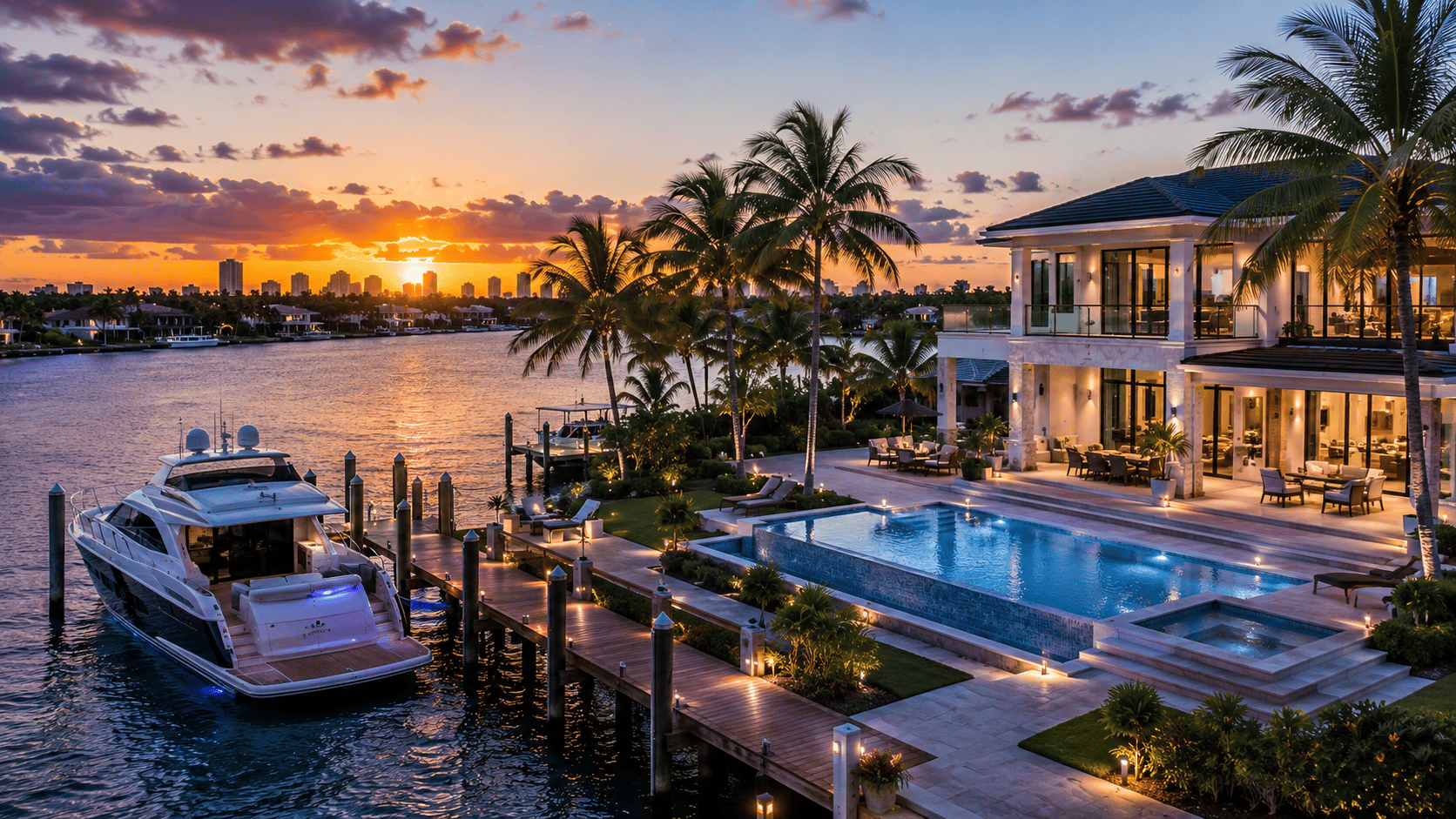
Your dream vessel deserves a home that was built to receive it. For discerning buyers, exploring waterfront estates with a private dock in Fort Lauderdale offers an extraordinary range of options, but the most beautiful estate on the water can quietly become the wrong choice if the dock can't accommodate your boat's draft, beam, or tower height. It's a detail that changes everything, and it's one that far too many buyers discover too late.
You already understand that a private dock elevates a waterfront residence into something categorically different. It's not simply an amenity; it's the entire point. What's less obvious are the layers of technical and structural due diligence that separate a truly functional private port from one that looks the part but falls short on the water. Bridge clearances, seawall integrity, dredging history, navigational access depth: each of these factors carries real weight in determining whether a property will serve your lifestyle or constrain it.
This guide walks you through the essential considerations for acquiring a premier waterfront estate with private dockage, covering the navigational specifications, structural realities, and long-term investment factors that ensure your vessel and your asset are genuinely aligned from day one.
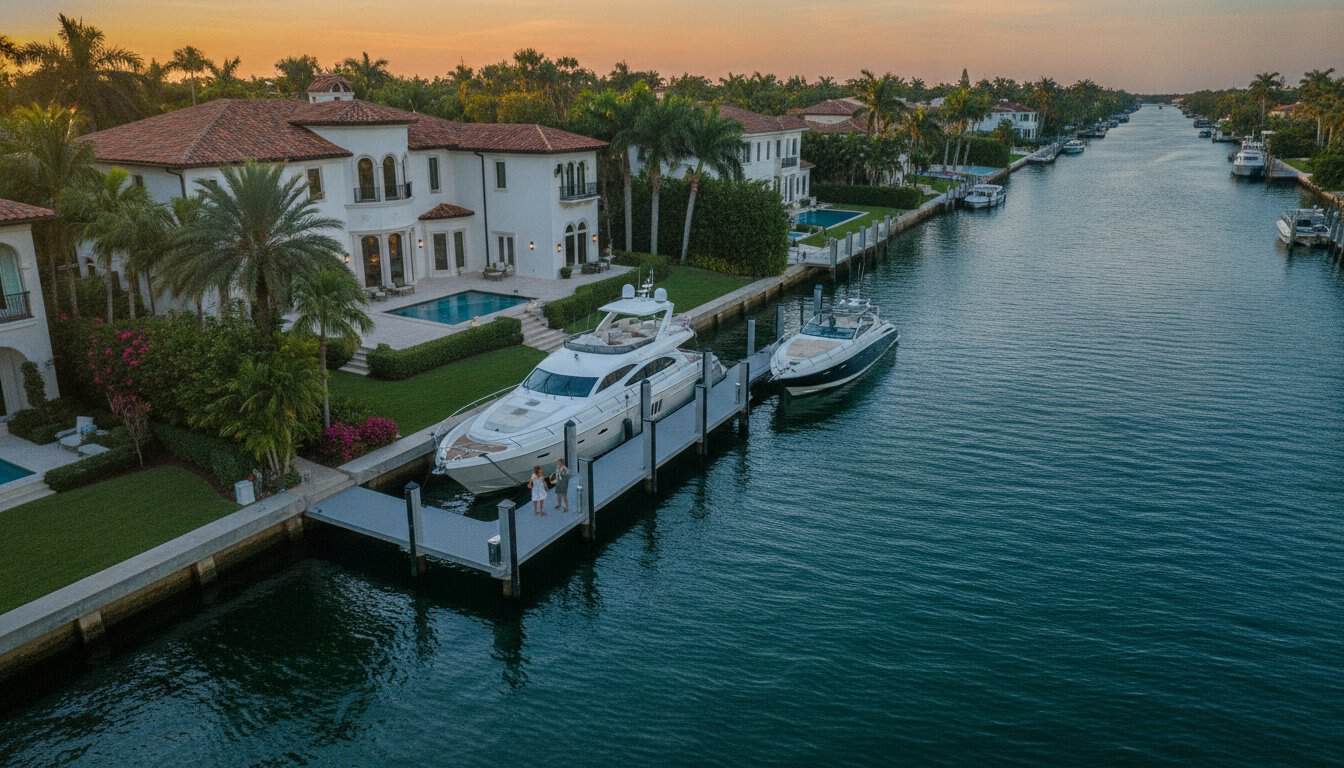
Key Takeaways
- Among waterfront estates with private dock Fort Lauderdale offers the most consequential factors aren't aesthetic — they're technical, including bridge clearances, canal depth, and seawall condition, all of which determine whether your vessel can actually live there.
- Dock infrastructure has evolved well beyond a simple slip; modern yachting demands high-capacity shore power, integrated freshwater systems, and seawall materials built to endure South Florida's marine environment for decades.
- Understanding the difference between fixed and bascule bridges — and calculating the controlling depth of your target canal — can make or break access for deep-draft or tall-masted vessels before you ever make an offer.
- A thorough acquisition requires specialized underwater inspections and permit verification, not just a standard home inspection, to uncover structural liabilities and confirm the legal potential for future dock expansion.
- Ongoing estate performance, from preventative maintenance to seasonal management, is what separates a waterfront asset that appreciates gracefully from one that quietly deteriorates between visits.
Table of Contents
- The Evolution of Luxury Waterfront Estates in 2026
- Essential Dock Infrastructure for Modern Yachting
- Navigational Freedom: Understanding Bridge and Depth Constraints
- Due Diligence for Waterfront Property Acquisitions
- The Abode Approach to Luxury Asset Management
The Evolution of Luxury Waterfront Estates in 2026
Something fundamental has shifted in how the world's most discerning buyers define a primary residence. It's no longer simply a place to return to; it's a curated personal retreat that reflects a philosophy of living, an environment engineered for the kind of ease and intentionality that the wider world rarely permits. Nowhere is this evolution more visible than along Fort Lauderdale's extensive waterway network, where the convergence of architectural sophistication and functional maritime utility has produced a category of estate that operates less like real estate and more like a private sanctuary with its own port of call.
For global coastal investors, private dockage has quietly become the ultimate requisition, the single feature that elevates a beautiful waterfront home into a genuinely irreplaceable asset. The reasoning is straightforward: a dock transforms how you inhabit a property. It changes the rhythm of your days, the nature of your social rituals, and the emotional relationship you have with the water itself. That's a different conversation than square footage or finish-level upgrades.
A Philosophy of Arrival and Belonging
The entryway of a luxury estate is being redefined. Where a grand front door once set the tone for a property, the water-facing facade now carries that weight for the buyers who matter most in this market. Arriving by vessel, stepping from the water directly into a thoughtfully designed outdoor living environment, creates an emotional resonance that no motor court can replicate. It's a seamless transition from sea to land, and the properties that facilitate it effortlessly command a loyalty from their owners that goes well beyond financial attachment. Boutique advisory expertise is essential here; understanding which estates genuinely deliver that experience, versus those that merely suggest it, requires the kind of localized, high-touch guidance that a firm like Abode Real Estate is positioned to provide.
Market Trends for Boating-Centric Properties
Demand is shifting toward estates capable of accommodating larger, more complex vessels, and the market is responding. Buyers exploring waterfront estates with private dock Fort Lauderdale options are increasingly asking technical questions first: What's the controlling depth? What's the shore power capacity? How does the property integrate with smart-home and marina-management systems? Technological integration has moved from a differentiating feature to a baseline expectation, with automated dock lighting, remote monitoring, and vessel management platforms now common in premier listings. Tactical planning in asset selection has never mattered more; the right property in the right canal, with the right infrastructure already in place, is a fundamentally different investment than one that requires years of remediation to reach its potential.
Essential Dock Infrastructure for Modern Yachting
A private dock is only as valuable as the infrastructure supporting it. That's a distinction that listing descriptions rarely make, and it's precisely where discerning buyers need to look beyond the photographs. When evaluating waterfront estates with private dock Fort Lauderdale properties, the dock itself deserves the same level of scrutiny as the main residence, because what sits beneath the waterline, inside the electrical panels, and within the pilings often tells a more honest story than anything visible from the seawall.
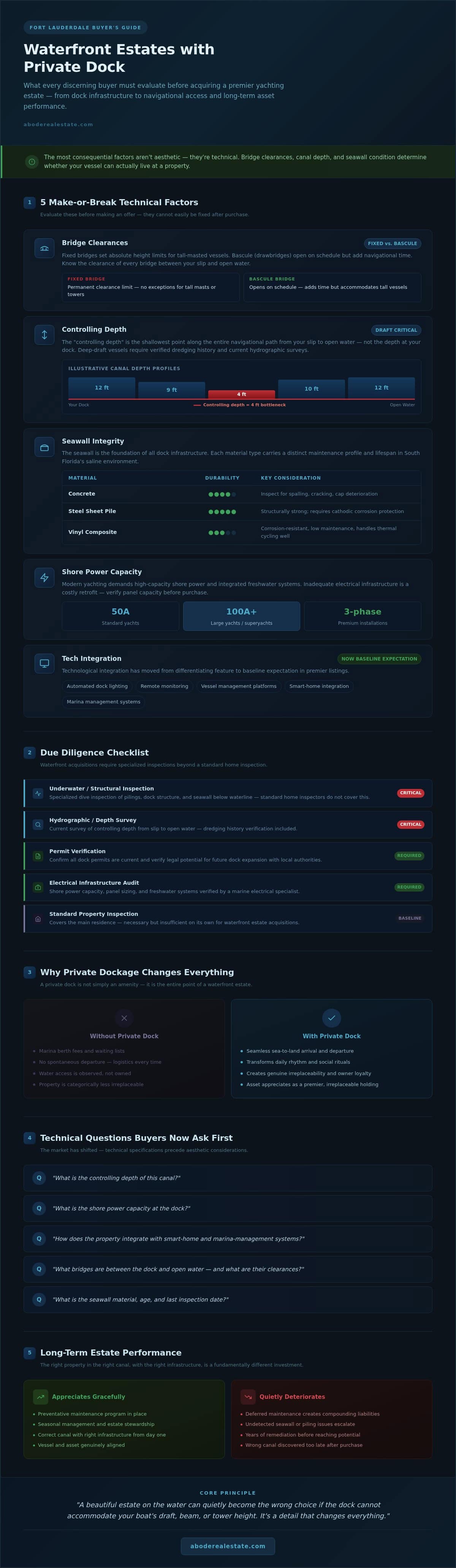
Seawall integrity is the foundation of that story. Concrete seawalls, when properly constructed and maintained, offer exceptional longevity in South Florida's saline environment, but they require periodic inspection for spalling, cracking, and cap deterioration. Steel sheet pile seawalls are structurally robust but vulnerable to corrosion over time without cathodic protection. Vinyl composite systems have gained significant traction in recent years because they resist corrosion, require less maintenance, and perform well under the thermal cycling that South Florida's climate demands. Each material carries a different maintenance cycle and replacement horizon, and understanding which one your target property uses directly informs your long-term cost model.
Piling selection deserves equal attention. Concrete pilings offer durability and resist marine borers, while treated timber pilings remain common in older installations but carry a shorter effective lifespan in warm, active waterways. The pilings must be sized and spaced to absorb lateral load during weather events, and their condition directly affects how safely your vessel can be secured during seasonal shifts in wind and current.
Shore power infrastructure is no longer optional for serious yachting. Large vessels typically require 50-amp or 100-amp, 480-volt three-phase service, and many estates built even a decade ago simply weren't wired to those specifications. Integrated freshwater systems, proper bilge pump connections, and weatherproof electrical enclosures round out the baseline requirements that a purpose-built yachting estate should already have in place.
Technical Specifications for Large Vessels
Dock length should exceed your vessel's overall length by a meaningful margin, with width accommodating beam plus fendering clearance on both sides. Heavy-duty cleats rated for your vessel's displacement aren't a luxury; they're a safety requirement. Modern dock installations increasingly integrate with smart-home maritime monitoring platforms, allowing remote tracking of water levels, line tension alerts, and shore power consumption from anywhere in the world. Properties with this infrastructure already embedded represent a meaningful advantage.
Seawalls and Riparian Rights
Ownership of the land beneath the waterline, known as riparian rights, varies by property and carries real legal weight. These rights govern what you can build, how far into the waterway you can extend a dock, and what permits are required for any modification. Dock construction and modification in Florida waterways falls under oversight frameworks that include U.S. Army Corps of Engineers navigational regulations, meaning permit history and compliance status are due diligence items, not afterthoughts. An estate with clean permit records and a properly maintained seawall is a fundamentally cleaner acquisition than one with unresolved structural or regulatory exposure.
On the aesthetic side, composite decking materials have largely supplanted tropical hardwoods like ipe in premium installations. They deliver a comparable visual warmth without the maintenance demands or sourcing concerns that come with natural timber in a marine environment. It's a practical evolution that doesn't compromise the visual character of a well-designed dock.
If you're assessing a property's dock infrastructure and want guidance on what to prioritize before making an offer, exploring curated South Florida luxury waterfront listings with documented dock specifications is a productive place to begin that conversation.
Navigational Freedom: Understanding Bridge and Depth Constraints
Four words carry more weight in Fort Lauderdale's waterfront market than almost any other phrase in a listing description: "no fixed bridges to ocean." For yacht owners with vessels exceeding a certain air draft, those four words aren't a preference; they're a prerequisite. A property that sits behind even a single fixed bridge with inadequate vertical clearance effectively becomes inaccessible to any sailboat with a tall mast or a motoryacht with a flybridge and radar arch. The estate can be architecturally flawless. It doesn't matter.
The distinction between fixed and bascule bridges is fundamental. Fixed bridges offer a static clearance height that never changes regardless of tide, meaning your vessel either clears it or it doesn't. Bascule bridges, by contrast, open on request during designated hours, granting passage to vessels of virtually any height. Properties with unobstructed bascule access or, ideally, no bridges at all between the dock and the nearest inlet represent a meaningfully higher tier of navigational freedom, and the market prices that advantage accordingly.
Depth is the other variable that photographs never reveal. The controlling depth of a canal, meaning the shallowest point along the entire navigational route from your dock to open water, sets an absolute ceiling on the draft of any vessel you can keep there. A canal that reads eight feet at the seawall may narrow to five feet at a bend two properties away. Buyers evaluating waterfront estates with private dock Fort Lauderdale properties should request hydrographic survey data or commission an independent depth sounding rather than relying on published figures, which can lag behind natural sedimentation cycles by years.
Tidal fluctuation adds another layer of complexity. South Florida's tidal range is modest compared to many coastal markets, but even a one-to-two-foot swing can determine whether a deep-draft vessel can transit a particular canal during certain hours of the day. Understanding your navigational windows, and whether they align with how you actually use your vessel, is a practical calculation that deserves attention before closing.
The Logistics of Ocean Access
The distance from a private dock to the nearest deep-water inlet shapes the daily rhythm of ownership in ways buyers often underestimate. Properties with direct Intracoastal Waterway frontage typically offer superior transit efficiency compared to those situated on secondary inland canals, where additional turns, lower bridges, and shallower controlling depths can extend the journey to open water considerably. Canal width also matters for larger vessels; a 70-foot motoryacht requires a meaningful turning radius, and some inland canals simply don't provide it safely.
Vessel-Specific Property Matching
Aligning your current fleet, and any vessels you anticipate acquiring, with a property's navigational profile is one of the most consequential exercises in the acquisition process. A fixed bridge that clears your current 45-foot sportfish becomes an insurmountable obstacle if you later move to a 65-foot convertible with a taller radar arch. Bridge height restrictions have a measurable effect on resale value precisely because they limit the buyer pool for any future sale. Consulting with a refined local expert who can verify navigational data against your specific vessel specifications, rather than relying on general neighborhood descriptions, is the kind of high-touch guidance that separates a well-advised acquisition from one that reveals its constraints after the fact. For buyers ready to begin that conversation, exploring Fort Lauderdale's premier waterfront communities with documented navigational access is a productive first step.
Due Diligence for Waterfront Property Acquisitions
A standard home inspection is simply not built for this category of asset. Waterfront estates with private docks Fort Lauderdale buyers are acquiring require a parallel track of specialized technical review that runs alongside the conventional residential process, and the two must be completed before any contingency period closes. Skipping that parallel track is how buyers inherit problems that were entirely discoverable before signing.
Underwater inspections are the starting point. A qualified marine surveyor should assess the seawall footings, piling bases, and any submerged structural components that a surface-level walkthrough will never reveal. Corrosion at the waterline, undercutting behind the seawall face, and compromised piling connections are all conditions that look fine from the dock deck but carry significant remediation costs. Commissioning this inspection independently, rather than relying on any report provided by the seller, is a non-negotiable step.
Permit verification deserves equal urgency. Every dock structure, seawall modification, and lift installation should carry a clean permit history with documented final inspections. Unpermitted additions create real liability exposure; they can trigger mandatory removal orders, complicate financing, and create complications at resale. Equally important is understanding the regulatory envelope for future expansion. Knowing what the property's riparian rights allow, and what local and state agencies will actually approve, tells you whether the dock can grow with your fleet or whether it's already at its legal ceiling.
The financial case for dockage deserves its own analysis within the broader acquisition model. A properly documented, code-compliant private dock is a standalone value driver within the estate, one that meaningfully narrows the competitive field for any future buyer. Properties without dockage, or with structurally compromised docking infrastructure, simply don't compete for the same buyer profile. That asymmetry is worth quantifying before you make an offer.
The Professional Facilitation Process
Boutique brokerages with genuine waterfront specialization coordinate the full spectrum of due diligence, connecting buyers with maritime engineers, environmental consultants, and real estate counsel who understand the specific regulatory frameworks governing South Florida's coastal properties. That coordination isn't incidental; it's where the real value of high-touch advisory is earned. Integrity in this phase means surfacing problems, not managing around them, and a trusted advisor will tell you when a property's structural or regulatory exposure changes the calculus of the deal. Explore Abode's investment acquisition strategies for a deeper framework on evaluating waterfront assets before committing.
Insurance and Regulatory Considerations
Flood zone designation directly shapes the insurance profile of any waterfront estate, and South Florida's FEMA flood maps carry real premium implications that vary significantly by property elevation and zone classification. Coastal construction regulations, environmental buffer requirements, and evolving climate resilience standards add further layers that a buyer should understand before closing, not after. Properties already built to current standards, with documentation to prove it, represent a cleaner long-term position than those requiring costly retrofits to meet the compliance benchmarks that regulators are steadily tightening.
The Abode Approach to Luxury Asset Management
Acquiring a premier waterfront estate is the beginning of a relationship, not the conclusion of one. What happens in the months and years after closing determines whether that asset appreciates with the quiet grace it deserves or quietly accumulates deferred maintenance, regulatory drift, and missed opportunity. For seasonal owners and global investors alike, the difference between those two trajectories almost always comes down to the quality of stewardship in place.
Preventative care is where that stewardship earns its value. A waterfront estate operates in one of the most demanding environments residential real estate encounters: salt air, humidity, tidal fluctuation, and the particular stress that a working dock places on both the maritime infrastructure and the property surrounding it. Seawall caps, dock decking, shore power connections, and piling hardware all require scheduled inspection and maintenance on a cadence that a standard property management firm simply isn't equipped to coordinate. Abode's approach integrates both the dwelling and the maritime infrastructure into a single, coherent care plan, so nothing falls between the categories.
Curated Management for Discerning Owners
The clinical efficiency of a national franchise is a poor fit for this category of asset. What discerning owners of waterfront estates with private dock Fort Lauderdale properties actually need is personalized attention from an advisor who knows the property as well as they do. Abode's full-service property management model is built around that standard: coordinating vendors, managing seasonal transitions, and ensuring that every arrival, whether the owner's or a curated guest's, unfolds without friction. That means the dock lines are set correctly, the systems are running, and the property feels lived-in rather than maintained.
Maximizing the Value of Your Waterfront Investment
Long-term wealth preservation in this market requires more than passive ownership. Leveraging structured investment property analysis to track performance, benchmark against comparable waterfront estates with private dock Fort Lauderdale transactions, and identify the right moments to optimize for private use or curated short-term rental income is an ongoing discipline. Abode brings a boutique partner's understanding of South Florida's local environmental character and waterfront market dynamics to that analysis, which is something a generalist firm simply can't replicate.
The right advisor doesn't just help you buy well. They help you hold well, manage well, and eventually exit well. If you're ready to explore what genuinely high-touch waterfront asset management looks like in practice, contact our team for a private consultation and begin that conversation.
Your Private Port Awaits: Begin the Search with Confidence
Finding the right waterfront estate is a discipline that rewards preparation. The technical realities covered here, from seawall integrity and shore power capacity to controlling depth and bridge clearance, exist not to complicate the search but to sharpen it. A property that genuinely aligns with your vessel and your lifestyle is a fundamentally different asset from one that simply looks the part from the dock.
What separates a well-advised acquisition from a costly one is almost always the quality of guidance behind it. Abode Real Estate brings deep expertise in maritime-centric real estate, a sophisticated boutique service model, and comprehensive management capabilities for luxury waterfront assets, all within a single, client-focused relationship. That combination matters when the stakes are this high.
Among waterfront estates with private dock Fort Lauderdale has to offer, the right property is out there. The goal is finding it with clarity, not discovering its limitations after closing. Explore our exclusive portfolio of luxury waterfront estates and take the first step toward an acquisition you'll feel confident about for years to come.
Frequently Asked Questions
What is the difference between a fixed bridge and a no-fixed-bridge property?
A fixed bridge has a static vertical clearance that never changes, meaning your vessel either fits beneath it or it doesn't, regardless of tide or time of day. A no-fixed-bridge property means your route from the dock to open water involves only bascule bridges, which open on request, or no bridges at all. For tall-masted sailboats and motoryachts with elevated radar arches or flybridges, this distinction determines whether a property is usable at all.
The market prices this advantage clearly. Properties with unobstructed navigational access consistently attract a broader buyer pool, which directly supports long-term resale value. It's one of the first questions worth asking before scheduling a showing.
How deep does the water need to be for a 50-foot yacht?
A 50-foot yacht's draft varies considerably by hull design, typically ranging from three to six feet for a motoryacht and potentially deeper for a sailing vessel with a full keel. As a general rule, you want the controlling depth of the canal, meaning the shallowest point along your entire route to open water, to exceed your vessel's draft by a comfortable safety margin, particularly at low tide.
Don't rely solely on published canal depth figures. Sedimentation accumulates over time, and those numbers can lag reality by years. Commissioning an independent hydrographic survey before making an offer gives you accurate, current data rather than an approximation.
Does a private dock increase the property value of a waterfront estate?
A properly documented, code-compliant private dock is a standalone value driver within a waterfront estate. It narrows the competitive field significantly for any future sale, because buyers who need dockage won't seriously consider properties without it. That scarcity creates a meaningful pricing premium that a well-maintained dock sustains over time.
The condition and infrastructure of the dock matter as much as its existence. A dock with adequate shore power, clean permit records, and structurally sound pilings commands a different premium than one with deferred maintenance or regulatory exposure. Among waterfront estates with private docks in Fort Lauderdale buyers actively pursue, documented infrastructure quality is a real differentiator at the negotiating table.
What are riparian rights and how do they affect my dock usage?
Riparian rights are the legal entitlements that come with owning land adjacent to a body of water. They govern what you can build into the waterway, how far a dock can extend, and what regulatory approvals are required for any modification or expansion. These rights vary by property and aren't automatically unlimited, so understanding the specific envelope your parcel carries is essential before assuming you can build or expand freely.
Permit history is the practical expression of those rights. Every dock structure and seawall modification should have documented permits with final inspections on file. Unpermitted additions can trigger removal orders and complicate future sales, so verifying compliance status is a non-negotiable step in any serious waterfront acquisition.
How often should a seawall be inspected on a luxury estate?
Most marine engineers recommend a professional seawall inspection every three to five years under normal conditions, with more frequent assessments after significant weather events or visible signs of deterioration like cracking, spalling, or soil movement behind the wall. South Florida's saline environment and seasonal storm activity accelerate wear on all seawall materials, making consistent inspection schedules genuinely important rather than merely precautionary.
The inspection should include both the visible cap and face and the submerged footing, which requires an underwater assessment. Surface-level reviews miss the conditions most likely to cause structural failure, so engaging a qualified marine surveyor rather than a general contractor is the appropriate choice for this type of evaluation.
Can I expand an existing dock to accommodate a larger vessel?
Dock expansion is possible on many properties, but it's governed by a layered approval process that includes your riparian rights, local zoning regulations, Florida state environmental permitting, and in some cases U.S. Army Corps of Engineers authorization. The regulatory envelope varies meaningfully by property, canal width, and proximity to protected waterways, so what's achievable on one estate may not be permitted on an adjacent one.
Before purchasing with expansion in mind, verify both the legal potential and the practical feasibility. A canal that's too narrow to safely accommodate a longer dock, or a regulatory framework that caps your extension at its current length, changes the calculus of the acquisition entirely. A boutique advisor with genuine waterfront specialization can help you assess that envelope accurately before you commit.
What shore power requirements are typical for modern luxury yachts?
Larger motoryachts commonly require 50-amp or 100-amp, 480-volt three-phase shore power service to run air conditioning, battery charging systems, and onboard electronics without running the vessel's generators continuously. Smaller yachts in the 40-to-50-foot range may operate on 30-amp or 50-amp single-phase service, but as vessel size and onboard systems grow, power demands increase substantially.
Many estates built more than a decade ago weren't wired to current yachting specifications, which means retrofitting shore power infrastructure can be a significant post-purchase expense. Confirming the existing electrical capacity at the dock, and whether it matches your vessel's requirements, is a practical due diligence item that belongs on the pre-offer checklist alongside depth and bridge clearance.
Why should I use a boutique brokerage for a waterfront purchase?
Waterfront estates with private docks in Fort Lauderdale buyers are acquiring involve technical complexity that a generalist brokerage simply isn't equipped to navigate. Bridge clearances, seawall condition, controlling depth, riparian rights, and permit compliance all require specialized knowledge and a network of maritime engineers, surveyors, and environmental consultants who can verify what listing descriptions don't reveal. A boutique firm with genuine waterfront specialization coordinates that full spectrum of due diligence as a matter of standard practice.
Beyond the transaction itself, the right advisor brings a long-term orientation to the relationship. Abode Real Estate's approach is built around high-touch guidance that extends from acquisition through ongoing asset management, ensuring the property performs as well in year five as it did on closing day. That continuity of expertise is something a national franchise model isn't structured to provide.
Posted by Brook Walsh onEnjoy this blog post? Click here to subscribe for updates
Leave A Comment