

A high cap rate is often a warning sign in disguise rather than a badge of investment success. You've likely felt that familiar pull of anxiety when reviewing a potential acquisition, wondering if you're overpaying for an asset or if your net operating income calculations have overlooked a critical expense. It's natural to feel a sense of hesitation when the lines between your cash-on-cash return and the fundamental process of calculating cap rate for rental property begin to blur. We understand that in 2026, where the 10-year Treasury yield sits near 4.60%, the margin for error in your financial modeling has never been thinner.
You deserve a clear, repeatable framework that transforms property evaluation from a stressful hurdle into a refined craft. This guide provides the exact formulas used by sophisticated investors to identify high-performing opportunities while building a truly resilient portfolio. We'll explore how to accurately account for rising maintenance costs, currently recommended at 1.5% of property value, and demonstrate how professional management serves as a vital tool for optimizing your long-term yield.

Key Takeaways
- Understand how cap rate serves as a universal language for comparing diverse real estate assets and evaluating risk beyond simple profit margins.
- Master the step-by-step process of calculating cap rate for rental property using current 2026 market data to ensure your projections are grounded in reality.
- Discover how to interpret national benchmarks for luxury residential assets and recognize the inverse relationship between property quality and yield.
- Learn why cap rate is only one piece of the investment puzzle and how professional management acts as a catalyst for protecting your net operating income.
- Identify the specific expenses that must be included in your NOI to avoid overpaying for an asset and build a truly resilient real estate portfolio.
Table of Contents
- Understanding the Fundamentals: What is Cap Rate in Real Estate Investing?
- The Step-by-Step Formula for Calculating Cap Rate for Rental Property
- Evaluating the Results: What Constitutes a Good Cap Rate in 2026?
- Beyond the Math: Why Cap Rate is Only One Piece of the Investment Puzzle
- Optimizing Your Yield: How Professional Management Protects Your Capitalization Rate
Understanding the Fundamentals: What is Cap Rate in Real Estate Investing?
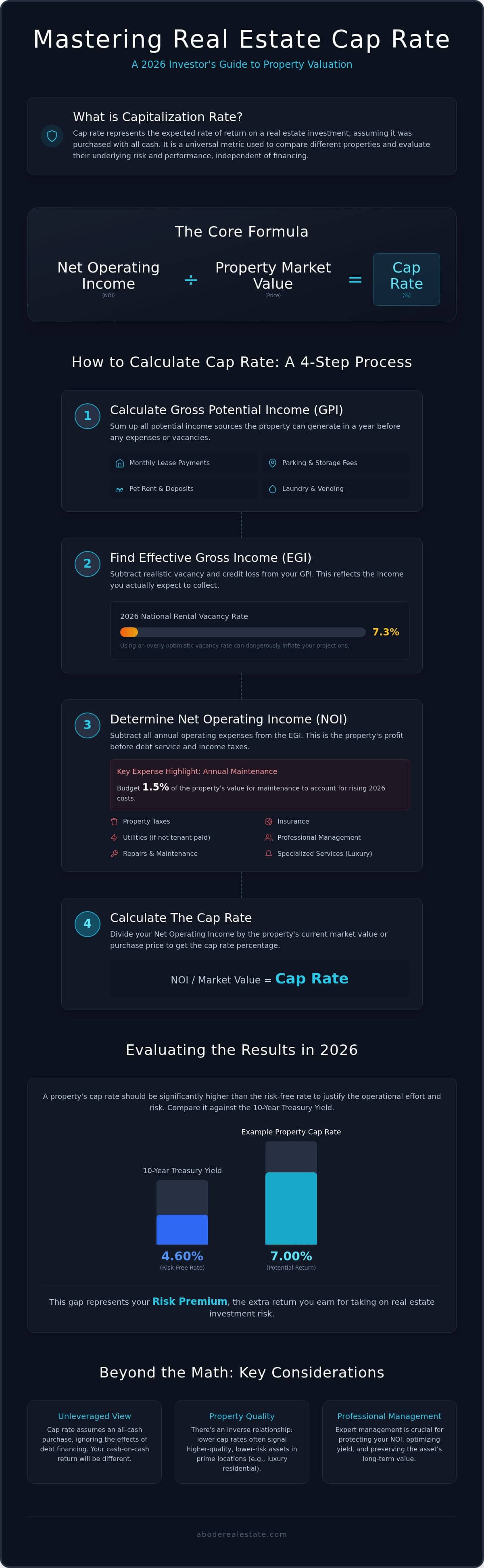
At its core, the capitalization rate represents the expected rate of return on a real estate investment property based on the income it's expected to generate. It serves as a vital bridge between emotional appeal and financial reality. Understanding the Fundamentals: What is Cap Rate allows you to strip away the complexities of mortgage structures and tax incentives to see a property's raw performance. By dividing the Net Operating Income (NOI) by the current market value, you arrive at a percentage that acts as a universal language for investors worldwide. It's the ultimate equalizer.
Calculating cap rate for rental property provides a clear snapshot of risk. A lower cap rate, often seen in the luxury sector, typically signals a lower-risk profile with high demand and stable appreciation. Conversely, a high cap rate might suggest a property in a declining neighborhood or one requiring significant capital expenditures. It's the primary tool we use during investment property acquisition to ensure our clients aren't lured by high paper returns that mask underlying instability. Stability is the true luxury.
The Role of Cap Rate in Portfolio Strategy
Cap rate isn't just a number; it's a strategic filter. During the discovery phase, it helps you quickly discard assets that don't align with your risk tolerance or cash flow requirements. As we move through 2026, comparing these rates against the 10-year Treasury yield of 4.60% is essential. If a property's cap rate isn't significantly higher than this risk-free rate, the investment may not justify the operational effort. It also helps establish a realistic exit strategy by allowing you to project future resale values based on market-standard exit caps. Precision matters here.
Cap Rate vs. Yield: Clearing the Confusion
Investors often confuse cap rate with yield or cash-on-cash return, but the distinction is critical. While yield often factors in the impact of financing, cap rate assumes an all-cash purchase. This unleveraged view is what makes it so powerful for comparing two disparate properties on equal footing. It lets you see how the asset performs on its own merits before you layer on the variables of debt. When you're calculating cap rate for rental property, you're essentially gauging the speed of your capital recovery. Cap rate serves as a refined mathematical expression of an asset's inherent risk and its capacity to sustain value over time.
The Step-by-Step Formula for Calculating Cap Rate for Rental Property
The process of calculating cap rate for rental property begins with a clear-eyed assessment of your potential revenue. You must first identify your Gross Potential Income, which encompasses more than just the monthly lease payments. It includes every stream of ancillary revenue, from parking fees and pet rent to laundry services or storage locker rentals. Once you have this total, you must subtract a realistic vacancy factor. As of the second quarter of 2026, the national rental vacancy rate has reached 7.3%, a figure that reflects an oversupply in many multifamily markets. Using an overly optimistic 3% or 5% vacancy rate in your modeling can lead to a dangerously inflated perception of an asset's performance.
After establishing your Effective Gross Income, you subtract your annual Operating Expenses. This is where many investors falter by underestimating the true cost of maintaining a premium asset. For a reliable result, your expenses must include property taxes, insurance, utilities, and professional management. While the 50% rule is a common industry shorthand, luxury assets often require a more nuanced approach. In 2026, we recommend budgeting 1.5% of the property's total value for annual maintenance to account for increased labor and material costs. The resulting figure is your Net Operating Income, the pulse of your investment's health.
Calculating Net Operating Income (NOI) with Precision
Precision in your NOI calculation is what separates a boutique investor from a casual buyer. For luxury properties, you must account for specialized costs that standard rentals simply don't face. High-end landscaping, the upkeep of complex smart home systems, and even concierge staffing can significantly impact your bottom line. We frequently advise clients to review our guide on Full-Service Property Management to understand how these professional fees, typically ranging from 8% to 12% of collected rent, are actually an investment in protecting your asset's NOI. By preventing costly tenant turnover and deferred maintenance, sophisticated management ensures your yield remains resilient.
Determining the Asset Value: Purchase Price vs. Market Value
The final step in calculating cap rate for rental property is dividing your NOI by the asset's value. If you are evaluating a potential acquisition, use the asking price or your projected offer. For an existing portfolio, a current professional appraisal is necessary to reflect the property's true worth in today's market. Understanding How Professional Management Protects Your Capitalization Rate is vital when evaluating how macroeconomic shifts influence your local market. An accurate assessment of a property's current market value serves as the essential bedrock upon which every other financial projection is built. If you are unsure how your current assets measure up, we invite you to speak with a specialist for a tailored portfolio review.
Evaluating the Results: What Constitutes a Good Cap Rate in 2026?
After you've finished calculating cap rate for rental property, the resulting percentage often sparks a debate: is higher always better? In the current 2026 environment, the answer is a nuanced no. We see a distinct inverse relationship between the quality of an asset and its capitalization rate. Premier properties in coveted coastal or urban markets often command lower cap rates because they offer something rare: emotional security and long-term capital preservation. These assets are viewed as safe havens, especially when the 10-year Treasury yield is hovering around 4.60%. Stability is a luxury in itself.
A "good" cap rate in 2026 must be viewed through the lens of the spread. This is the difference between your property's yield and the risk-free rate of government bonds. If you are looking at a luxury residential asset with a 4.8% cap rate, you are essentially accepting a return slightly above a Treasury note but with the added benefits of tax depreciation and potential appreciation. For many of our clients, this represents a sophisticated wealth play rather than a simple cash-grab. Interest rate shifts directly influence these expectations; as rates rise, investors typically demand higher cap rates to maintain that spread, which can lead to a cooling of prices. Precision in your initial math ensures you aren't caught on the wrong side of these shifts.
Cap Rate Compression and Expansion
We are currently witnessing a fascinating period of market recalibration. Cap rate compression occurs when high demand drives property values up faster than rents can follow, a trend common in the early 2020s. In 2026, with a national vacancy rate of 7.3% and an oversupply of multifamily units, we are seeing signs of expansion in some sectors. Expansion happens when values soften or vacancy rises, pushing the cap rate higher. For luxury investors, the "sweet spot" involves identifying markets where supply is constrained but demand for high-end lifestyle remains robust. Identifying these pockets requires a deep understanding of local narratives and community spirit.
Market Classifications and Their Expected Returns
Understanding where an asset sits in the market hierarchy is essential for setting expectations. Class A luxury properties are the gold standard, often trading at cap rates between 3% and 5% due to their superior construction and desirable locations. You can explore our curated selection of South Florida Luxury Homes for Sale to see how these top-tier assets are currently priced. Class B and C properties will naturally show higher rates, sometimes reaching 7% or 8%, but these come with a risk premium that includes higher maintenance needs and more frequent tenant turnover. Calculating cap rate for rental property across different classes reveals the true cost of chasing higher yields. A higher percentage is rarely a free lunch.
Beyond the Math: Why Cap Rate is Only One Piece of the Investment Puzzle
While calculating cap rate for rental property provides a clear baseline for comparison, it remains a static snapshot of a single moment in time. It's a photograph of a property's financial health, yet successful investing requires watching the entire movie. A cap rate does not account for the potential for future appreciation or the looming impact of capital expenditures. For the sophisticated investor, relying solely on this metric can lead to a narrow view that ignores the broader narrative of wealth creation. A property is more than its current yield; it's a living asset with a trajectory that math alone cannot fully predict.
Financing costs are perhaps the most significant element missing from the cap rate equation. Because the formula assumes an all-cash purchase, it ignores the reality of mortgage interest and debt service. In a climate where interest rates fluctuate, a property with a seemingly attractive cap rate can quickly become a low-cash-flow burden if your financing terms are unfavorable. This is often referred to as negative leverage. Additionally, major capital expenditures like roof replacements or HVAC overhauls are excluded from the net operating income used in the formula, meaning a high-performing asset on paper could actually require a significant infusion of cash that erodes your actual long-term return.
The Importance of Total Return Analysis
To build a truly resilient portfolio, you must look toward total return analysis. This approach combines your annual yield with projected appreciation and the steady principal reduction of your mortgage. Over a ten-year hold, the equity built through debt paydown often rivals the cash flow generated by the property itself. We explore these nuances deeply in our guide on Florida Investment Property Acquisition Strategies, where we detail how to balance immediate yield with long-term wealth goals. True success is found at the intersection of cash flow and compounding growth.
Risk Factors That Cap Rates Ignore
There are qualitative risks that no formula can capture with perfect accuracy. Liquidity risk, for instance, determines how quickly you can exit an investment if your strategy shifts. A luxury asset in a premier neighborhood often enjoys higher liquidity than a high-yield property in a remote area. Neighborhood stability and potential zoning changes also play a massive role in your asset's future value. A property with a 4% cap rate in a high-growth urban hub often delivers superior long-term wealth compared to an 8% cap rate in a declining market because the former benefits from compounding appreciation and increasing rental demand. If you are ready to move beyond basic metrics, our team is here to help you with investment property acquisition that prioritizes your total financial legacy.
Optimizing Your Yield: How Professional Management Protects Your Capitalization Rate
Calculating cap rate for rental property is a vital exercise in precision, yet the most accurate formula in the world cannot account for the human element of asset stewardship. A capitalization rate is only as stable as the operational excellence behind it. While many investors view professional management fees as a line item that reduces net operating income, we view high-touch management as the primary mechanism for yield protection. In a market where the national vacancy rate is 7.3%, a proactive approach to tenant retention and strategic rent alignment is what keeps your investment ahead of the curve. Stability is the true luxury.
Professional management transforms a static asset into a high-performance vehicle for wealth. By implementing rigorous tenant screening, we significantly reduce the risk of costly delinquencies and legal expenses that can devastate your NOI. We focus on the subtle art of strategic rent increases. Keeping your property aligned with 2026 market rates requires a delicate balance of data analysis and relationship management. This ensures your revenue remains robust without triggering the expensive turnover that often follows aggressive, unmanaged hikes. Precision protects your bottom line.
Protecting the NOI Through Operational Excellence
Operational excellence is found in the details of daily management. We leverage deep vendor relationships to lower the cost of high-end repairs, ensuring that the 1.5% of property value you've budgeted for maintenance goes further. Sophisticated lease enforcement and streamlined reporting provide the transparency needed to prepare your asset for a high-value exit. We protect your peace of mind. If you are looking to refine your current strategy, we invite you to visit our Abode Real Estate Contact Page for a personalized investment consultation. We focus on optimizing every facet of your portfolio.
The Abode Approach to Luxury Asset Management
Our boutique philosophy is rooted in the belief that every property is a curated move into a new chapter. We move beyond basic sales terminology to focus on the concepts of arrival and belonging. When tenants feel a deep sense of connection to their residence, they are more likely to treat the property with care and remain for the long term. This lifestyle-oriented approach allows us to command premium rental rates that directly support your capitalization rate. Calculating cap rate for rental property is merely the beginning of our journey together. We invite you to reach out for a professional portfolio analysis to see how our hands-on attention can elevate your luxury assets and secure your financial legacy. Excellence is our standard.
Securing Your Financial Legacy Through Precision
Masterfully navigating the 2026 real estate market requires more than just a passing interest in data. It demands a commitment to the refined craft of asset evaluation. By now, you understand that calculating cap rate for rental property is a foundational skill that allows you to strip away the noise of financing and see an asset's raw potential. You've learned to look beyond the high-yield sirens of distressed properties, focusing instead on the resilient, low-risk stability of luxury investments that offer long-term security. Precision in your initial math ensures that your portfolio remains a sanctuary of wealth rather than a source of stress.
Success in this landscape is found at the intersection of data-driven investment analysis and comprehensive property management solutions. Protecting your net operating income isn't a passive task; it requires the boutique luxury expertise that only a dedicated partner can provide. Whether you're refining your entry strategy or preparing a portfolio for a high-value exit, the right guidance ensures every move is intentional and every asset is optimized for its highest and best use. Ready to optimize your investment portfolio? Contact the experts at Abode Real Estate today for a curated property analysis.
Your journey toward a more sophisticated and resilient portfolio begins with a single, calculated step toward clarity. We look forward to helping you write the next chapter of your success story.
Frequently Asked Questions
What is a good cap rate for a rental property in 2026?
A good cap rate is generally one that provides a healthy spread above the risk-free rate of the 10-year Treasury yield, which currently sits at approximately 4.60%. For luxury residential assets, a rate between 3% and 5% is considered standard and reflects a lower risk profile. Investors seeking higher immediate yields may look for rates of 7% or more in Class B or C markets, though these properties come with increased operational challenges.
Does cap rate include mortgage payments?
No, the capitalization rate formula specifically excludes mortgage payments, interest, and any other debt service costs. It's designed to measure the property's natural performance as if it were purchased entirely with cash. This unleveraged view allows you to compare the inherent value of different assets without the results being skewed by individual financing terms or down payment amounts.
How do I calculate cap rate if I don't know the property's value?
You can estimate a property's value by using the income approach, provided you know the Net Operating Income and the average market cap rate for similar local assets. By dividing the NOI by the prevailing market cap rate, you arrive at a fair market valuation. This method is particularly useful when calculating cap rate for rental property during the early stages of an acquisition to see if an asking price is realistic.
Is a higher cap rate always better for an investor?
A higher cap rate is not always better because it often signals higher risk or lower potential for appreciation. Properties with elevated cap rates might be located in areas with a high national rental vacancy rate, which reached 7.3% in mid-2026, or they may require significant immediate repairs. Lower cap rates often represent stable, premier assets that offer better long-term security and emotional peace of mind.
How does professional property management affect my cap rate?
Professional management protects your capitalization rate by optimizing the Net Operating Income through superior tenant screening and preventative maintenance. While the management fee is an operating expense, the reduction in vacancy and turnover costs usually results in a more stable and resilient NOI. A well-managed property maintains its market value more effectively, ensuring your yield remains protected over the entire hold period.
What is the difference between cap rate and cash-on-cash return?
The main difference lies in how financing is treated; cap rate measures the asset's performance alone, while cash-on-cash return measures the performance of the specific cash you invested. Cap rate is a static snapshot of the property's raw yield. Cash-on-cash return factors in your mortgage payments and leverage, showing the actual flow of money into your pocket after all debt is settled.
Can cap rate be used for both residential and commercial properties?
Yes, the cap rate is a universal metric used across both the residential and commercial sectors to evaluate income-producing assets. It's an essential tool when calculating cap rate for rental property because it provides a standardized way to compare a luxury villa with a commercial office suite. This mathematical consistency helps investors make informed decisions across different asset classes within their portfolios.
Why do luxury properties usually have lower cap rates?
Luxury properties have lower cap rates because they are viewed as safer, more desirable assets with significant potential for capital appreciation. Investors are often willing to accept a lower immediate yield in exchange for the security of a premier location and a higher-quality tenant base. These properties tend to be more resilient during market downturns, making them a preferred choice for long-term wealth preservation.
Posted by Brook Walsh onEnjoy this blog post? Click here to subscribe for updates
Leave A Comment