

What if your most profitable real estate exit wasn't actually an exit at all, but a perfectly timed pivot into a more prestigious asset? You've likely felt the quiet anxiety that comes with the strict 45-day identification window, or perhaps you've questioned if your sun-drenched coastal retreat truly qualifies as a like-kind investment under the 1031 exchange rules Florida enforces. It's a high-stakes environment where the fear of capital gains tax eroding your hard-earned ROI is very real. You deserve a transition that feels less like a financial hurdle and more like a curated move into a new chapter of your portfolio.
This guide provides the clarity you need to defer taxes successfully and scale your luxury holdings with confidence. We'll explore the 2026 landscape, including the impact of expiring federal tax provisions and the specific safe harbor rules that allow your seasonal properties to work harder for you. From understanding the "swap till you drop" philosophy to mastering the precision of the 180-day purchase deadline, you're about to discover how to turn technical regulations into a refined craft for wealth preservation. Let's ensure your next move is your most sophisticated one yet.

Key Takeaways
- Learn how to shield your portfolio from federal capital gains tax by reinvesting sale proceeds into high-performing replacement properties.
- Understand how the 1031 exchange rules Florida follows interact with the state's lack of income tax to maximize your total wealth preservation.
- Master the strict 45-day and 180-day deadlines to avoid common pitfalls that could trigger an unexpected tax liability.
- Navigate the nuances of like-kind requirements, including the safe harbor provisions that allow vacation homes to qualify as legitimate investment assets.
- Elevate your investment strategy by pairing tactical tax planning with professional management to ensure your new luxury property thrives.
Table of Contents
- Deferring Capital Gains: How a 1031 Exchange Protects Your Wealth
- Maximizing ROI: Navigating Florida-Specific Tax Advantages and Rules
- Avoiding Costly Mistakes: Mastering the 45-Day and 180-Day Deadlines
- Identifying Eligible Assets: Like-Kind Requirements and Vacation Home Safe Harbors
- Elevating Your Portfolio: Strategic Acquisition Through Professional Guidance
Deferring Capital Gains: How a 1031 Exchange Protects Your Wealth
For the sophisticated investor, the true cost of a property sale isn't found in the closing fees or commissions. It's the silent erosion of equity that occurs when federal capital gains taxes claim a significant portion of your hard-earned appreciation. This is where the 1031 exchange rules Florida investors rely on become a vital instrument for wealth preservation. Rather than treating a sale as a final exit, this provision allows you to view it as a tactical pivot. By deferring the tax liability, you maintain the full strength of your capital, ensuring every dollar remains deployed in the pursuit of higher yields and more prestigious assets.
A 1031 exchange is a strategic deferral of federal capital gains tax that allows an investor to reinvest all sale proceeds into a new, like-kind property. This "swap" mechanism is foundational for anyone focused on investment property acquisition at a high level. It's not merely about avoiding a bill; it's about maintaining liquidity in a market where luxury estates can appreciate by millions of dollars over a single holding period. Without this strategy, your purchasing power for a replacement asset is immediately diminished by the "tax bite," often forcing a move into a lower-value property or requiring additional out-of-pocket capital to maintain your current lifestyle standards.
The Financial Logic of Tax Deferral
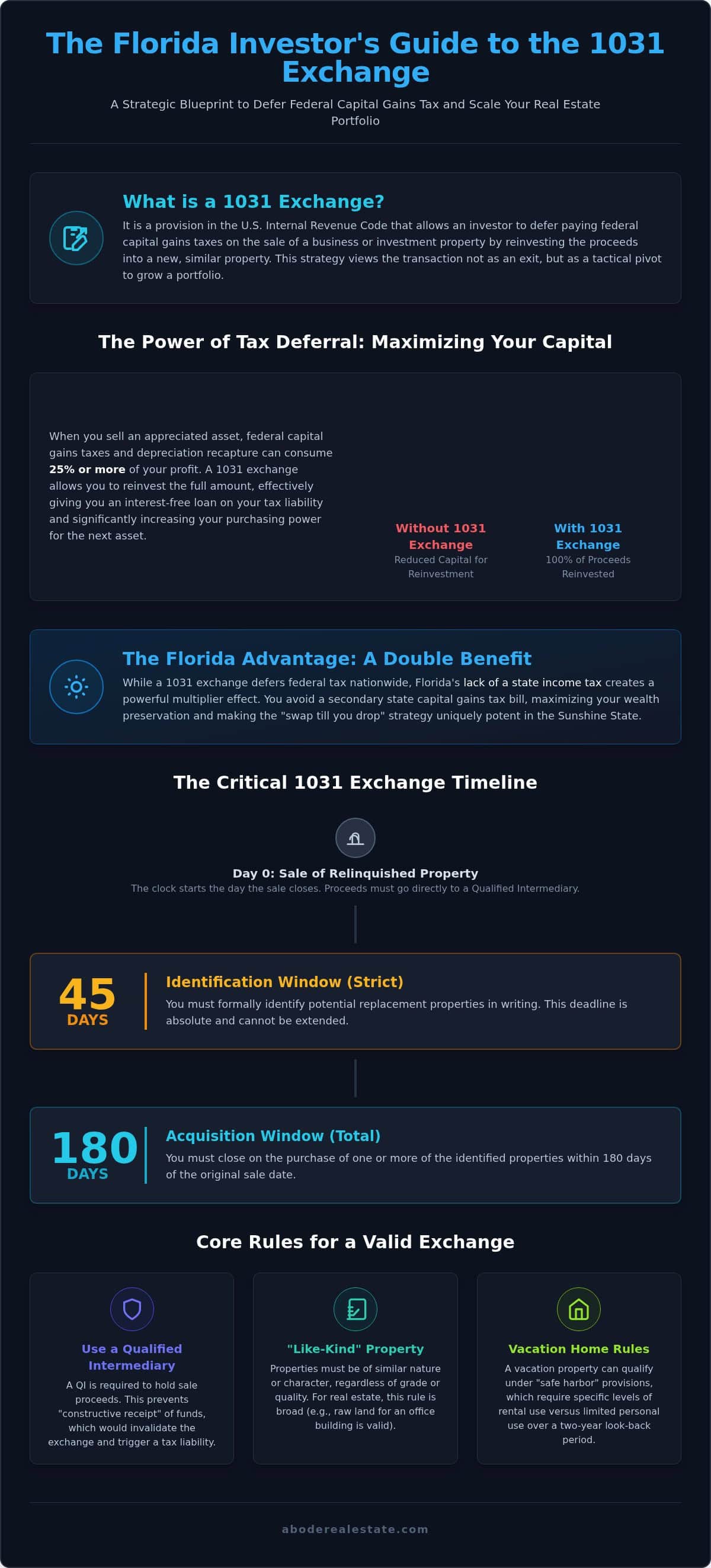
The math behind deferral is as compelling as the properties themselves. When you sell a highly appreciated luxury estate, the combined impact of federal capital gains taxes and depreciation recapture can easily reach 25% or more of your profit. By utilizing the Internal Revenue Code section 1031, you effectively receive an interest-free loan from the government for the amount of the tax you would have owed. This allows you to scale your portfolio with precision, moving from a single high-maintenance asset into a diversified collection of managed properties or a more significant, higher-value landmark residence without losing momentum.
The Role of the Qualified Intermediary
To ensure your exchange remains valid in the eyes of the IRS, you must never have "constructive receipt" of the sale proceeds. The moment those funds hit your personal bank account, the tax deferral is lost. This is why the role of a Qualified Intermediary (QI) is non-negotiable. A reputable, bonded QI acts as the safe harbor for your capital, holding the funds in a restricted account from the closing of your relinquished property until the purchase of your replacement asset.
- The QI prepares the necessary legal documentation to structure the sale and purchase as an exchange rather than two separate transactions.
- They ensure strict compliance with the 1031 exchange rules Florida mandates, specifically regarding the timing of fund disbursements.
- A professional intermediary provides an essential layer of transparency and security during high-stakes financial transitions.
Selecting an intermediary is a decision that requires the same level of care as choosing the property itself. Because these funds are often substantial, working with a well-connected guide who understands the local market nuances ensures your exchange is executed with the calm confidence your portfolio deserves.
Maximizing ROI: Navigating Florida-Specific Tax Advantages and Rules
Florida offers a distinct landscape for investors that goes far beyond the allure of its coastal skylines. While the federal 1031 exchange rules Florida investors must follow are standard across the country, the state's tax-friendly environment acts as a powerful multiplier for your returns. Most states take a second bite of the apple by taxing capital gains at the state level. Florida's lack of a state income tax means that when you defer your federal liability, you aren't left with a secondary state tax bill to settle. This creates a double benefit that accelerates your ability to compound wealth within the local market.
The Florida State Tax Advantage
The "swap till you drop" strategy reaches its full potential in the Sunshine State. In high-tax jurisdictions like California or New York, the state-level tax on a property sale can significantly diminish the capital available for your next acquisition. By contrast, Florida investors keep more of their equity working for them. This advantage is further amplified by the lack of a state inheritance tax. When an asset eventually passes to heirs, they often receive a "step-up" in basis to the current market value, effectively wiping out a lifetime of deferred capital gains. For those refining their investment property acquisition strategies, this makes Florida an unrivaled destination for long-term wealth preservation.
Closing Costs and Documentary Stamps
While the income tax benefits are clear, you must remain mindful of the specific transaction costs that impact your exchange proceeds. Florida levies a documentary stamp tax on deeds at a rate of $0.70 per $100 of the property's value in most counties. If you are looking at the vibrant Miami-Dade market, the rate for single-family residences is $0.60 per $100, while other property types incur an additional $0.45 surtax. These costs, along with the $0.35 per $100 tax on mortgages and the $0.20 per $100 intangible tax on new financing, should be factored into your identification of a replacement asset. According to Forbes Advisor's 1031 exchange guide, failing to account for these transactional nuances can lead to "boot," or taxable cash left over after the exchange.
Navigating these local requirements requires a guide who understands the interplay between lifestyle and ledger. Whether you are transitioning a primary residence by relinquishing a homestead exemption to unlock investment potential or moving capital from out of state, the goal remains a seamless transition into a higher-value asset. If you are ready to begin exploring high-yield assets that align with these tax advantages, professional insight is your greatest asset.
Avoiding Costly Mistakes: Mastering the 45-Day and 180-Day Deadlines
Time is the one asset that even the most successful investors cannot negotiate. In the context of the 1031 exchange rules Florida mandates, the calendar functions as a strict gatekeeper for your capital. You have exactly 45 days to identify replacement properties and a total of 180 days to complete the purchase. These are calendar days, not business days. There are no extensions for market volatility, seasonal inventory shifts, or delays in luxury property availability. This rigid structure demands a proactive approach where the search for your next acquisition begins long before your current asset is even under contract.
Mastering these timelines is less about speed and more about meticulous preparation. Many investors feel a sense of urgency that can lead to compromised decisions, but a well-connected guide helps transform that pressure into a structured path. By pre-vetting south Florida luxury homes for sale well in advance, you ensure that your 45-day window is spent on final due diligence rather than a frantic search. It's about moving with intent rather than reacting to a ticking clock.
The Identification Phase Checklist
To satisfy the IRS, your identification must be a formal, written document delivered to your Qualified Intermediary by midnight of the 45th day. You generally have two paths: the 3-property rule, which allows you to name three assets of any value, or the 200% rule, where you can identify more properties as long as their combined value doesn't exceed twice the price of the property you sold. The 45-day clock begins the day the relinquished property is deeded. Precision in your descriptions is vital; listing a general neighborhood isn't enough, as the IRS requires a specific legal description or a clear street address to validate the exchange.
Managing the Closing Timeline
The 180-day window covers the entire lifespan of your exchange, which includes the initial 45-day identification period. This means you have roughly five months after your identification is finalized to settle every detail of the purchase. Coordination between your lender, title company, and intermediary must be seamless to avoid last-minute hurdles that could jeopardize your tax-deferred status. Because unique luxury properties often come with complex inspections or specialized financing requirements, identifying backup properties is a critical safety net. If your primary choice encounters an insurmountable title issue on day 170, your investment is only protected if you've already identified a secondary asset within that original 45-day window.
Identifying Eligible Assets: Like-Kind Requirements and Vacation Home Safe Harbors
The definition of like-kind is often more generous than many investors realize. It doesn't mean you're restricted to swapping a coastal villa for another coastal villa. Instead, the IRS focuses on the intent of the property use rather than its physical characteristics. This flexibility is a cornerstone of the 1031 exchange rules Florida investors use to diversify their holdings. You can transition from a single-family luxury rental into a multi-family commercial unit or even exchange raw land for a developed income property, provided both assets are held for productive use in a trade, business, or for investment.
While the rules are broad, they aren't without boundaries. Personal residences are strictly excluded from 1031 eligibility. However, many investors eventually choose to convert a replacement property into a primary residence after a sufficient holding period. To do this safely, you generally need to hold the property as an investment for at least two years before moving in. If you later decide to sell that home, you must have owned it for a total of five years to qualify for any portion of the Section 121 capital gains exclusion, a nuanced strategy that requires careful tactical planning.
The Vacation Rental Safe Harbor
For those looking to exchange into the vibrant Florida seasonal market, Revenue Procedure 2008-16 provides a vital safe harbor for vacation homes. To qualify, the property must be owned for at least 24 months. Within each of the two 12-month periods preceding or following the exchange, you must rent the property at a fair market rate for at least 14 days. Your personal use is strictly limited to the greater of 14 days or 10% of the days the property is actually rented. This isn't just a suggestion; it's a rigid requirement. Precise documentation of rental income and owner usage is essential to satisfy IRS scrutiny and protect your tax-deferred status.
Broadening the Definition of Like-Kind
The ability to pivot between different asset classes allows you to respond to shifting market trends with agility. You might find that the equity in a high-maintenance luxury home is better served in a commercial office space or a curated portfolio of luxury homes for sale that function as high-yield short-term rentals. This broad definition ensures that your wealth isn't just preserved, but optimized for the current economic climate. By moving capital from low-growth assets into high-demand areas, you refine your portfolio's performance without the friction of an immediate tax bill.
Successful execution of these strategies often hinges on the quality of the asset's oversight. To ensure your replacement property consistently meets the fair market rent requirements of the safe harbor rules, engaging with professional property management is a prudent step for any serious investor.
Elevating Your Portfolio: Strategic Acquisition Through Professional Guidance
The successful execution of a tax-deferred swap is more than a legal maneuver. It's a calculated move toward a more refined lifestyle. While mastering the technical 1031 exchange rules Florida mandates is essential for compliance, the true value of the process lies in the quality of the replacement asset you secure. A boutique brokerage provides the localized, high-touch service necessary to identify properties that don't just meet IRS requirements but also align with your long-term financial vision. This specialized insight is particularly vital as the Florida market shifts toward a more balanced environment in 2026, with median home sale prices reaching $386,333 and inventory levels offering more negotiating power for savvy buyers.
Abode Real Estate facilitates this transition by moving beyond basic market data to provide deep investment property analysis. We treat the identification of your replacement property as a refined craft, focusing on assets that promise both emotional resonance and tactical growth. Whether you are seeking a coastal retreat or a high-yield commercial unit, our goal is to ensure the frictionless experience we promise results in a curated addition to your wealth.
Protecting Your New Investment
Once the exchange is complete, the focus shifts from acquisition to optimization. Maintaining the tax-deferred status of your new asset requires consistent adherence to the intent of the law, especially if you've utilized the vacation home safe harbor. This is where full-service property management becomes an indispensable part of your strategy. By implementing concierge-level oversight, you ensure the property is rented at fair market value while maintaining the meticulous records necessary for future IRS audits. Professional marketing and rigorous tenant placement don't just protect your ROI; they enhance the essential character of the home, ensuring it remains a prestigious part of your portfolio.
Long-Term Wealth Strategies
The most successful investors view the 1031 exchange as a recurring cycle rather than a one-time event. By repeatedly utilizing the 1031 exchange rules Florida offers, you can effectively "swap till you drop," continuously upgrading into higher-value assets while deferring capital gains indefinitely. This strategy serves as a powerful tool for estate planning, allowing you to build a legacy of curated luxury for the next generation. As the market stabilizes and homes take a median of 46 days to go pending, having a guide who understands these emerging trends is the difference between a simple transaction and a sophisticated wealth-building move. We act as your facilitator, ensuring that every transition is seamless, transparent, and designed to elevate your personal retreat into a high-yielding masterpiece.
Mastering Your Next Chapter in Florida Real Estate
Mastering the tax-deferred landscape is a journey that transforms a simple transaction into a legacy-building event. You've seen how the 1031 exchange rules Florida offers can shield your equity from erosion while allowing you to pivot into higher-value luxury assets. By strictly adhering to the identification deadlines and leveraging the state's unique tax advantages, you position your portfolio for sustainable, long-term growth. This process is less about avoiding a tax bill and more about optimizing your arrival into a new level of curated living.
Achieving these results requires a partner who understands the intersection of lifestyle and investment. Abode Real Estate brings sophisticated boutique market expertise and comprehensive property management to every exchange. We provide the integrity-driven advisory needed for high-stakes transactions, ensuring your transition is as seamless as it is profitable. Contact Abode Real Estate for expert investment property analysis and 1031 guidance to begin your move into a more prosperous future. Your next investment shouldn't just be a property; it should be a destination where you truly belong.
Frequently Asked Questions
What are the 1031 exchange rules in Florida for 2026?
The 1031 exchange rules Florida investors follow are primarily federal guidelines, as the state does not impose a separate income or capital gains tax. You must identify a like-kind property within 45 days and close within 180 days while using a Qualified Intermediary to hold all proceeds. It's a process that requires precision to ensure your capital remains fully deployed in your next luxury asset.
How long do I have to identify a replacement property in a 1031 exchange?
You have exactly 45 calendar days from the date you close on your relinquished property to identify potential replacements. This deadline is strictly enforced by the IRS, and there are no extensions for market conditions or inventory shortages. Most successful investors begin their search well before their current property sells to ensure they have a viable list ready for their intermediary.
Can I use a 1031 exchange for a luxury vacation home in Florida?
Yes, a luxury vacation home can qualify if it meets the safe harbor requirements under Revenue Procedure 2008-16. You must own the property for at least 24 months and rent it at fair market value for at least 14 days in each of the two 12-month periods. Your personal use must not exceed the greater of 14 days or 10% of the days the property is actually rented to maintain its investment status.
What is the 45-day rule in a 1031 exchange?
The 45-day rule is the identification period where you must formally designate your replacement property in writing to your Qualified Intermediary. You generally use the 3-property rule, which allows you to name three assets of any value, or the 200% rule for identifying more. This window is often the most critical part of the process, requiring a well-connected guide to navigate the local inventory quickly.
Can I move into my 1031 exchange property after I buy it?
You can eventually move into the property, but doing so immediately will likely disqualify the exchange. The IRS requires that the property be held for productive use in a trade or business or for investment purposes. Most professionals recommend a holding period of at least 24 months of investment use before converting the dwelling into a primary residence to demonstrate your original intent.
What happens if I miss the 180-day closing deadline?
Missing the 180-day closing deadline results in a failed exchange, making the entire capital gain from your sale immediately taxable. This window includes the initial 45-day identification period, meaning you have roughly five months to finalize the purchase after your list is set. Because the IRS does not grant extensions, having backup properties identified and a reliable closing team is essential for protecting your ROI.
Does Florida have a state-level capital gains tax on real estate sales?
Florida does not have a state-level capital gains tax, which is a significant advantage for real estate investors. This means your 1031 exchange only needs to satisfy federal requirements to defer your tax liability. While you avoid state income tax, you must still account for local documentary stamp taxes on deeds, which are $0.70 per $100 of value in most counties outside of Miami-Dade.
What is a Qualified Intermediary and why do I need one?
A Qualified Intermediary is a mandatory third party who facilitates the exchange by holding the sale proceeds so you never have actual receipt of the funds. If you touch the money even for a moment, the tax deferral is lost. They prepare the legal documentation and ensure all 1031 exchange rules Florida mandates are followed with precision, acting as a secure bridge between your sale and your next acquisition.
Posted by Brook Walsh onEnjoy this blog post? Click here to subscribe for updates
Leave A Comment