

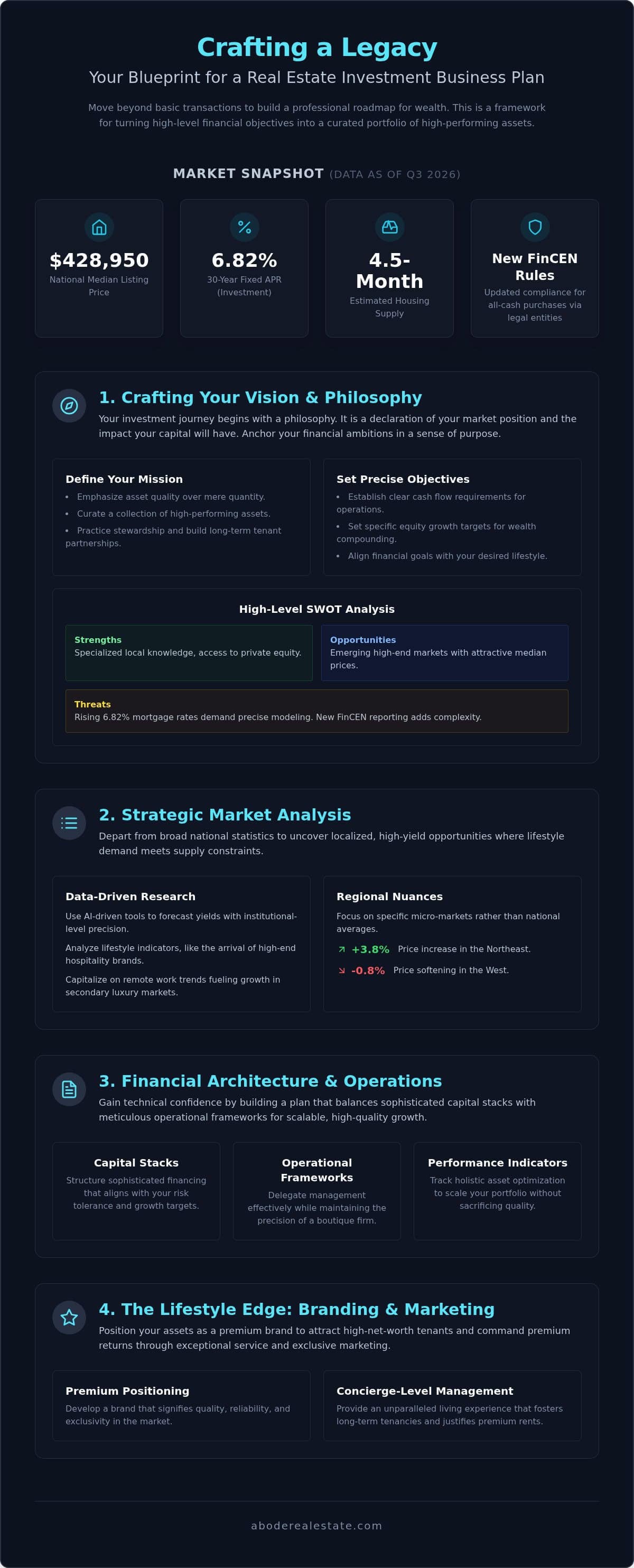
What if the difference between a volatile portfolio and a legacy of generational wealth isn't the capital you deploy, but the narrative you've constructed before the first acquisition? Many investors find themselves reacting to the market rather than shaping it, feeling the weight of uncertainty as national median listing prices adjust to $428,950 and new FinCEN reporting requirements add layers of complexity to legal entities. You likely understand that creating a real estate investment business plan is the only way to secure the confidence of high-level partners while navigating the 6.82% mortgage rates currently defining the landscape. It's a common frustration to feel like you're managing properties instead of orchestrating a vision.
This guide ensures you master the art of turning high-level financial objectives into a curated portfolio of high-performing assets. We'll show you how to move beyond basic transactions to build a professional roadmap for wealth. You'll discover a framework for establishing clear asset selection criteria and learn how to delegate management while maintaining the precision of a boutique firm. This is your blueprint for turning tactical planning into a refined craft that serves your lifestyle as much as your bank account.

Key Takeaways
- Define your investment approach as a refined philosophy of living, ensuring every acquisition aligns with your long-term legacy and specific lifestyle goals.
- Navigate the complexities of the 2026 market by using advanced analytics to identify high-yield opportunities in emerging luxury corridors and stable residential pockets.
- Gain the technical confidence required for creating a real estate investment business plan that balances sophisticated capital stacks with meticulous operational frameworks.
- Discover how to position your assets as a premium brand, attracting high-net-worth tenants through a commitment to concierge-level property management and exclusive marketing.
- Implement sophisticated performance indicators that track the holistic optimization of your assets, allowing you to scale your portfolio without sacrificing quality or personal oversight.
Table of Contents
- Crafting a Vision: The Foundation of Your Real Estate Investment Business Plan
- Strategic Market Analysis: Identifying High-Yield Opportunities
- Financial Architecture and Operational Frameworks
- The Lifestyle Edge: Branding and Marketing Your Portfolio
- From Blueprint to Reality: Executing and Refining Your Strategy
Crafting a Vision: The Foundation of Your Real Estate Investment Business Plan
Your investment journey begins long before you sign a closing statement. It starts with a philosophy. A vision is more than a goal; it's a declaration of how you intend to occupy space in the market and what kind of impact you want your capital to have on the communities you enter. Creating a real estate investment business plan requires you to anchor your financial ambitions in a sense of purpose. Whether you're focused on high-end investment property acquisition or commercial assets, your plan must reflect your long-term legacy. Before diving into the technicalities of your portfolio, it's helpful to ground your strategy in a real estate investing overview to understand how valuation and capital stacks interact with your long-term vision.
Financial objectives must be precise. You need to establish clear cash flow requirements to sustain your operations while setting equity growth targets that ensure your wealth compounds over time. These numbers shouldn't exist in a vacuum. They should support specific lifestyle goals, such as the freedom to travel or the ability to fund philanthropic ventures. The executive summary acts as the distilled essence of these complex strategies. It's the first thing a partner or lender sees, and it must communicate your quiet authority and market expertise in a single, unhurried narrative.
Defining Your Mission and Investment Philosophy
A mission statement for a boutique firm emphasizes asset quality over mere quantity. You aren't just collecting properties; you're curating a collection of high-performing assets. Stewardship is the core of this philosophy. It means treating every dwelling as a sanctuary and every tenant relationship as a long-term partnership built on integrity. This approach differentiates short-term gains from genuine wealth architecture. Focus on the optimization of assets through meticulous care rather than chasing rapid, unsustainable turnover. It's about arrival and belonging, ensuring each property adds value to its neighborhood.
Conducting a High-Level SWOT Analysis
A robust analysis identifies where your boutique strengths meet market realities. Internal strengths might include specialized knowledge of local luxury enclaves or access to private equity. External opportunities currently exist in emerging high-end markets where the median listing price remains attractive at $428,950. However, you must also evaluate threats with transparency. As of August 2026, the 30-year fixed mortgage APR for investment properties sits at 6.82%, demanding more precise financial modeling. New FinCEN reporting requirements for all-cash purchases, effective March 1, 2026, also require updated compliance strategies for those using legal entities.
Strategic Market Analysis: Identifying High-Yield Opportunities
Strategic growth requires a departure from broad national statistics that often mask localized opportunities. While the national median listing price dipped by 2.4% as of July 2026, the luxury segment continues to operate by its own rules. Creating a real estate investment business plan means looking beyond the headlines to find where lifestyle demand meets supply constraints. Local nuances, such as the 3.8% price increase in the Northeast versus the 0.8% softening in the West, demonstrate that your roadmap must be as specific as the properties you seek to acquire. With housing inventory sitting at an estimated 4.5-month supply, the market is showing signs of balancing, giving selective investors more room to negotiate for premium assets.
Data-Driven Market Research and Technology
Sophisticated investors now use AI-driven tools to forecast yields with a level of precision previously reserved for institutional funds. These platforms analyze lifestyle indicators like the arrival of high-end hospitality brands or the growth of private social clubs. These signals often precede a spike in residential demand. Remote work trends continue to reshape the market, making secondary luxury markets more than just vacation spots. They're now permanent retreats for a mobile, affluent workforce seeking security and social bonds.
Selecting Your Investment Niche
Selecting your niche is an exercise in defining your brand. You might find your rhythm in luxury residential sales, where the emotional resonance of a home drives value. Alternatively, boutique commercial real estate in high-growth corridors offers a different kind of stability. National average rents reached $1,965 in June 2026, a 2.2% increase that underscores the continued demand for high-quality rental dwellings. For deeper tactical insights, reviewing established investment property acquisition strategies helps bridge the gap between market data and a signed contract.
Whether you focus on high-end rentals or commercial real estate sales, your niche should reflect your core expertise. The goal is to build a portfolio that feels curated rather than merely accumulated. If you're looking for a partner to help navigate these specific geographic shifts, exploring our detailed community profiles is a logical next step toward localized mastery.
Financial Architecture and Operational Frameworks
Once you've identified a neighborhood with high appreciation potential, the focus shifts to the structural integrity of your finances. Creating a real estate investment business plan requires a transition from market theory to the hard mechanics of asset performance. This stage is where you move beyond simple spreadsheets to develop sophisticated financial models that account for the high-touch requirements of luxury assets. A pro forma is a comprehensive financial model that projects future income and expenses based on historical data and market trends. In the premium sector, these projections must include generous allowances for concierge-level service and meticulous maintenance to ensure the property remains a lifestyle asset rather than a deteriorating liability.
Your capital stack strategy should be as curated as your property selection. With the national average for 30-year fixed mortgage APRs on investment properties sitting at 6.82%, and 15-year rates at 6.125%, the cost of debt is a significant factor in your 2026 projections. For those pursuing larger multifamily assets, commercial mortgage rates starting at 5.70% offer a different path toward scaling. Balancing traditional financing with private equity partners can provide the flexibility needed to act quickly when a rare opportunity surfaces, ensuring you aren't limited by the constraints of a single lending institution.
Financial Projections and Risk Mitigation
A resilient five-year financial roadmap includes both conservative and aggressive growth scenarios to prepare for market fluctuations. It's vital to account for the 3.8% Net Investment Income Tax and the 37% top marginal income tax rate that applies to high-income investors in 2026. Each asset class in your portfolio requires a predefined exit strategy, whether that involves a 1031 exchange or a long-term hold for generational equity. This level of foresight reduces the anxiety often associated with market volatility and provides a clear path for wealth preservation.
Building Your Professional Support Team
Frictionless ownership is only possible when you've assembled a team of refined experts who act as high-level facilitators. This inner circle must include specialized real estate attorneys who understand the FinCEN reporting requirements for legal entities and tax advisors capable of optimizing the 20% pass-through deduction. Integrating professional property management services early in the planning phase ensures that day-to-day logistics never compromise the quality of your portfolio. Clear communication protocols between you and your management team allow you to delegate the mechanical aspects of the industry while maintaining quiet authority over your investments.
The Lifestyle Edge: Branding and Marketing Your Portfolio
A successful portfolio is more than a collection of deeds; it's a curated brand that signals exclusivity and meticulous care. While the previous sections focused on the technical foundation and the finances, this phase of creating a real estate investment business plan addresses how you present your vision to the world. In the high-end market, your properties must communicate a sense of arrival and belonging. This isn't just about finding tenants. It's about attracting individuals who value the same standards of stewardship and precision that you do. High-net-worth guests and residents look for dwellings that feel like personal retreats, and your marketing must mirror that desire through every digital and physical touchpoint.
When creating a real estate investment business plan, you must treat your holdings as a boutique hospitality brand rather than a simple real estate company. This shift in perspective ensures that every asset you acquire adds value to your overall identity. By focusing on the emotional resonance of your properties, you elevate the discussion beyond price points and physical dimensions, positioning your portfolio as a premier choice for discerning clients.
Creating a Cohesive Portfolio Identity
Your portfolio needs a visual and emotional aesthetic that links disparate assets together. Whether you're managing luxury vacation rentals or long-term estates, a consistent brand voice helps you resonate with a sophisticated national audience. This identity isn't just a logo; it's a philosophy of living that guests experience from the first interaction. Every touchpoint should reinforce the boutique nature of your business, making transitions feel like a curated move into a new chapter. This unhurried approach to branding builds a sense of quiet authority that reassures partners and tenants alike.
High-Touch Tenant and Guest Acquisition
Attracting the right residents requires a multi-platform strategy that prioritizes quality over reach. Professional photography and curated staging are non-negotiable for luxury asset presentation. These tools transform physical dimensions into evocative narratives that showcase the unique spirit of the community. To maintain these high standards, implement rigorous screening processes that ensure alignment with your property's character. The arrival experience is the most critical moment for building immediate trust. It sets the tone for long-term loyalty and reduces the anxiety often associated with high-stakes moves. If you're ready to elevate how your assets are presented to the market, our full-service property management model provides the high-touch support required to sustain a premium brand.
From Blueprint to Reality: Executing and Refining Your Strategy
Transitioning from the theoretical to the tangible is where the most sophisticated investors differentiate themselves. Creating a real estate investment business plan provides the essential structure, but execution requires an unhurried, intentional pace. Moving too quickly can lead to costly oversights, especially when national housing inventory is slowly increasing to 1.13 million homes as of August 2026. This balancing market demands patience and a commitment to your original criteria. You aren't just buying property; you're onboarding a new chapter of your financial legacy. By maintaining a steady rhythm, you ensure that every acquisition is a calculated step toward your long-term objectives.
The Acquisition and Onboarding Process
A standardized due diligence checklist is your primary tool for risk mitigation during the acquisition phase. This process should cover the physical integrity of the dwelling, the financial history of the asset, and the legal compliance of the holding entity under the latest federal regulations. Transitioning an asset from purchase to active management should feel like a polished handoff rather than a frantic scramble. It's helpful to consult with a luxury real estate advisor to refine your initial purchase criteria. This collaboration ensures that every property you consider fits the specific aesthetic and financial profile you've established in the earlier stages of your planning.
Iterative Planning and Long-Term Scaling
Business health is measured by more than simple ROI. You should track key performance indicators such as tenant retention rates, brand sentiment, and the appreciation of your assets relative to the 1.5% national median price increase seen in the second quarter of 2026. An annual strategy retreat provides the necessary space to step back from daily logistics. Use this time to review your philosophical goals and adapt to shifting market dynamics without the pressure of active transactions. Quarterly financial reviews allow you to adjust operational budgets and evaluate the potential for 1031 exchanges. These exchanges remain a powerful tool for deferring capital gains taxes while upgrading the overall quality of your portfolio.
Scaling is a refined craft that requires staying attuned to emerging trends in luxury living, from sustainable design to integrated smart-home technology. When creating a real estate investment business plan, you must view it as a living document that evolves alongside your success. By combining disciplined execution with regular refinement, you ensure that your portfolio remains a high-performing collection of assets that supports your lifestyle and preserves your wealth for years to come.
Building Your Legacy Through Strategic Precision
Your real estate portfolio is more than a financial vehicle; it's a curated reflection of your lifestyle and long-term legacy. By focusing on a vision-driven philosophy and leveraging precise 2026 market data, you transform high-level objectives into a resilient collection of assets. Creating a real estate investment business plan isn't a one-time task but a commitment to iterative growth and meticulous stewardship. Success in this refined landscape requires balancing technical expertise with an unhurried, intentional approach to acquisition and management.
Our team brings specialized expertise in luxury residential sales and a proven track record in high-end market analysis to every engagement. We believe property is a lifestyle asset that deserves a boutique approach to property management, ensuring your peace of mind while your wealth compounds. Whether you're refining your current strategy or just starting, we're here to act as your well-connected guide.
Begin your investment journey with a professional consultation to see how a tailored roadmap can secure your future. The path to generational wealth is built one intentional decision at a time, and it starts today.
Frequently Asked Questions
How long should a real estate investment business plan be?
A comprehensive plan typically spans 15 to 25 pages, though the depth depends on your portfolio's complexity. You want enough detail to reassure partners without overwhelming them with clinical data. Focus on clarity and unhurried descriptions of your investment philosophy. The executive summary should remain a concise one- or two-page distillation that captures your quiet authority and market expertise immediately.
What is the most important section of an investment business plan?
The executive summary is arguably the most critical component because it's the first touchpoint for stakeholders. It must weave your financial objectives into a narrative of property stewardship. However, the financial architecture section follows closely in importance. It provides the technical validation required for creating a real estate investment business plan that stands up to the scrutiny of high-level private equity partners.
Do I need a separate business plan for each property?
You don't need an entirely new plan for every dwelling, but each acquisition requires its own detailed pro forma. Your master business plan serves as the philosophical blueprint for your entire entity. Individual assets are then treated as specific entries that must meet the rigorous selection criteria you've already established. This approach maintains a cohesive brand identity across your entire collection of properties.
How often should I update my real estate investment plan?
You should conduct a formal review of your plan at least once a year during a dedicated strategy retreat. This allows you to adjust for macroeconomic shifts, such as the 6.82% mortgage rates seen in 2026. Quarterly updates are also beneficial for refining operational budgets. These regular touchpoints ensure your strategy remains a living document that evolves with the market's steady rhythm.
Can I use a business plan to secure private funding for luxury properties?
A professional plan is the most effective tool for securing private funding for high-end assets. It demonstrates that you aren't just buying property, but are instead building a sophisticated business. Private lenders value the transparency and risk mitigation strategies found in a well-crafted plan. It signals that you possess the specialized knowledge required to handle luxury assets with precision and care.
What are the common mistakes when creating a real estate business plan?
Common mistakes include underestimating maintenance reserves for high-touch properties and failing to define clear exit strategies. Many investors also ignore the lifestyle indicators that drive luxury demand. Creating a real estate investment business plan without a localized SWOT analysis often leads to impulsive acquisitions. Avoiding these errors requires a disciplined focus on asset quality and a commitment to long term wealth architecture.
How do I incorporate property management into my business plan?
Incorporate property management into the operational framework section by outlining your specific service model. You should detail how a boutique approach reduces owner friction and enhances the resident experience. Include the costs of professional management in your pro forma statements to ensure your yields are realistic. This shows partners that you have a framework for delegating day-to-day logistics without losing quality.
Posted by Brook Walsh onEnjoy this blog post? Click here to subscribe for updates
Leave A Comment