

The rental with the highest nightly rate may not deliver the strongest investment. When investing in short-term vs long-term rentals, gross income tells only part of the story. Expenses, vacancies, management demands, and applicable rules all affect the returns you keep.
Short stays can appeal to investors who want to host a steady flow of visitors and potentially use the property between bookings. Long-term rentals may provide a more predictable income schedule and fewer turnovers. Each model, however, calls for different amounts of time, capital, and tolerance for uncertainty. The right choice depends on more than projected revenue.
This guide compares income potential, operating workload, risks, and flexibility to help you match a rental strategy to your investment horizon and capacity. It also covers what to investigate before buying or repositioning a property, including demand, requirements, and suitability for each type of stay. Investment property analysis can help connect a home’s characteristics with your goals, while professional management can support the work of operating it. The best strategy fits both the property and the role you want it to play in your life.

Key Takeaways
- Compare net income, not just potential rental revenue, by accounting for each model’s expenses and vacancy.
- Consider the frequent guest turnover involved in short stays alongside the tenant-related responsibilities of long-term rentals.
- When investing in short-term vs long-term rentals, align the strategy with your time horizon, risk tolerance, and intended use of the property.
- Assess the property’s suitability and target demand before choosing a rental model.
- Validate demand, review applicable requirements, project returns, and decide who will handle ongoing management.
Table of Contents
- Short-Term vs. Long-Term Rentals: What Each Investment Model Involves
- Compare Rental Income, Expenses, and Returns Before You Invest
- Short-Term vs. Long-Term Rentals: Workload, Risk, and Flexibility
- How to Choose the Right Rental Strategy for Your Property
- Plan Rental Operations and Next Steps With a Clear Strategy
Short-Term vs. Long-Term Rentals: What Each Investment Model Involves
A rental strategy shapes more than how income arrives. Short-term rentals host guests for temporary stays, while long-term rentals involve an ongoing landlord-tenant relationship. Furnishings, turnover, communication, and the owner’s day-to-day role can differ substantially. Compare the operating model, not just the advertised rate.
For investors investing in short-term vs long-term rentals, neither format is inherently more profitable. The vacation rental market offers a general overview of short-stay lodging, but a property’s performance depends on its demand, expenses, and operating plan.
For an overview of how short-term rental investing is often discussed, watch this educational video:
How Short-Term Rentals Work for Property Investors
Short-term rentals provide lodging for temporary stays. There is no single duration that defines every market or arrangement. The home is commonly furnished and prepared for each arrival, and owners or managers coordinate bookings, guest communication, cleaning, and turnover. Occupancy and nightly rates can change with seasonality and demand, so income may vary from one period to the next.
How Long-Term Rentals Work for Property Investors
Long-term rentals typically involve a tenant living in the property under an ongoing lease, with rent collected on a recurring schedule. The home may be unfurnished, depending on the intended tenant and rental plan. Owners still need to manage tenant placement, lease administration, maintenance coordination, and vacancies. Longer tenancies can mean fewer turnovers, but they don’t eliminate ongoing management responsibilities.
Compare the Operating Rhythm
Keep the income terms distinct when comparing the models. Gross rental income is the amount generated before expenses. Vacancy is time when the property isn’t producing rent. Operating expenses are the costs of running the rental, such as maintenance and management. Net operating income (NOI) is rental income after operating expenses, before financing costs and income taxes. It provides a clearer operating comparison than gross receipts alone.
| Factor | Short-term rental | Long-term rental |
|---|---|---|
| Income pattern | Bookings and nightly rates can fluctuate. | Rent is generally collected on a recurring schedule. |
| Owner involvement | Frequent guest communication and turnover coordination. | Tenant placement, lease administration, and ongoing property care. |
| Flexibility | May allow owner use between bookings, subject to the operating plan. | Use is shaped by the tenant’s occupancy and lease. |
| Key uncertainties | Demand, seasonality, occupancy, and booking patterns. | Vacancy, tenant placement, and ongoing operating needs. |
Compare Rental Income, Expenses, and Returns Before You Invest
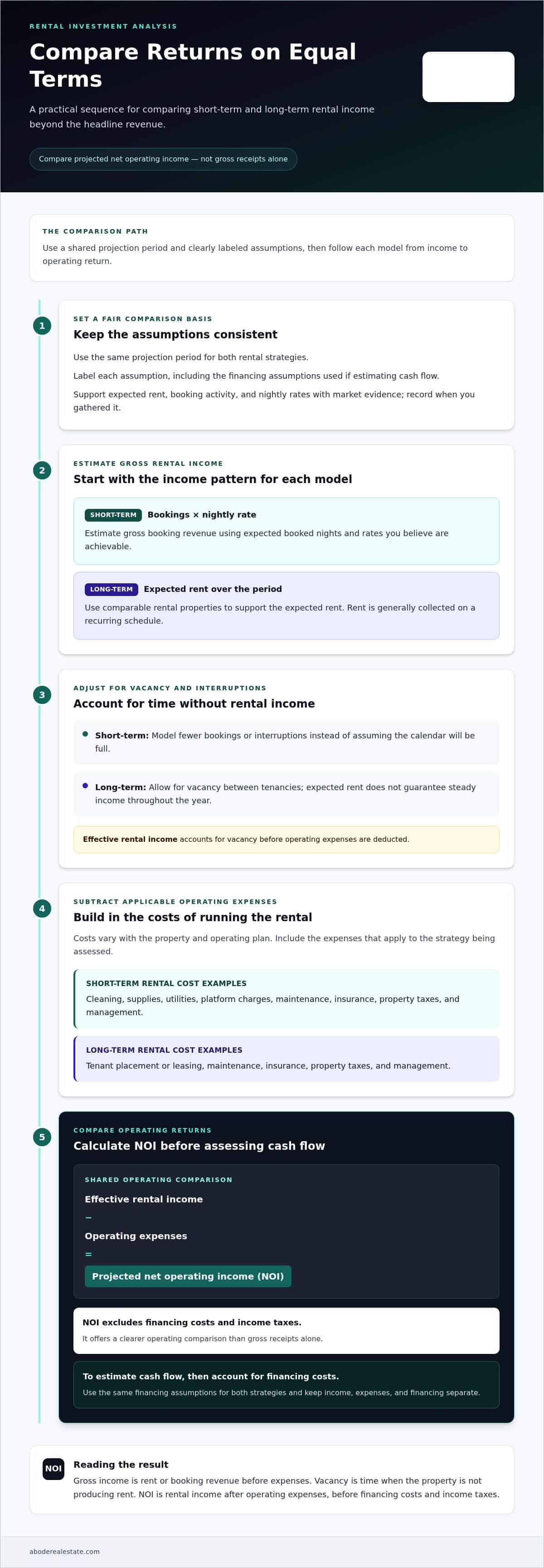
Start with a like-for-like projection, not the most attractive revenue figure. Short-term income depends on booked nights and nightly rates; long-term income usually starts with expected rent. In either model, vacancy and operating costs reduce gross receipts before you can assess what the property may earn.
Gross rental revenue alone can’t show investment performance. Vacancy, expenses, and the work required to operate the property all affect the income that remains.
Build a Fair Short-Term Rental Income Estimate
Base a short-term projection on booking and nightly-rate evidence for the property’s market, and note when you gathered it. Estimate gross revenue by multiplying expected booked nights by the rates you believe are achievable. Then model a more cautious scenario with fewer bookings or interruptions instead of assuming the calendar will be full.
Subtract the operating costs that apply to the property and management plan. These may include cleaning, supplies, utilities, platform charges, maintenance, insurance, property taxes, and management. A guide to short-term rental investing can provide additional context, but your own projection should reflect the property’s intended market and operating plan.
Calculate Long-Term Rental Cash Flow and Vacancy Exposure
For a long-term estimate, use comparable rental properties to support the expected rent, and record when you gathered the information. Account for vacancy between tenancies and applicable costs such as tenant placement or leasing, maintenance, insurance, property taxes, and management. Don’t assume that a rent figure translates directly into steady income throughout the year.
To compare operating performance, subtract projected operating expenses from effective rental income, which accounts for vacancy. The result is projected net operating income (NOI). To estimate cash flow, then account for financing costs using the same financing assumptions for both strategies. Keep income, expenses, and financing separate so you can assess each model on consistent terms.
- Short-term framework: expected booked nights × estimated nightly rate = gross booking revenue; subtract vacancy effects and applicable operating expenses to estimate NOI.
- Long-term framework: expected rent over the projection period, adjusted for vacancy, minus applicable operating expenses = estimated NOI.
Use the same projection period for both models and label each assumption. Investment property analysis can help connect a home’s characteristics with your intended rental strategy, grounding the comparison in the asset and its planned operations.
Short-Term vs. Long-Term Rentals: Workload, Risk, and Flexibility
A high potential nightly rate can attract an investor’s attention, but it doesn’t guarantee a stronger return. Revenue potential is what a property might earn; investment performance is what remains after vacancy, operating costs, and the work required to run it. When investing in short-term vs long-term rentals, consider whether each model’s workload and uncertainty suit your capacity, not just its income potential.
Short-Term Rental Trade-Offs: Control, Turnover, and Variable Demand
Short stays can offer more control over when a property is available, including the possibility of personal use between bookings. That flexibility has trade-offs: owner use leaves fewer nights available to guests, while frequent stays require ongoing booking oversight, guest communication, cleaning coordination, and listing upkeep. Furnishings and guest-ready presentation also affect operating assumptions, maintenance, and how the home is used.
Demand can shift with seasonality, cancellations, and gaps between reservations. A strong calendar during a peak period may not represent the full year. Consider how interruptions could affect income and whether you can manage the additional coordination. Vacation rental management can support guest communication, cleaning coordination, and listing optimization, but projections should still account for variable bookings.
Long-Term Rental Trade-Offs: Stability, Vacancy, and Tenant Responsibilities
A lease with recurring rent may make income easier to project, but it can’t guarantee uninterrupted occupancy or eliminate vacancy between tenants. The landlord-tenant relationship also brings responsibilities such as tenant screening and placement, maintenance requests, lease renewals, and eventual turnover. These tasks may come up less frequently than guest changeovers, but they still require time and clear processes.
Lease terms and the property’s condition affect access, future use, and when the home can be repositioned. Owners who hope to use the property personally may have less immediate flexibility while it’s occupied. Long-term property management can support tenant placement, rent collection, maintenance coordination, and financial reporting.
Risk also extends beyond occupancy. Insurance needs, tax treatment, and applicable rental requirements can vary by property and jurisdiction. Include them in your due diligence rather than assuming the same rules apply everywhere. Neither model eliminates uncertainty; each concentrates it in different areas.
- Short-term: more frequent operating decisions, changing demand, and potential owner-use flexibility.
- Long-term: recurring lease income, tenant-related responsibilities, and flexibility shaped by occupancy and lease terms.
The right balance depends on how much variability you can absorb, how involved you want to be, and what role the property should play in your life and investment plan.
How to Choose the Right Rental Strategy for Your Property
The right rental model aligns with your financial objectives, intended use, and capacity to oversee the property. A thoughtful comparison of investing in short-term vs long-term rentals starts with your priorities, then tests whether the property and market can support them.
1. Define your goals, time horizon, and intended use. Decide whether you’re prioritizing operational simplicity, personal use, income flexibility, or portfolio growth. Consider how long you expect to hold the property and whether you may want to occupy it yourself. Your answers help determine how much flexibility you need and which rental pattern better fits your plan.
2. Match the operating model to your available time. Be realistic about the attention you can provide. Short stays can involve frequent guest communication, booking oversight, and cleaning coordination. Long-term rentals bring tenant placement, lease administration, maintenance requests, and renewals. Professional management can support either model and help define your role, but include management costs in your projections.
3. Test the property’s suitability and target demand. Consider whether the home’s layout, condition, furnishing needs, and location suit the intended renter or guest. Compare relevant long-term rental listings or short-stay booking evidence for the property’s market, and record when you gathered it. A property’s appeal to one renter profile doesn’t automatically mean it will perform well for another.
4. Review requirements and operating conditions. Rental rules, insurance conditions, and tax considerations vary by property and jurisdiction. Research current requirements through authoritative sources relevant to the property rather than relying on assumptions from another market or an outdated summary.
5. Compare conservative, expected, and stronger scenarios. Use documented assumptions for rents or booking activity, vacancy, expenses, maintenance, management, and interruptions. The conservative case should account for lower demand or unexpected repairs. Keep the stronger case plausible rather than treating it as a promise. Compare the results using consistent assumptions, and consider whether the investment still fits your goals if performance falls short of expectations.
Investment property analysis and acquisition support can help connect a property’s characteristics with your intended rental strategy. Use that analysis to evaluate the asset, test your assumptions, and make a considered decision before committing.
Plan Rental Operations and Next Steps With a Clear Strategy
The best choice in investing in short-term vs long-term rentals is the one supported by documented assumptions and an operating plan you can sustain. Before committing, validate demand for the property, review applicable requirements and insurance conditions using current authoritative information, and build projections that account for vacancy, expenses, and changing demand. Then decide who will handle each recurring responsibility.
Prepare an Operating Plan for Your Chosen Rental Model
For a long-term rental, map out tenant placement, rent collection, maintenance coordination, and financial reporting. For a short-term rental, account for guest communication, cleaning coordination, listing optimization, and booking oversight. These responsibilities shape the owner’s involvement even after the property is acquired.
Assign responsibility for each task. If you plan to work with a professional management team, clarify which duties it will handle and which remain with you. A written plan connects your financial projections to the practical work required to operate the rental.
Move From Investment Analysis to Ongoing Management
Before launch, compare your assumptions with current rental or booking evidence, confirm the requirements that apply to the property, and document how you’ll respond to maintenance needs, vacancies, or gaps in bookings. Keep the conservative scenario visible as a reference if conditions differ from expectations.
Abode Real Estate supports investment property analysis and acquisition, along with long-term and vacation rental management. Long-term management can include tenant placement, rent collection, maintenance coordination, and financial reporting. Vacation rental management can include guest communication, cleaning coordination, and listing optimization. These services support ongoing operations but don’t promise a particular investment result.
Abode Real Estate’s property management and investment analysis services can support both the acquisition decision and the rental plan that follows. Aligning the two helps connect the property’s potential with the work required to operate it.
Move Forward With a Rental Strategy That Fits
Choosing between short-term and long-term rentals is less about finding a universal winner and more about selecting a model that suits your investment horizon, available time, and intended use for the property. When investing in short-term vs long-term rentals, compare realistic income projections after expenses, then weigh the operating responsibilities and uncertainty each strategy brings.
Before you commit, validate demand, review applicable requirements, and test conservative, expected, and stronger scenarios. A clear operating plan matters just as much: tenant placement, rent collection, maintenance coordination, and financial reporting shape long-term oversight, while guest communication, cleaning coordination, and listing optimization support short-term stays.
Abode Real Estate offers investment property analysis and acquisition support, along with management for long-term rentals and vacation rentals. Explore Abode Real Estate’s investment and property management services to bring your rental strategy and operating plan into focus.
Frequently Asked Questions
Is a short-term rental more profitable than a long-term rental?
Not necessarily. A short-term rental may generate higher gross receipts during periods of strong demand, but bookings can fluctuate and operating costs may also be higher. A long-term rental may provide recurring rent, though vacancy and ongoing expenses still affect returns. When investing in short-term vs long-term rentals, compare projected net operating income using property-specific assumptions instead of choosing based on nightly rates or gross rent alone.
Can I switch a property from long-term to short-term rental use?
Possibly, but first assess whether the change is permitted and practical for the property. Review current requirements, insurance conditions, any applicable lease or ownership restrictions, and the home’s suitability for guest stays. Then estimate furnishing, setup, operating, and vacancy assumptions before changing course. A property’s past use doesn’t establish that another rental model is permitted or financially suitable.
How much work does a short-term rental require compared with a long-term rental?
Short-term rentals generally involve more frequent coordination, including bookings, guest communication, cleaning, and listing upkeep. Long-term rentals usually have fewer turnovers but still require tenant placement, rent collection, maintenance coordination, renewals, and financial tracking. Either model can take meaningful owner time. A written task plan that identifies what you’ll handle and what a professional manager will oversee helps clarify the actual workload.
What happens if a short-term rental has low occupancy?
Low occupancy reduces booking income while many property expenses continue, which can weaken cash flow or leave the property operating at a loss. Review possible causes, such as seasonal demand, booking gaps, or market changes, and compare actual performance with your projections. Revisit pricing, listing presentation, and expenses, then update your conservative scenario. Avoid assuming occupancy will quickly return to an earlier level.
Are long-term rental returns more predictable than short-term rental returns?
They can be easier to forecast because lease rent is typically recurring, but returns aren’t guaranteed or uninterrupted. Vacancy between tenants, late or missed rent, maintenance, and other expenses can change results. Short-term income may vary more with bookings and demand. Compare both models over the same period, include realistic vacancy and operating costs, and distinguish projected net operating income from cash flow after financing.
Do short-term rentals have different tax or legal requirements?
They may. Tax treatment and rental requirements vary by jurisdiction and can depend on the property and how it’s operated. Don’t assume rules that apply to a long-term lease also cover short stays, or that requirements are the same in different locations. Before acquiring or converting a property, review current information from relevant government authorities and qualified tax or legal professionals for the property’s jurisdiction.
Should I hire a property manager for a rental investment?
A property manager may suit you if you want support with recurring operations or have limited time to manage them yourself. For long-term rentals, management can include tenant placement, rent collection, maintenance coordination, and financial reporting. Short-term rental management can cover guest communication, cleaning coordination, and listing optimization. When investing in short-term vs long-term rentals, weigh the management arrangement and its expense against your workload and projections.
Posted by Brook Walsh onEnjoy this blog post? Click here to subscribe for updates
Leave A Comment