
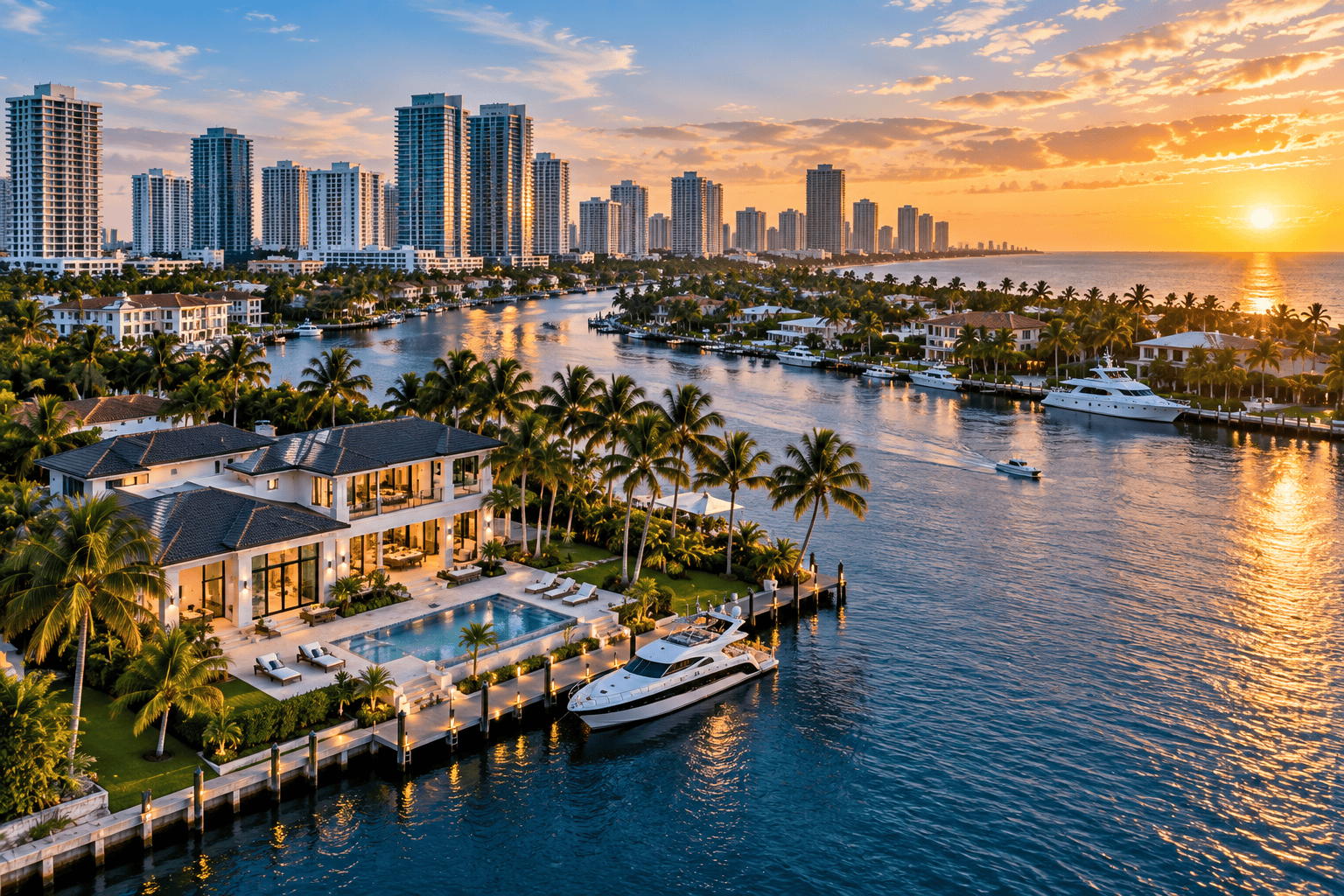
The South Florida luxury real estate market isn't cooling down. It's restructuring entirely. What many investors still interpret as a cyclical boom is, in fact, a permanent architectural shift in how wealth moves, settles, and compounds in this region. If you've been watching the South Florida luxury real estate market trends and wondering whether the window has closed, this report was written specifically to answer that question.
You're right to approach 2026 with measured curiosity rather than blind confidence. The concerns are legitimate: a market that feels increasingly competitive, interest rate environments that complicate even cash-heavy acquisitions, and the ongoing challenge of managing a seasonal asset from a distance. These aren't small considerations. They're the exact friction points that separate a well-positioned acquisition from a costly misstep.
What follows is a clear-eyed look at the forces reshaping luxury real estate across Fort Lauderdale, Hollywood, and the broader South Florida corridor. You'll discover which structural drivers are sustaining price appreciation, how Florida's residency advantages translate into genuine financial strategy, and what to look for in a trusted advisor who can guide both acquisition and long-term asset management with equal precision.
Key Takeaways
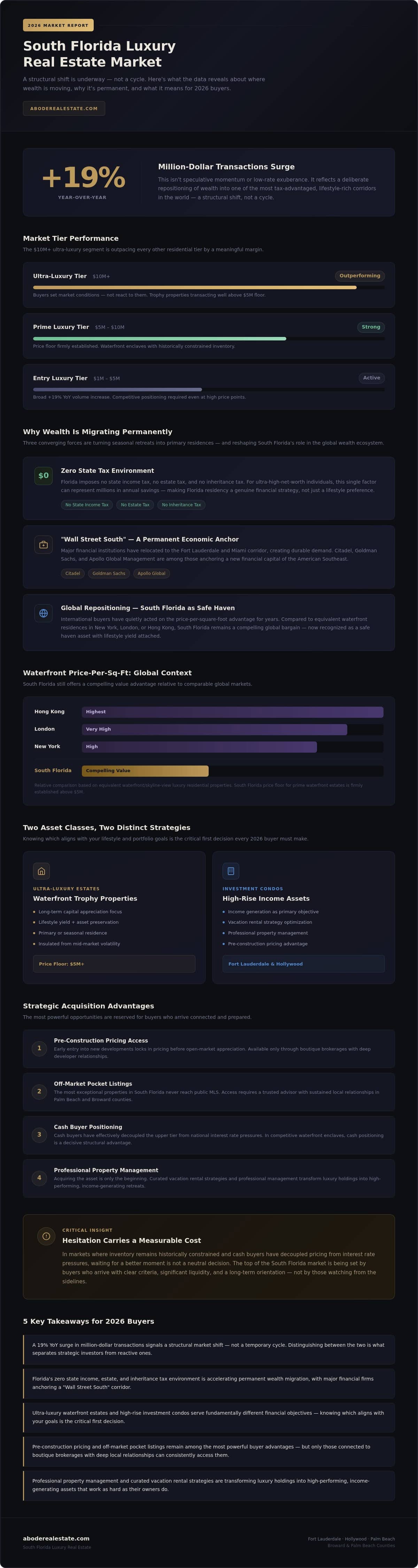
- The South Florida luxury real estate market trends reveal a 19% year-over-year surge in million-dollar transactions, signaling a structural shift rather than a temporary cycle — and understanding this distinction is what separates strategic investors from reactive ones.
- Florida's zero state income, estate, and inheritance tax environment is accelerating permanent wealth migration, with major financial firms anchoring a "Wall Street South" corridor that continues to reshape demand across Fort Lauderdale and Hollywood.
- Ultra-luxury waterfront estates and high-rise investment condos serve fundamentally different financial objectives — and knowing which asset class aligns with your lifestyle and portfolio goals is the critical first decision every 2026 buyer must make.
- Access to pre-construction pricing and off-market pocket listings remains one of the most powerful advantages available to luxury buyers, but only those connected to boutique brokerages with deep local relationships can consistently unlock these opportunities.
- Acquiring the asset is only the beginning — discover how professional property management and curated vacation rental strategies are transforming luxury holdings into high-performing, income-generating retreats that work as hard as you do.
Table of Contents
- The 2026 South Florida Luxury Real Estate Landscape: A Record-Breaking Era
- The Catalyst of Wall Street South: Why Wealth is Migrating Permanently
- Ultra-Luxury Estates vs. High-Yield Investment Condos
- Strategic Acquisition: Navigating New Construction and Off-Market Gems
- Beyond the Closing Table: Maximizing Luxury Asset Value in Florida
The 2026 South Florida Luxury Real Estate Landscape: A Record-Breaking Era
Something significant is happening at the top of the market, and the numbers are beginning to tell a story that goes well beyond a typical real estate cycle. Million-dollar transactions across South Florida climbed 19% year-over-year, a figure that sounds impressive in isolation but becomes genuinely revealing when you examine what's driving it. This isn't speculative momentum or low-rate-fueled exuberance. It's a deliberate repositioning of wealth into one of the most tax-advantaged, lifestyle-rich corridors in the world.
The $10M-and-above ultra-luxury segment is outpacing every other residential tier by a meaningful margin. Buyers at this level aren't reacting to market conditions; they're setting them. They arrive with clear criteria, significant liquidity, and a long-term orientation that insulates the top of the market from the volatility affecting mid-range residential inventory nationwide. Understanding this distinction is central to reading the South Florida luxury real estate market trends with any real accuracy in 2026.
Perhaps the most telling shift is one that doesn't show up cleanly in transaction data: the transition from seasonal retreat to primary residence. Global elites who once maintained South Florida homes as warm-weather escapes are now establishing permanent domicile here, driven by a convergence of fiscal policy, remote work flexibility, and a genuine appreciation for the region's quality of life. This isn't a trend. It's a reclassification of what South Florida represents in the global wealth ecosystem.
The Rise of Million-Dollar Sales in Prime Counties
Palm Beach and Broward counties are anchoring the luxury volume conversation in 2026. Inventory in the most coveted waterfront enclaves remains historically constrained, which is pushing qualified buyers into competitive positioning even within a high-price-point market. Cash buyers are a defining force here; they've effectively decoupled the upper tier from national interest rate pressures, allowing pricing to hold firm and, in select submarkets, continue appreciating. The result is a market where hesitation carries a measurable cost.
South Florida as a Global Bargain for Ultra-High-Net-Worth Individuals
Compared to equivalent waterfront or skyline-view residences in New York, London, or Hong Kong, Fort Lauderdale and the broader South Florida corridor still offer a compelling price-per-square-foot advantage, a fact that sophisticated international buyers have quietly acted on for several years now. The psychological reframe is complete: South Florida is no longer viewed as a secondary market. It's a safe haven asset with lifestyle yield attached. In 2026, the price floor for prime waterfront estates in this corridor has firmly established itself north of $5 million, with ultra-luxury trophy properties regularly transacting well above that threshold.
For buyers exploring luxury homes for sale across South Florida, this landscape rewards those who arrive prepared, connected, and advised by professionals who understand the nuances of each submarket.
The Catalyst of Wall Street South: Why Wealth is Migrating Permanently
There's a phrase circulating among institutional real estate analysts and private wealth advisors that would have seemed hyperbolic a decade ago: South Florida has become the financial capital of the American Southeast. It's not hyperbole anymore. The deliberate relocation of major financial institutions, hedge funds, and private equity firms to the Fort Lauderdale and Miami corridor has created something more durable than a trend. It's created a permanent economic anchor, one that continues to reshape the South Florida luxury real estate market trends from the ground up.
Citadel, Goldman Sachs, Apollo Global Management, and a growing roster of institutional names have either established or significantly expanded their Florida footprints. These aren't satellite offices. They're headquarters-level commitments, and they arrive with something real estate markets prize above almost everything else: a highly compensated, high-net-worth workforce that needs somewhere exceptional to live.
Corporate migration of this scale doesn't just generate transaction volume. It creates a permanent floor for luxury property values by ensuring that demand is replenished continuously, regardless of broader economic cycles. That's a fundamentally different dynamic than a market sustained by seasonal visitors or speculative buyers.
Tax Incentives and the Financial Landscape
Florida's tax structure is the engine underneath all of this movement. The state levies no income tax, no estate tax, and no inheritance tax. For a senior executive relocating from New York, Connecticut, or California, the annual savings can reach into the hundreds of thousands of dollars, sometimes more, depending on compensation structure and asset base. The Tax Cuts and Jobs Act amplified this calculus by capping the federal deduction for state and local taxes at $10,000, effectively penalizing high earners who remain in high-tax states. That legislative shift didn't just influence relocation decisions; it accelerated them with a clarity that financial advisors found difficult to argue against.
Strategic residency planning has evolved into a discipline in its own right. Buyers at the luxury level aren't simply purchasing a home; they're establishing a domicile that serves as the cornerstone of a broader wealth preservation strategy. The real estate acquisition and the tax strategy are inseparable decisions, and advisors who understand both dimensions are the ones earning trust at this level of the market.
Lifestyle Infrastructure: More Than Just Beaches
Wealth follows infrastructure, and infrastructure follows wealth. South Florida has entered a self-reinforcing cycle where the arrival of affluent permanent residents has catalyzed investment in the amenities that make permanent residency genuinely compelling. International Baccalaureate programs and elite private schools have expanded their footprints. Michelin-caliber dining concepts have opened in Fort Lauderdale neighborhoods that, five years ago, wouldn't have supported them. Private aviation terminals at Fort Lauderdale-Hollywood International have upgraded significantly, and the yachting ecosystem along the Intracoastal continues to mature into one of the most sophisticated in the world.
This is what the Abode philosophy of living recognizes that pure market analysis often misses: the community itself is part of the asset. The quality of the schools, the texture of the dining scene, the ease of private travel, the culture of the marina. These aren't amenities layered on top of a real estate investment. They're intrinsic to its long-term value. Explore our community guides to understand how each South Florida neighborhood offers its own distinct character and lifestyle proposition before you commit to a submarket.
For buyers evaluating where permanent wealth is settling and why, the corporate migration story isn't background context. It's the single most important structural force shaping luxury property values across this corridor in 2026 and well beyond.
Ultra-Luxury Estates vs. High-Yield Investment Condos
Not all luxury real estate performs the same way, and in South Florida, the distinction between asset classes matters enormously. A deep-water estate on the Fort Lauderdale Intracoastal and a fully amenitized high-rise condo in Hollywood serve fundamentally different financial and lifestyle objectives. Treating them as interchangeable is one of the more costly assumptions a 2026 buyer can make.
The clearest way to approach this decision is to separate what you want the asset to do. Estates build generational wealth through scarcity and appreciation. Condos generate yield through flexibility and demand. Both have a place in a sophisticated portfolio; the question is which one belongs in yours first.
Waterfront Estates: The Ultimate Status Symbol
Deep-water dockage is the single most coveted feature in Fort Lauderdale's estate market right now. Properties with direct ocean access or Intracoastal frontage capable of accommodating large yachts command a meaningful premium over comparable inland estates, and that gap has been widening. Supply is structurally limited; you simply cannot manufacture new waterfront, and the buyers who understand this are acquiring accordingly.
Privacy and security have risen to the top of the priority list for estate buyers in 2026, often above square footage or interior finishes. Gated enclaves, smart home security integration, and generous setbacks from public access points are no longer optional features; they're baseline expectations at this price tier. For buyers ready to explore what's currently available, view luxury homes for sale across South Florida to see how the current inventory reflects these evolving priorities.
Investment Condos and the Short-Term Rental Boom
The luxury condo market in Hollywood and the broader South Florida corridor has quietly become one of the more compelling income-generating opportunities in the current South Florida luxury real estate market trends conversation. A new class of high-rise development has emerged with flexible rental policies specifically designed to attract investor-owners, buildings where world-class amenities, concierge services, and hotel-grade management are baked into the structure itself.
This is the lock-and-leave luxury model fully realized. A multi-city executive can occupy the residence for two weeks, activate a professional vacation rental program for the remainder of the season, and return to a property that has been maintained, marketed, and monetized in their absence. The operational friction that once made income property feel like a second job has been engineered out of the equation.
In 2026, luxury condos in high-demand coastal zones are generally posting stronger short-term yield percentages than single-family estates, while estates continue to outperform on long-term appreciation, particularly those with irreplaceable waterfront positioning. The takeaway for portfolio-minded buyers isn't to choose one over the other; it's to recognize that each asset class hedges the other's primary risk. Condos generate income while estates accumulate value, and together they create a South Florida real estate position that's both resilient and productive.
Diversification within this market isn't a defensive strategy. It's an offensive one.
Strategic Acquisition: Navigating New Construction and Off-Market Gems
Knowing that South Florida's luxury market is structurally sound is one thing. Knowing how to actually secure the right asset, at the right price, before someone else does, is an entirely different discipline. The buyers who consistently win in this environment aren't simply the most motivated; they're the best advised. They understand that the most compelling acquisitions rarely appear on the open market, and that the gap between a good deal and a great one is almost always measured in relationships, not search filters.
The Pre-Construction Opportunity
Buying into a development before it breaks ground remains one of the most reliable ways to capture meaningful appreciation in a rising market. Pre-construction pricing reflects today's cost structure, not tomorrow's demand, and in South Florida's luxury corridor, that distinction has historically translated into significant equity gains by the time a project delivers. The developers worth paying attention to in 2026 are those with a demonstrable track record: projects delivered on schedule, finishes that match what was promised, and building systems engineered for the South Florida climate rather than retrofitted for it.
Customization is the other underappreciated advantage of buying early. Entering a development during its pre-sales phase often grants access to floor plan modifications, finish selections, and unit positioning that simply aren't available once a project is further along. For buyers with a clear vision of how they intend to use the residence, whether as a primary home, a seasonal retreat, or an income-generating asset, that flexibility has real financial value. Risk management matters here, too. Reputable advisors will scrutinize developer financials, construction timelines, and contract contingencies before a client commits a deposit, because the due diligence window in pre-construction is the only window that truly exists.
Investment Property Acquisition Strategies
The South Florida luxury real estate market trends conversation tends to center on the most visible submarkets, but some of the most tactically interesting opportunities in 2026 are emerging in areas like Hollywood and Cape Coral, where price-per-square-foot still offers meaningful upside relative to the trajectory of comparable coastal markets. Identifying these pockets requires more than a market report; it requires granular, neighborhood-level insight that only comes from sustained, on-the-ground presence.
The Abode approach to investment property analysis is built around that kind of precision. Every acquisition conversation begins with a clear understanding of the client's financial objectives, their intended hold period, and how the property fits within a broader portfolio strategy. From there, the analysis layers in submarket dynamics, rental demand patterns, and the physical due diligence that separates a sound acquisition from an expensive lesson. For waterfront properties specifically, that means scrutinizing seawall condition and age, understanding setback regulations, and pressure-testing insurance cost assumptions before a number is put on paper. Flood zone classifications and wind mitigation ratings aren't footnotes in this market; they're material to the true cost of ownership.
Pocket listings deserve particular attention here. Off-market transactions in the luxury segment are far more common than public data suggests, and access to them is almost entirely a function of brokerage relationships. Boutique firms with deep local networks are consistently the first to know when a motivated seller is considering a quiet exit, and that early access can mean the difference between acquiring a trophy asset and watching it close to someone else. For buyers ready to move with intention, explore 15 powerful strategies for building long-term wealth through Florida investment property acquisition and discover how a structured, advisor-led approach changes the outcome at every stage of the process.
The right advisor doesn't just open doors. They help you decide which doors are worth walking through.
Beyond the Closing Table: Maximizing Luxury Asset Value in Florida
Acquiring a luxury property in South Florida is a significant achievement. What happens next determines whether that asset appreciates quietly in the background or actively compounds your wealth over time. Most buyers discover this distinction only after the closing documents are signed, which is precisely why so few competitors in this market address it with any real depth. The gap between a well-managed luxury holding and a neglected one isn't measured in aesthetics. It's measured in dollars, depreciation, and missed opportunity.
Full-Service Management for Peace of Mind
The transition from buyer to property owner introduces a new set of responsibilities that can feel disproportionately demanding for someone managing a complex professional life across multiple cities. Tenant screening, lease enforcement, maintenance coordination, and regulatory compliance aren't tasks that reward improvisation. At the luxury level, they require the same precision and discretion that the acquisition itself demanded.
For seasonal residents and international owners especially, concierge-level property oversight isn't a convenience. It's a prerequisite. A South Florida estate that sits unattended between visits is an estate that accumulates deferred maintenance, missed rental income, and exposure to the kind of slow deterioration that waterfront environments accelerate. Salt air, humidity, and storm season don't pause because the owner is abroad. A professional management team that treats your property with the same attention it would receive if you were present is the only reliable answer to that reality.
Waterfront estates carry specific maintenance demands that generic property management firms routinely underestimate. Seawall integrity, dock systems, marine-grade exterior finishes, and HVAC systems engineered for coastal humidity all require scheduled, expert attention. Preventative maintenance at this level isn't an expense; it's the mechanism that preserves the asset's premium positioning in a market where condition drives pricing as much as location does. Learn about Abode's full-service property management approach and how it's built specifically for the demands of luxury ownership in this corridor.
The Future of Luxury Living in South Florida
Looking toward 2027 and beyond, two forces are reshaping what luxury buyers expect from their properties before they ever make an offer. Sustainability credentials, including energy-efficient systems, impact-resistant construction, and smart home integration, are shifting from differentiators to baseline expectations among the next generation of ultra-high-net-worth buyers. Properties that already incorporate these features aren't just more comfortable to live in; they're more competitive to sell or rent when the time comes.
Smart home technology deserves particular attention here. Automated climate control, remote security monitoring, and integrated building management systems aren't novelties in the 2026 luxury market. They're the infrastructure that makes a lock-and-leave lifestyle genuinely viable, which directly supports the vacation rental revenue strategies that are transforming how owners think about yield. A well-positioned luxury condo or estate with professional rental management, curated guest experiences, and hotel-grade hospitality protocols can generate meaningful seasonal income while the owner is elsewhere, without sacrificing the property's condition or character.
Staying ahead of South Florida luxury real estate market trends requires more than reading quarterly reports. It requires an advisor who is embedded in the market continuously, tracking submarket shifts, monitoring new development pipelines, and anticipating where demand is moving before it arrives. That kind of sustained, relationship-driven guidance is what separates a single successful acquisition from a long-term wealth-building strategy.
Abode Real Estate was founded on the belief that the most valuable thing a boutique brokerage can offer isn't access to listings. It's continuity of counsel, from the initial acquisition conversation through years of asset stewardship. If you're ready to explore what that kind of partnership looks like for your specific situation, connect with the Abode team for a personal consultation and begin the conversation that serious investors in this market are already having.
Your Next Move in South Florida Starts Here
The structural forces shaping South Florida luxury real estate market trends aren't slowing down. Permanent wealth migration, a maturing Wall Street South corridor, and constrained waterfront inventory are converging into conditions that reward decisive, well-advised buyers and quietly penalize those who wait for a cleaner signal that never arrives.
Three things remain clear heading into 2026 and beyond: the right asset class depends entirely on your financial objectives, off-market access separates exceptional acquisitions from ordinary ones, and the long-term value of any luxury holding is shaped as much by how it's managed as by where it's located.
Abode Real Estate brings boutique expertise across Fort Lauderdale, Hollywood, and Cape Coral, combining specialized investment property analysis with full-service management designed to protect and grow your asset over time. This isn't transactional guidance. It's a long-term partnership built around your specific goals.
Connect with an Abode Real Estate specialist for a curated market analysis and take the first step toward a South Florida acquisition that performs as well as it feels to own.
Frequently Asked Questions
What is driving the South Florida luxury real estate market trends in 2026?
Several converging forces are sustaining the current momentum: constrained waterfront inventory, a dominant cash-buyer pool that insulates the upper tier from interest rate pressure, and the continued arrival of institutional financial firms anchoring a permanent high-income workforce across the region. These aren't cyclical conditions. They reflect a structural repositioning of South Florida within the global wealth ecosystem.
International buyers have also accelerated their presence, drawn by a price-per-square-foot advantage that still compares favorably to equivalent residences in London, New York, or Hong Kong. The combination of fiscal incentives, lifestyle infrastructure, and genuine asset scarcity is what separates this market from others experiencing surface-level luxury demand.
Is it better to invest in a luxury condo or a single-family home in South Florida?
The honest answer is that it depends entirely on what you need the asset to do. Luxury condos in coastal zones tend to generate stronger short-term rental yield and suit buyers who want a lock-and-leave lifestyle with income potential. Single-family waterfront estates, particularly those with deep-water dockage, tend to outperform on long-term appreciation due to irreplaceable land positioning and structural scarcity.
Portfolio-minded buyers increasingly hold both asset types, using condo income to offset carrying costs while estates accumulate equity. Your intended hold period, liquidity preferences, and lifestyle requirements should drive this decision more than any market-level generalization.
How do Florida tax laws benefit luxury real estate buyers?
Florida imposes no state income tax, no estate tax, and no inheritance tax. For a buyer relocating from California, New York, or Connecticut, the annual savings on state income tax alone can reach into the hundreds of thousands of dollars depending on compensation structure. That figure compounds significantly over a decade of residency.
The federal cap on state and local tax deductions, set at $10,000, has made high-tax-state residency increasingly difficult to justify from a pure financial planning perspective. Establishing Florida domicile isn't just a lifestyle decision at the luxury level; it's a wealth preservation strategy that many advisors now treat as foundational to a broader asset plan.
What are the most sought-after locations for luxury waterfront property right now?
Fort Lauderdale's Intracoastal enclaves remain the most consistently competitive submarket, particularly properties offering deep-water dockage capable of accommodating large vessels. Inventory here is historically constrained, and qualified buyers frequently find themselves in competitive positioning even at elevated price points. Palm Beach County continues to anchor volume at the ultra-luxury tier.
Hollywood has emerged as a tactically interesting submarket for buyers seeking meaningful upside relative to the trajectory of comparable coastal markets, with price-per-square-foot still offering room for appreciation. Cape Coral attracts a different buyer profile, typically those prioritizing canal-front access and a quieter residential character over urban proximity.
Can I manage a South Florida luxury vacation rental from out of state?
Yes, but only if the management infrastructure beneath the property is genuinely professional. The lock-and-leave model works when a qualified local team handles guest communication, maintenance coordination, regulatory compliance, and property presentation consistently. Without that foundation, remote ownership of a short-term rental quickly becomes reactive and costly.
Boutique firms offering integrated sales and vacation rental management, where the same team that advised your acquisition continues to steward the asset, tend to deliver the most seamless experience for out-of-state owners. The continuity of that relationship matters as much as the operational capability itself.
What should I look for when hiring a luxury property management firm?
Start with specificity: does the firm have direct, documented experience managing properties in your exact submarket? A firm that manages a broad residential portfolio across multiple price tiers is a different proposition than one built specifically around luxury coastal assets. Waterfront properties carry distinct maintenance demands, including seawall integrity, marine-grade exterior care, and coastal HVAC requirements, that generalist firms routinely underestimate.
Equally important is the firm's approach to preventative maintenance. At the luxury level, reactive management erodes asset value quietly and consistently. The right firm treats scheduled upkeep as a core discipline rather than an afterthought, and communicates proactively rather than waiting for a problem to surface.
How has the 'Wall Street South' migration impacted property values?
The relocation of major financial institutions to the Fort Lauderdale and Miami corridor has created something more durable than demand: it's created a permanent floor for luxury property values. When a market's buyer pool is continuously replenished by a highly compensated, high-net-worth workforce, pricing doesn't depend on seasonal visitors or speculative momentum to hold its level.
The secondary effect is equally significant. Corporate migration at this scale catalyzes investment in the surrounding lifestyle infrastructure, the schools, dining, private aviation, and marina ecosystems that make permanent residency genuinely compelling. That infrastructure investment feeds back into property values in a self-reinforcing cycle that benefits owners across the luxury tier.
What are the risks of buying pre-construction luxury real estate in 2026?
The primary risks cluster around three areas: developer credibility, timeline reliability, and contract terms. A developer with an incomplete track record, undercapitalized financing, or a history of specification changes after contracts are signed represents a different risk profile than one with multiple delivered projects and transparent financials. Scrutinizing these factors before committing a deposit is the only window where meaningful protection exists.
Timeline risk is real in the current construction environment, and buyers should pressure-test delivery schedules against a developer's supply chain relationships and permitting history. Contract contingencies matter enormously here; understanding what protections exist if a project is delayed or materially altered is essential due diligence that a qualified advisor should lead before any agreement is executed.
Posted by Brook Walsh onEnjoy this blog post? Click here to subscribe for updates
Leave A Comment