

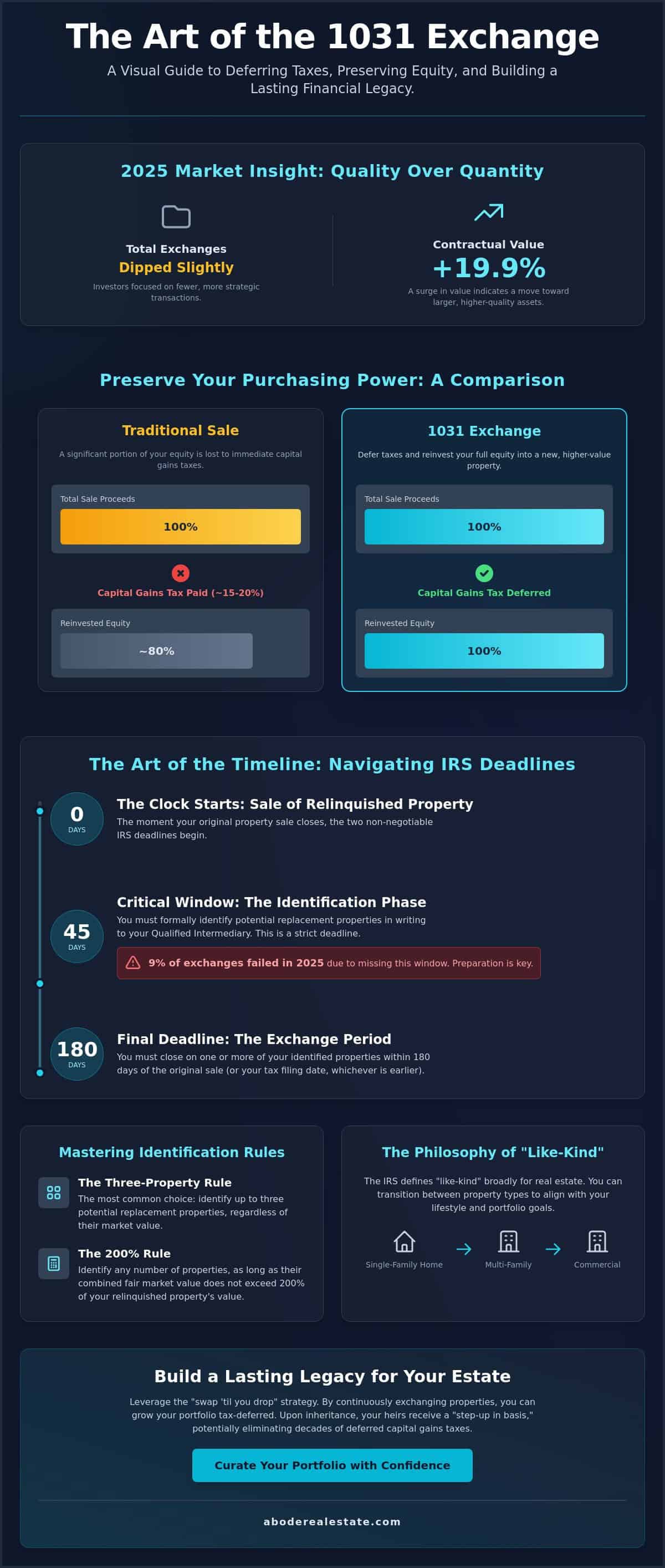
In 2025, while the total number of exchanges dipped slightly, the contractual value of properties transitioned through tax-deferred structures surged by 19.9%. This shift signals a sophisticated move toward larger, more selective deals among investors who understand that true stewardship isn't just about what you earn; it's about what you preserve.
You likely recognize that a 1031 exchange for investment properties is a powerful tool for growth. Yet, the fear of missing the rigid 45-day identification window or the 180-day closing deadline often creates more anxiety than inspiration. It's frustrating to receive generic financial advice when you're seeking a bespoke strategy to transition into a higher-value asset. We'll show you how to navigate these complexities with calm confidence, allowing you to defer capital gains and curate a more robust portfolio that serves as a sanctuary for your family's future. This guide explores the art of the transaction, from selecting a qualified intermediary to identifying management-free assets that align with your lifestyle.

Key Takeaways
- Master the non-negotiable IRS timeline by treating the 45-day identification window as a bespoke opportunity for portfolio evolution rather than a source of anxiety.
- Understand how a 1031 exchange for investment properties preserves your equity, allowing you to reinvest the full portion of your proceeds into a higher-value sanctuary.
- Protect the integrity of your capital by learning to identify and avoid taxable "boot" through precise value matching and strategic professional stewardship.
- Build a lasting financial legacy for your estate by leveraging the "swap 'til you drop" strategy and the significant tax advantages of a step-up in basis for your heirs.
Table of Contents
- Understanding the 1031 Exchange for Investment Properties
- The Art of the Timeline: Navigating IRS Deadlines
- Comparing Strategies: 1031 Exchange vs. Traditional Sale
- Seamless Execution: Avoiding Common Pitfalls and Boot
- Curating Your Next Chapter: The Future of Your Investment
Understanding the 1031 Exchange for Investment Properties
True wealth is rarely static. It requires a philosophy of active stewardship, where each asset is curated to serve a greater purpose for your family's future. A 1031 exchange for investment properties represents the pinnacle of this approach, offering a sophisticated path to evolve your portfolio without the immediate friction of capital gains taxes. While many view this strictly through a financial lens, we see it as a transition into a new chapter of your legacy. It's about moving from one stage of life to the next with grace and strategic intent.
By utilizing Section 1031 of the Internal Revenue Code, you aren't eliminating taxes; you're deferring them to maximize your current purchasing power. This distinction is vital. It allows you to keep 100% of your equity working for you rather than losing a significant portion to the 15% or 20% capital gains brackets. With real estate transaction volumes anticipated to rise by 20% in 2026, the current market offers an unparalleled window for those ready to move from smaller holdings into more significant, high-value assets. It's a year for decisive action and refined growth.
To better understand the fundamental mechanics of this process, watch this helpful video:
The Philosophy of Like-Kind Real Estate
The IRS maintains a surprisingly generous definition of "like-kind" property. You don't need to swap a beach house for a beach house. Instead, you can transition a single-family home into a multi-family sanctuary or even a commercial space. This flexibility is the cornerstone of bespoke portfolio management. It empowers you to shift with market trends, moving from high-maintenance properties into passive, management-free investments that offer a true sense of calm and freedom. Your investment should support your lifestyle, not dictate it.
Who Benefits from This Strategic Transition?
This transition serves investors who value longevity over quick wins. If you're focused on long-term wealth preservation for your estate, this strategy is your most reliable ally. It's for the individual who views their property not just as a line item, but as a foundational element of a curated financial life. In 2025, even as the number of exchanges dipped, the total contractual value of these sales rose by 19.9%. This tells us that serious investors are going bigger and being more selective. They're choosing quality over quantity, a hallmark of the Abode philosophy. We believe your portfolio should be as unique as your home.
The Art of the Timeline: Navigating IRS Deadlines
Precision is the price of tax deferral. While the concept of a 1031 exchange for investment properties is rooted in the philosophy of stewardship, its execution relies on a rigid, unyielding clock. The IRS does not grant extensions for holidays or weekends; the timeline begins the moment you close on the sale of your relinquished property. In 2025, the rate of failed exchanges rose to 9% specifically because investors struggled to identify replacement properties within the initial window. This statistic underscores the importance of approaching your timeline with calm confidence and a well-prepared strategy rather than a sense of last-minute urgency.
To ensure a seamless transition, you must master two critical milestones: the 45-day identification period and the 180-day exchange period. These aren't merely suggestions. They are the structural pillars of your transaction. Missing either deadline by even a few hours can trigger an immediate tax liability, effectively ending your opportunity for a tax-deferred reinvestment. Understanding sophisticated 1031 exchange strategies allows you to move through these phases with the grace of a curated transition rather than the friction of a financial hurdle.
Step 1: The Identification Phase
The first 45 days are your period of curated selection. During this window, you must formally identify potential replacement properties in writing to your Qualified Intermediary. Most investors utilize the "Three-Property Rule," which allows you to identify up to three properties of any value. Alternatively, the "200% Rule" permits you to identify any number of properties, provided their combined fair market value doesn't exceed double the value of the property you sold. This phase requires a discerning eye. You aren't just looking for a building; you're seeking a sanctuary for your capital that aligns with your lifestyle objectives and long-term estate goals.
Step 2: The Acquisition Phase
The 180-day window covers the entire duration from the initial sale to the final closing of your new asset. It's important to remember that this is not 180 days in addition to the identification period; the two windows run concurrently. During this time, your Qualified Intermediary holds the sale proceeds in a restricted account to prevent "constructive receipt" of the funds. A successful acquisition phase involves:
- Finalizing due diligence on your identified properties within the first 60 to 90 days.
- Ensuring your new title matches the exact name or entity that held the original property.
- Coordinating with a dedicated concierge to manage the closing logistics.
The secret to a successful exchange is parallel processing. Don't wait for your current sale to close before you begin scouting for your next chapter. By the time you reach the closing table for your relinquished home, you should already have a shortlist of replacement assets in mind. If you are ready to begin your search for a higher-value asset, our team specializes in investment property acquisition to help you find the perfect match before the clock even starts.
Comparing Strategies: 1031 Exchange vs. Traditional Sale
Deciding how to exit an asset is as much an art as the acquisition itself. While a traditional sale offers the simplicity of a clean break, it often comes with a significant tax friction that can erode years of hard-earned equity. Choosing a 1031 exchange for investment properties isn't just a technical maneuver; it's a commitment to the ongoing stewardship of your assets. It allows you to transition your capital from one sanctuary to another without the immediate depletion caused by capital gains liabilities. There is a common misconception that these exchanges are reserved for institutional developers, yet they are a vital tool for any individual investor looking to curate a more refined portfolio or pivot into a higher-performing neighborhood.
Consider the impact on your purchasing power using the 2026 long-term capital gains tax brackets. For single filers with taxable income exceeding $545,500, the tax rate is a firm 20%. When you factor in the 3.8% Net Investment Income Tax, nearly a quarter of your profit could be diverted to the IRS before you even begin your search for a replacement home. By choosing an exchange, you keep that capital working for you. You are essentially receiving an interest-free loan from the government, allowing you to acquire a more valuable, higher-yielding property that would otherwise be out of reach. This isn't just about saving money; it's about maximizing the value of every dollar you've invested.
The Power of Compounding Equity
Reinvesting the tax portion accelerates your portfolio growth by keeping your entire equity base intact. An investor who consistently uses the 1031 exchange for investment properties will inevitably see a higher net worth than one who settles for a traditional sale and pays taxes at every transition. This compounding effect builds a bridge to a more secure future, allowing you to move from a single-family rental into a sophisticated multi-family complex or a management-free commercial asset.
The strategic deferral of taxes serves as a powerful engine for elevating your family's financial standing across generations.
When a Traditional Sale Might Make Sense
There are moments when a traditional sale is the more practical choice for your specific chapter of life. If your taxable income in 2026 falls below $49,450 for single filers, you may qualify for a 0% capital gains rate, making the exchange process an unnecessary layer of complexity. Likewise, if you require immediate liquidity to fund a lifestyle change or a new community connection, the reward of cash on hand may outweigh the benefits of deferral. We help you weigh these options with calm confidence, ensuring your choice aligns with your broader vision for your estate and your personal sense of freedom.
Seamless Execution: Avoiding Common Pitfalls and Boot
The art of the transaction lies in the details that often go unseen until the final signature. When executing a 1031 exchange for investment properties, your primary objective is to maintain the integrity of your equity by avoiding "boot." This term refers to any non-like-kind property received during the exchange, which the IRS views as a taxable gain. To achieve a perfectly seamless transition, you must adhere to the "equal or greater" rule. The replacement asset must have a value and net equity equal to or greater than the property you relinquished. Even a small discrepancy can result in a taxable event, eroding the very value you're trying to preserve.
Managing these regional nuances requires a level of precision that goes beyond simple paperwork. States like California, Massachusetts, and Oregon have ongoing reporting requirements if your replacement property is located out-of-state. California specifically may withhold 3.33% of the sales price during an exchange. Recovering these funds requires filing a non-resident tax return, a step that demands careful oversight to avoid disrupting your cash flow. It's about protecting your sanctuary from avoidable friction.
Managing Cash and Mortgage Boot
Boot typically manifests in two forms: cash and mortgage. If you receive excess funds at closing or fail to reinvest every dollar of your net proceeds, that remainder becomes taxable. Similarly, if your new mortgage is smaller than your previous one, the IRS considers that reduction in debt as a financial benefit to you. This "mortgage boot" can trigger an unexpected tax event even if you never touch the cash. A sophisticated approach involves balancing these scales perfectly. You must ensure your new asset carries a debt load that satisfies the debt replacement requirement, allowing for a total deferral of gains.
Selecting a Bespoke Qualified Intermediary
A successful exchange requires a disinterested third party to act as the steward of your funds. This Qualified Intermediary (QI) is the cornerstone of the process. Many investors don't realize that their personal attorney or real estate agent is legally barred from this role if they've provided services in the past two years. Choosing a QI requires a partner who offers transparency and quiet authority. For a standard forward exchange, fees typically range from $750 to $1,500. More complex reverse or improvement exchanges, where you acquire the new asset before selling the old one, can cost between $5,000 and $15,000. This investment ensures your funds are held in a restricted account, preventing "constructive receipt" and keeping your tax-deferred status intact. Don't forget that your 180-day window can be shortened if your tax filing deadline arrives early, unless you file for an extension.
If you're ready to move toward a more valuable asset without the friction of unnecessary taxes, our team provides expert investment property acquisition services to guide your selection.
Curating Your Next Chapter: The Future of Your Investment
Wealth stewardship is a lifelong journey that culminates in the legacy you leave behind. The 1031 exchange for investment properties offers a unique path known colloquially as "swap 'til you drop," a strategy where you continuously defer taxes by reinvesting in higher-value assets throughout your lifetime. This approach transforms your real estate holdings into a multi-generational asset. When these properties eventually pass to your heirs, they benefit from a "step-up in basis" to the current fair market value. This effectively eliminates the deferred capital gains tax liability, ensuring your family receives the full value of your hard work and vision. It's a profound way to turn a strategic financial tool into a permanent family sanctuary.
Your investment is more than a line item; it's a foundation for your future. By choosing to reinvest rather than liquidate, you're making a conscious decision to keep your equity working at its maximum potential. This long-term view of real estate allows you to transition into higher-quality sanctuaries that offer better appreciation and stronger community connections. It's about building a bridge between the life you've worked for and the legacy you want to leave.
Transitioning from Management to Passive Income
As you move into a more relaxed chapter of life, your priorities often shift from active growth to stable, passive income. A 1031 exchange for investment properties allows you to transition from high-maintenance rentals into lower-effort assets like Triple Net Lease (NNN) properties or Delaware Statutory Trusts (DSTs). In 2025, the market saw a growing demand for these management-free investments as baby boomers sought to simplify their responsibilities. By integrating full-service property management into your strategy, you can enjoy the rewards of ownership without the daily friction of operations. This shift isn't just about financial efficiency; it's about reclaiming your time to focus on community and connection.
The Abode Approach to Investment Real Estate
At Abode, we treat your real estate portfolio as a curated collection, not just a series of transactions. Our boutique approach provides the calm confidence you need to navigate these high-stakes transitions with ease. We believe in the art of the transaction, where technical expertise meets a deep, personal understanding of your long-term goals. Whether you're looking for investment property acquisition or seeking to preserve your estate's value, our team acts as a dedicated concierge. We invite you to a personalized conversation about your bespoke investment goals and how we can help you curate a future that feels like home. Welcome home to a new standard of stewardship.
Elevating Your Legacy Through Strategic Stewardship
Transitioning your assets shouldn't feel like a financial hurdle; it's a curated move toward a more refined sanctuary for your capital. By mastering the 45-day identification period and ensuring your replacement asset matches or exceeds your net equity, you protect your wealth from the 20% capital gains bracket. A 1031 exchange for investment properties is your most reliable tool for building a multi-generational estate that eventually benefits from a step-up in basis for your heirs. With a 20% year-over-year increase in real estate transaction volume anticipated for 2026, the current market offers an unparalleled window to act with quiet authority.
Our team provides the boutique investment property analysis and specialized knowledge in luxury asset stewardship required for these high-stakes moments. We ensure seamless transaction management so you can focus on the connection to your new community rather than the complexity of tax terminology. Discover how Abode Real Estate can curate your next investment transition and help you find a property that truly feels like home. Your next chapter of wealth stewardship begins with a single, intentional step toward a more secure future.
Frequently Asked Questions
Can I use a 1031 exchange for my primary residence?
No, you cannot use a 1031 exchange for your primary residence. Section 1031 applies exclusively to real property held for productive use in a trade, business, or for investment. Personal dwellings don't meet the "held for investment" criteria required by the IRS, though you may be eligible for other tax exclusions under Section 121 if you meet residency requirements.
What qualifies as a like-kind property for investment purposes?
Like-kind property refers to any real estate held for investment or business use, regardless of its specific grade or quality. This broad definition allows you to swap a raw plot of land for an apartment building or a boutique commercial space for a luxury rental home. The flexibility of these rules supports a curated transition into different asset classes as your portfolio needs evolve.
How many properties can I identify in a 1031 exchange?
You can identify up to three properties of any value under the "Three-Property Rule," or any number of properties provided their combined value doesn't exceed 200% of the property you sold. In 2025, the identification failure rate reached 9% because investors didn't utilize these rules effectively. Managing a 1031 exchange for investment properties requires a clear selection strategy within the first 45 days.
What happens if I miss the 45-day identification deadline?
Missing the 45-day identification deadline results in the immediate disqualification of your exchange and triggers a taxable event. The proceeds held by your intermediary will be treated as "constructive receipt" income, and you'll owe capital gains taxes at the 2026 rates of 15% or 20% based on your income level. There are no extensions for this non-negotiable window, regardless of holidays or weekends.
Can I do a reverse 1031 exchange if I find the new property first?
Yes, a reverse exchange allows you to acquire a new property through an exchange accommodation titleholder before selling your current one. This strategy is increasingly popular in 2026 as investors seek to secure desirable assets in a competitive market. While a standard exchange is more common, a reverse exchange typically costs between $5,000 and $15,000 due to the complexity of the holding structure.
Are vacation homes eligible for a 1031 exchange?
Vacation homes are eligible for a 1031 exchange provided they are held primarily for investment and meet specific usage requirements. You must rent the property at fair market value for at least 14 days in each of the two 12-month periods before and after the exchange. Additionally, your personal use cannot exceed 14 days or 10% of the days it was rented annually to maintain its investment status.
What is a Qualified Intermediary, and why do I need one?
A Qualified Intermediary is a mandatory third party who holds the sale proceeds to ensure you never have physical control of the funds. This role is essential because "constructive receipt" of money during the transaction would invalidate the 1031 exchange for investment properties. They act as a professional steward, facilitating a seamless transfer of equity between your relinquished and replacement homes without triggering tax liability.
How do 1031 exchanges impact my state taxes in 2026?
In 2026, state tax impacts vary significantly depending on where your replacement property is located. For instance, California may withhold 3.33% of the sales price, while states like Massachusetts and Oregon require ongoing reporting for out-of-state exchanges. Understanding these localized rules is vital for maximizing your tax efficiency and ensuring that your strategic investment remains a sanctuary for your family's future wealth.
Posted by Brook Walsh onEnjoy this blog post? Click here to subscribe for updates
Leave A Comment