

What if a property that feels like the right fit carries a concern you haven’t uncovered? A home’s appeal is only part of the decision. The importance of due diligence in real estate is that it helps you look beyond first impressions, verify key details, and understand what you’re agreeing to before closing.
It’s natural to be unsure which inspections and records deserve attention, or whether a finding is serious enough to affect your offer. Due diligence isn’t about expecting every property to be perfect. It’s about replacing guesswork with clear information, then weighing what you learn against your priorities.
This guide explains what to investigate, how to assess findings in light of your plans, and when to consult specialists such as inspectors or attorneys. You’ll also learn how a real estate advisor can help organize questions and interpret market context without replacing expert advice. Whether you’re buying a personal residence or an investment property, the goal is a considered, documented decision that supports the way you intend to use the property.
Key Takeaways
- The importance of due diligence in real estate lies in verifying the property, its records, and its fit for your intended use.
- Review the building, ownership information, financial considerations, and plans for the property. No single report can answer every question.
- Sort findings by evidence, potential impact, and appropriate next steps so urgent concerns stand apart from routine maintenance or personal preferences.
- Use a clear purchase workflow and track dates and responsibilities against your actual agreement and professional advice.
- Bring in qualified specialists for technical or legal questions. A real estate advisor can help organize the process and interpret market context.
Table of Contents
- Why Due Diligence in Real Estate Matters Before You Commit
- What to Investigate During Real Estate Due Diligence
- How to Compare Due Diligence Findings Without Overreacting
- A Practical Due Diligence Workflow for a Real Estate Purchase
- Make Due Diligence Part of a Confident Ownership Plan
Why Due Diligence in Real Estate Matters Before You Commit
A property can feel like the right choice before you understand the questions that could shape your ownership experience. A polished walkthrough and an appealing listing offer a first impression, not a complete picture. The importance of due diligence in real estate is that it gives you a structured way to verify relevant facts before committing, so your decision rests on more than enthusiasm or assumptions.
Broadly, due diligence means gathering and assessing information before proceeding. In a property purchase, this process can clarify condition, ownership, financial considerations, and whether the property suits your intended use. It can reveal questions that deserve follow-up, but it can’t guarantee that every issue will be discovered.
For a concise introduction to the concept, watch this video:
What does due diligence mean when buying real estate?
Think of due diligence as a set of connected questions, not one form or report. Property-condition checks help you understand the building. Ownership and record reviews address who holds an interest and which documents may matter. A financial review considers costs beyond the initial commitment, while intended-use questions test whether the property aligns with your plans. The precise process depends on the property, purchase contract, and applicable jurisdiction.
No single inspection or document can answer everything. A building inspection may identify visible concerns, for example, but it won’t necessarily resolve questions about ownership records or whether a property fits your investment strategy. Match each question to appropriate evidence, and ask a qualified specialist when interpretation falls outside your expertise.
What can happen when buyers skip important checks?
Without adequate investigation, a buyer may encounter unbudgeted repairs, incomplete or unclear records, or a property that doesn’t suit its intended use. These are possibilities, not inevitable outcomes. The purpose of due diligence is to surface uncertainties while there may still be time to understand them and decide how they affect your plans.
Raise questions early and share relevant documents with the professionals best placed to assess them. An inspector can address condition concerns, while legal or ownership questions may call for an attorney or another qualified specialist. A real estate advisor can help organize questions and add market context without replacing expert advice. If an investment purchase may require ongoing oversight, include management planning in your ownership picture. Learn more about full-service property management.
What to Investigate During Real Estate Due Diligence
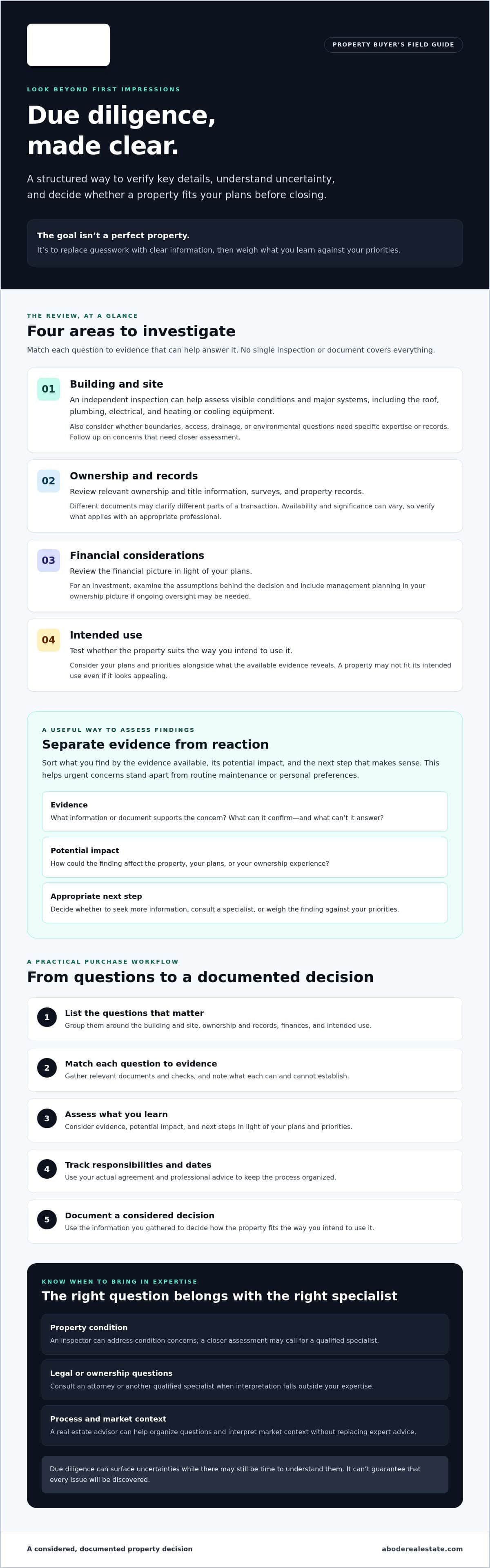
A thorough review is easier to manage when you group questions into four areas: the building and site, ownership and records, finances, and intended use. The importance of due diligence in real estate isn’t measured by how many reports you collect. It comes from checking whether the available evidence answers the questions that matter for this property and your plans for it.
Start with the building. An independent inspection can provide an informed view of visible conditions and major systems, such as the roof, plumbing, electrical, and heating or cooling equipment. It also has limits. If the inspector identifies a concern that needs closer assessment, ask whether a qualified specialist should evaluate it. Boundaries, access, drainage, and environmental questions may also require specific expertise or records.
Review the property, its records, and its finances
Gather relevant documents and identify what each one can and cannot confirm. Ownership and title information, surveys, and property records may clarify different aspects of a transaction, but their availability and significance can vary. For general residential buyer questions, a real estate commission offers guidance on due diligence for residential buyers. Treat this as jurisdiction-specific information, not a universal checklist, and verify applicable requirements with an appropriate professional.
Review the financial picture in light of your plans. For an investment, test the assumptions behind expected income and expenses, and account for ongoing responsibilities such as maintenance and management. For a personal residence, consider whether the property’s condition and characteristics suit your needs over time. In either case, distinguish confirmed information from estimates that need further support.
Match the review to your intended use
Ask whether the property can practically serve the purpose you have in mind, and identify which use-related details need verification. A space that appears suitable for a particular activity may still raise questions that require a review of records or advice from a qualified professional. Don’t assume that a listing description, walkthrough, or single report settles every issue. Each provides a different piece of the picture.
Keep the process organized in one place. Save source documents, note unanswered questions, and assign each follow-up a responsible person and next step. This record helps you spot gaps, compare advice, and understand how you reached your decision. If you’d like an advisor’s help organizing property questions and market context, contact Abode Real Estate. An advisor can support the process, while inspectors, attorneys, and other specialists address matters within their expertise.
How to Compare Due Diligence Findings Without Overreacting
A report can feel alarming when it raises a concern without explaining its context. Before changing your offer or abandoning a purchase, separate what’s confirmed from what’s uncertain. Then consider the issue’s possible effect on safety, ownership, cost, or your plans. The importance of due diligence in real estate is not that every finding demands the same response. It’s that each finding deserves a measured next step.
Use a simple comparison table to turn reports and comments into a clear decision record. The examples below are illustrative, not conclusions about any particular property.
| Finding | Evidence | Potential impact | Specialist | Next step |
|---|---|---|---|---|
| Possible safety concern | Inspection notes an issue requiring further review | Could affect safe occupancy or require prompt attention | Appropriately qualified inspector or specialist | Ask for clarification and a focused evaluation |
| Unclear ownership or title detail | Records raise a question that hasn’t been resolved | May affect the buyer’s understanding of ownership or transaction terms | Real estate attorney or relevant professional | Verify the record and its implications before deciding |
| Routine maintenance item | Inspection identifies an aging or worn component | May affect near-term upkeep or future budgeting | Relevant maintenance specialist, if needed | Clarify condition and consider it in the ownership plan |
| Preference or fit concern | Buyer observes a mismatch with personal priorities | Could influence comfort or satisfaction, rather than indicate a defect | Buyer, with advisor input if useful | Decide how much the issue matters to intended use |
Match the response to the evidence and your goals
Safety concerns and unresolved ownership questions generally call for verification before you treat them as settled. A maintenance item may be manageable, while a preference issue may matter greatly to one buyer and little to another. Significance depends on your intended occupancy, budget, risk tolerance, investment assumptions, and the quality of the available evidence.
For technical questions, seek an appropriately qualified inspector or specialist. Refer contract, title, and legal questions to a real estate attorney or relevant professional. If a report is uncertain, label it “to verify,” not “confirmed defect.” Ask what additional evidence could change your view, and avoid making a decision based on a dramatic estimate or isolated comment without context.
For an investment purchase, compare findings with your operating assumptions and ownership plans. Exploring investment property acquisition strategies can help frame the broader decision. Then document what you know, what remains open, and why the next step fits your goals.
A Practical Due Diligence Workflow for a Real Estate Purchase
A clear sequence turns a complicated purchase into a series of manageable decisions. Adapt the process to the property, your goals, and the terms of your agreement. The importance of due diligence in real estate becomes especially practical when you know what to do next, which questions remain open, and who is responsible for resolving them.
Move from goals to evidence to a decision
Begin by defining the property’s intended use, your priorities, financial assumptions, and any concerns you already have. A personal residence and an investment property call for different questions. An investor, for example, may want to test expected income and ongoing expenses, while a future resident may focus on condition and day-to-day suitability.
Then work through an adaptable sequence:
- Clarify goals: Record what the property needs to deliver and which trade-offs you’re willing to consider.
- Collect records: Request and organize available property, ownership, and financial documents. Note gaps rather than treating missing information as confirmation.
- Inspect: Arrange appropriate independent evaluations and keep the resulting reports with the relevant records.
- Investigate: Follow up on issues that call for additional documents, specialist input, or clarification.
- Review: Discuss technical, title, contract, or legal questions with appropriately qualified professionals.
- Decide: Compare verified findings with your goals and determine a suitable next step with professional guidance.
There’s no universal timetable. Track important dates and responsibilities against your actual purchase agreement, and confirm how they apply with your real estate professional or attorney. Don’t rely on a generic online schedule in place of the contract.
Keep questions, evidence, and follow-ups together
Use a dated checklist or shared document to track each item’s source, status, and next action. Separate confirmed facts from professional opinions, your own assumptions, and details still awaiting verification. For every open question, record who will follow up and what information would resolve it. This creates a useful record without confusing an estimate or initial observation with a confirmed conclusion.
Once the evidence has been reviewed, possible paths may include requesting further review, discussing negotiation, proceeding, or withdrawing. Which options are available, and when, depends on the agreement and the advice of relevant professionals. For investment purchases, Abode’s investment acquisition services can help frame strategic questions. To discuss investment property acquisition with Abode Real Estate, contact the team.
Make Due Diligence Part of a Confident Ownership Plan
A considered purchase doesn’t end with identifying concerns. It brings verified information together with what matters to you, whether that’s a home that supports your daily life or an investment aligned with your financial objectives. That balance reflects the importance of due diligence in real estate: the goal isn’t to eliminate every uncertainty, but to make a clear decision using the best available evidence and appropriate professional guidance.
When can a real estate advisor help during due diligence?
An experienced real estate advisor can help organize questions, interpret market context, and coordinate transaction communication so important details don’t get lost between conversations. Their perspective can help you connect a finding to your purchase goals, but it isn’t a substitute for independent review. Technical concerns belong with appropriately qualified inspectors or specialists; legal and title questions with a real estate attorney or relevant professional; and financial advice with a qualified financial professional.
Good guidance is tailored to your priorities. It helps you understand what to ask and whom to ask, while leaving specialist opinions to the people equipped to provide them.
What should buyers carry forward after closing?
Keep useful reports, records, and decision notes together, and ask the relevant professionals how long to retain them and what requirements apply. Turn unresolved maintenance or operating questions into a practical ownership plan: identify the next action, who will handle it, and what information is still needed. For an investment property, include realistic ongoing management responsibilities rather than treating them as an afterthought.
As you shape that next chapter, compare the property’s needs with your capacity and investment approach. Abode’s overview of full-service property management considerations can help investment owners think through management as part of ownership planning.
Whether you’re weighing a personal residence or an investment, a real estate advisor can help connect your priorities with relevant market context and organize the next conversation. To discuss your property goals and management considerations, contact Abode Real Estate.
Move Forward With Clarity and Confidence
A thoughtful property decision brings verified information together with your personal priorities or investment objectives. Review the building, records, financial assumptions, and intended use, then weigh each finding according to its evidence and potential impact. The importance of due diligence in real estate lies in making that decision deliberately, not in expecting every uncertainty to disappear.
Keep your questions and follow-up actions organized, and involve qualified specialists when technical, legal, or financial expertise is needed. A real estate advisor can help you interpret market context and coordinate communication, while your own goals remain central to the choice.
Abode Real Estate is a boutique brokerage offering luxury residential sales, investment property acquisition, and property management. If you’re considering your next move, explore your real estate options with Abode. To discuss your property goals with the team, contact Abode Real Estate.
Frequently Asked Questions
Is due diligence necessary when buying a house?
Yes. Due diligence is a prudent way to verify information and surface questions before you commit to a home purchase. Its scope should reflect the property, your goals, and the transaction documents. The importance of due diligence in real estate is its role in supporting an informed choice, not promising a perfect property. Ask qualified inspectors or legal and financial professionals to address questions within their expertise.
What does real estate due diligence include?
Real estate due diligence may include reviewing the property’s physical condition, available ownership and title information, relevant records, financial assumptions, and fit with your intended use. The specific checks depend on the property and jurisdiction. One inspection or document won’t necessarily cover every concern. Clarify what each review addresses, identify unanswered questions, and ask qualified professionals which additional evaluations may be appropriate for your transaction.
How long does due diligence take when buying property?
There’s no single timeline that applies to every property purchase. The time available may depend on your contract, document availability, specialist schedules, and questions that arise during review. Check the dates and responsibilities in your own agreement with your real estate and legal professionals. Arrange evaluations promptly, and don’t rely on a general timeline found online as a substitute for reviewing your transaction documents.
Can a home inspection replace real estate due diligence?
No. A home inspection can provide valuable information about observable property condition, but it may not address ownership records, contract questions, financial assumptions, or concerns requiring specialist review. Due diligence is broader than any one evaluation. Ask what the inspection covers and what it doesn’t. If a finding raises a question outside the inspector’s scope, seek advice from an appropriately qualified professional before deciding how to proceed.
What happens if due diligence reveals a serious problem?
First, ask an appropriately qualified professional to confirm the finding and explain its implications. Then review your purchase agreement and discuss possible next steps with relevant real estate and legal advisors. Depending on the evidence and contract terms, you might seek more information, discuss terms, proceed, or reconsider the purchase. Don’t assume a particular remedy or deadline applies to every transaction. Base your response on the facts and professional guidance.
Should investment property buyers use a different due diligence process?
Investment buyers should review condition and ownership information while also testing the assumptions behind the planned investment. Consider expected operating responsibilities, potential maintenance, and whether the property fits your strategy. Financial and legal reviews depend on the specific purchase, so consult qualified professionals. Treat projected performance as an estimate, not a guarantee, and consider how ongoing management responsibilities fit your resources and ownership plan.
Does due diligence guarantee that a property has no hidden problems?
No. Inspections and records reviews can reduce uncertainty, but they can’t promise that every defect, risk, or future expense will be identified. Results depend on the scope of each review, access to relevant areas and records, and professional judgment. Ask what each evaluation covers and note what remains uncertain. Then consider whether those open questions are acceptable in light of your goals, budget, and risk tolerance.
Posted by Brook Walsh onEnjoy this blog post? Click here to subscribe for updates
Leave A Comment